
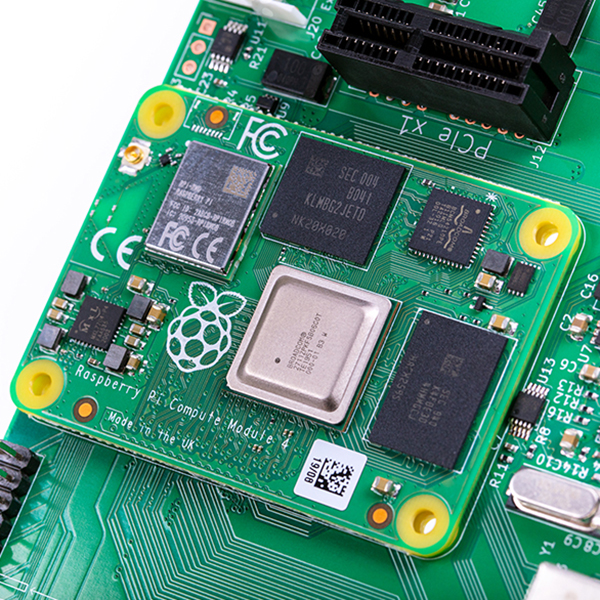
Brightix, a hardware team based in São Paulo, Brazil, has posted a pre-launch page on Crowd Supply for LoraReach. Its campaign page calls it an open baseboard for a LoRaWAN gateway and describes "a carrier board built around a Raspberry Pi CM4 (or any pin-compatible module)." The page currently reads "This project is launching soon. Coming Soon" and has 0 updates. No funding goal, price or ship date is shown. In crowdfunding terms LoraReach is announced. It is not yet taking pledges, and it is not shipping.
The circuitrocks blog put it this way in an independent write-up published on October 21, 2026: "It is a board, not a finished box." That is the most useful way to think about it. Brightix supplies the carrier, the radio slots, the power stage and the I/O. The buyer supplies the compute module, the LoRaWAN concentrator, the cellular modem if they want one, and the storage.
What is on the board
The design is simple to describe. A Compute Module 4 (or a pin-compatible module) provides the Linux host. Two mini-PCIe slots provide the radios. Brightix's listed features, taken from the Crowd Supply page:
- Compute: Raspberry Pi CM4 or any pin-compatible module (not included).
- LoRaWAN radio: a mini-PCIe slot for an SPI-based LoRaWAN concentrator module (not included).
- Cellular backhaul: a second mini-PCIe slot for a 4G/LTE module, with a SIM slot (module not included).
- GNSS: integrated GPS with an onboard patch antenna, which Brightix says is used for location and precision network timing.
- Wired networking: 1x Gigabit Ethernet.
- Storage: microSD slot (card not included).
- Wireless LAN: Wi-Fi "if available on the CM4". The board relies on the module's own radio, so it depends on which CM4 variant you fit.
- Power: integrated power supply, universal input 120-240 VAC, typically under 10 W.
- Mechanical: 146 x 118 x 50 mm; 300 g.
- Openness: schematics and BOM are open source.
The circuitrocks write-up gives the same figures: two mini-PCIe slots (SPI concentrator, optional 4G modem with SIM), GigE, microSD, a GPS patch antenna, a built-in supply taking 120 to 240 VAC, a draw of under 10 W, and 146 x 118 x 50 mm dimensions. We found no conflict between the two sources on any spec.
Brightix has not published some details on the pages we could read. It names no concentrator chipset, no specific 4G module, no GPS receiver part number and no regional frequency plans. Since the concentrator is supplied by the buyer, the operating band will depend on which mini-PCIe card goes in the slot. Brightix does not name any validated concentrator cards, so we won't guess at them.
The software side
The software approach is conservative, and that is a good thing. Per Crowd Supply, LoraReach runs standard Linux with the official Semtech packet forwarder, and boots standard Linux distributions compatible with the CM4 ecosystem. Brightix says it has been validated against The Things Network, Loriot "and others", and elsewhere on the page calls it compatible with ChirpStack. Circuitrocks also lists The Things Network, Loriot and ChirpStack as targets via the Semtech packet forwarder.
In practice the board should behave like most Linux-based gateways that use an SPI concentrator. The packet forwarder relays uplinks from the concentrator to whichever network server you point it at, whether that is a public community network, a commercial service or a self-hosted ChirpStack instance. Brightix has not published a gateway OS image, a BSP repository or a list of specific tested Linux distributions on the pages we reviewed. People who want to run their own network server on the CM4 or provision it remotely will want those details before the campaign opens.
The onboard GPS matters more than it may seem. Brightix specifies it for precision network timing as well as location. Brightix has not said which timing-dependent features, if any, it supports, so treat "timing" as the spec-sheet word for now.
Why a CM4 carrier, and what Brightix leaves out
Basing the gateway on a compute module rather than a soldered-down SoC has the usual trade-offs. On the plus side, you pick the RAM, eMMC and wireless configuration that suits your deployment, and you can swap the module later. Raspberry Pi Ltd describes the module in its CM4 datasheet (release 4, build date 30/06/2026) as "a Raspberry Pi for deeply embedded applications". That is the document to check for memory options, wireless variants and electrical limits before you choose a module for this board. We have not quoted CM4 figures here because Brightix's page does not say which module configurations it has tested.
The downside is cost and sourcing. A bare LoraReach board needs at least three more purchases before it can forward a single packet: a CM4 or compatible module, a LoRaWAN concentrator card and a microSD card. Cellular backhaul adds a fourth (a 4G module) and a SIM. Brightix states plainly that the "SD Card, CM4, LoraWan Concentrator module and 4G module are not part of the package." Antennas for the LoRa and LTE radios are not mentioned on the Crowd Supply page. Prospective backers should check what is in the box when pledge tiers are posted.
The mains-input supply is the most unusual choice. Brightix has put a universal 120-240 VAC input supply on the board, with typical consumption under 10 W, and its page describes units powered directly from mains. That simplifies installs where only mains is available. It also means the carrier carries mains voltage, which is a factor when choosing an enclosure. Brightix has not stated safety certifications or PoE support on the pages we reviewed, and we are not reporting on how to wire it.
What It Means for Makers
Who it is for: people who want a LoRaWAN gateway they can inspect and change. Brightix itself points to research projects that log raw packet data, agricultural and environmental deployments, and smart city or industrial rollouts. It is also a plausible fit for community-network volunteers, people running private ChirpStack deployments, and educators who want students to see the whole gateway stack, from concentrator to packet forwarder to network server, on a plain Linux machine (our inference, not a Brightix claim). The open schematics and BOM matter most for that last group. They also matter for anyone who wants to fork the design for a custom enclosure or a different radio.
What it replaces or enables: LoraReach sits between a closed, ready-made gateway and a home-built stack of a Raspberry Pi, a concentrator HAT and a separate LTE dongle. Compared with the home-built route, it combines a second mini-PCIe slot for 4G with a SIM socket, onboard GPS, Gigabit Ethernet and the power supply on one 146 x 118 x 50 mm board. Compared with a closed gateway, you get a standard Linux host you control and published design files. You also take on the job of integrating it yourself.
Price and availability: as of October 22, 2026, LoraReach is listed on Crowd Supply as "Coming Soon" with 0 updates. Brightix has not announced a price or campaign date. Circuitrocks also reported that "Brightix has not yet announced pricing or the crowdfunding date." Until a pledge tier appears, total cost can't be estimated: the CM4, concentrator, optional 4G module and SD card are all extra. Crowd Supply's subscribe option on the campaign page is the way to hear when it goes live.
