
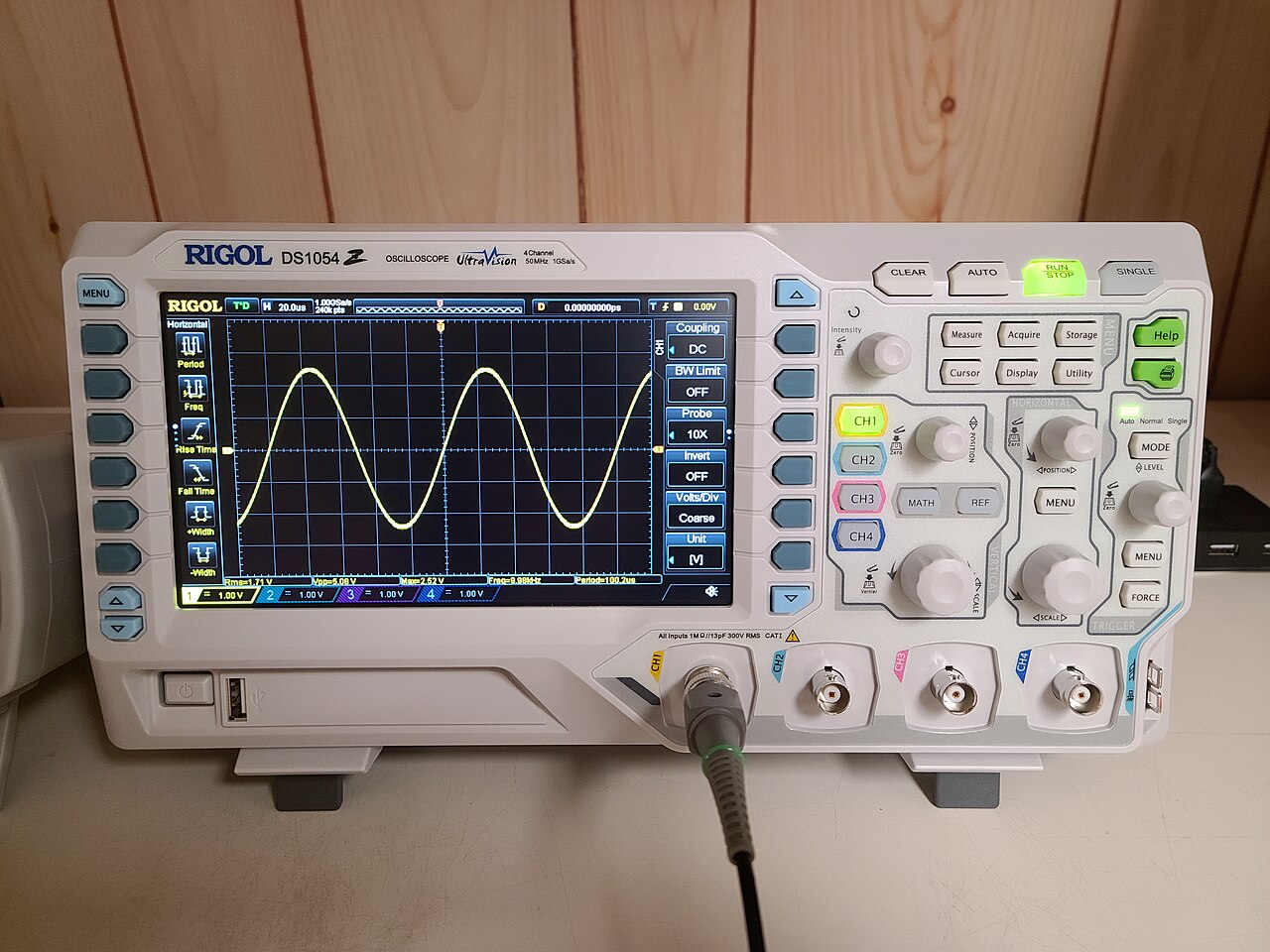
Rigol's DHO line, which Hackaday describes as the 2022 follow-on to the long-hacked 1000Z series, now has a community operating system of its own. It is called OOS, and its developer, dekajoule, describes it as an open operating system for the Rigol DHO800/DHO900. It does not patch Rigol's firmware. It replaces the scope's software stack with a Linux 6.12 kernel and a new oscilloscope application written in Rust.
On November 15, 2026, the project published v0.1.13, its third release in three days. Before anyone reaches for an SD card, it matters what the project calls itself: Experimental, not calibrated to any standard, and not for safety-relevant, medical or compliance measurements.
How OOS sits on the instrument
According to the project README, OOS runs from the scope's own SD card, next to the stock system, and the user can switch back to Rigol's software at any time. Hackaday describes it the same way: OOS boots from the scope's built-in SD card alongside the existing OS.
In the EEVblog forum announcement thread, the developer states that OOS never touches the FPGA flash or the factory calibration partitions. Its own self-calibration results go into separate files. The README's risk list still warns that factory calibration can be lost if the user has no backup, so keeping your own copy is part of the deal.
Hackaday reports that installation options range from cloning the SD card to using ADB over the network. PinoutFeed does not reproduce installation procedures here. Anyone thinking about it should read the project's own documentation and risk list in full first.
What the Rust scope app does
The EEVblog thread lists the feature set the developer claims for the new application:
- Acquisition modes: normal, peak detect, average and high-res
- Memory depth: up to 125 M points
- Timebase: 1 ns/div up to roll and scan mode
- Hardware triggers: edge, pulse, slope, video, pattern, duration, timeout, runt, window, delay, setup/hold and Nth edge
- Other triggers: protocol and zone triggers
- Measurement: 35 automatic measurements with statistics, cursors, a DVM and a counter
That list describes software features. It is not a statement of analogue performance. The README adds that several functions have never run on real hardware, so a listed feature does not mean a verified one.
What changed in v0.1.13
The headline change in v0.1.13 is consolidation. The release notes say it merges two community forks: PR #7 from fumingcaps/ichnograph, and PRs #8 through #13 from W4R/wasimlhr. The release notes list these functional changes:
- Every protocol decoder is now a module.
- Settings no longer change each other.
- STOP now applies over the whole record.
- Mean and RMS measurements work on deep records.
- A second screen with its own view.
The release follows two others that came out on November 13. According to the v0.1.12 release notes, that version added a GPU-drawn picture, mDNS, NTP taken from DHCP, and changes to the CH2/CH4 colours. The v0.1.11 release notes say that version fixed HDMI flicker, added an AC trigger and added a Bode plot that uses a USB generator. The EEVblog thread is where users have been reporting the features that landed between 0.1.11 and 0.1.13.
Updating follows the version you already run, according to the release notes. From 0.1.7 or newer, you apply the oos-0.1.13.oosupd package through the scope's web update page on port 8080 or through System > Update, and the scope restarts via kexec. From 0.1.6 or older, you must install 0.1.7 first.
Which scopes it covers, and which have actually run it
The README lists the DHO802/812, DHO804/814/824, DHO914/924 and the EDU variants as supported models. Actual testing is much narrower. The release notes say v0.1.13 was run on a DHO924S. DHO804 units have run earlier versions, and the README lists that model as running OOS on the strength of a user report. Hackaday's summary agrees: the project is still new and has been tested on only a couple of models. Treat every other model on the list as untested.
The security model: read this part twice
The README is direct about network exposure. Apart from SSH, which uses a password or key, OOS has no authentication, so the following services are open to anyone who can reach the scope:
- telnet, which is on by default and gives a shell with no password
- SCPI, VXI-11 and HiSLIP
- web remote
- an MCP interface
The community signing key for updates is also public. In the README's words, that means anyone on the network can install an update. On a scope running OOS, the network-based update path is a way for anyone on your network to install code on the instrument. A bench scope on a shared office, school or makerspace LAN deserves an isolated network segment, or no network at all.
The README also lists these risks:
- The install may void the warranty.
- The SD card can be left unbootable.
- Factory calibration can be lost without a backup.
- Option licences may need to be entered again.
What It Means for Makers
Who it is for: DHO800/DHO900 owners who are comfortable with experimental embedded Linux, who keep backups, and who want an instrument whose software they can read and change. Rust developers interested in a real-time instrument user interface, and anyone who wants to write protocol decoders, have a clear way in, since the release notes say every decoder is now a module.
What it replaces or enables: OOS replaces Rigol's scope application and OS with Linux 6.12 and a Rust app. Because it boots beside the stock system, it does not remove that system. Recent releases add features the community has been asking for, including Bode plots with a USB generator, a second screen, and Mean/RMS on deep records. The project's emphasis, though, is on being open, not on matching the stock software feature for feature.
Who should not use it: anyone whose measurements must be traceable. The project says plainly that OOS is not calibrated to any standard and is not for safety-relevant, medical or compliance work. Classrooms and shared labs should look hard at the unauthenticated telnet and the public update signing key first.
Price and availability: none of the sources gives a price. Release builds, including v0.1.13 dated November 15, 2026, are published on the project's GitHub releases page. Status is an experimental community release, not a vendor product. The README states that OOS is an independent project, not affiliated with, endorsed by or supported by Rigol, and tells users not to contact Rigol for support.
Sources
- OOS v0.1.13 release notes (dekajoule/oos, GitHub, Nov 15 2026)
- OOS v0.1.12 release notes (dekajoule/oos, GitHub)
- OOS v0.1.11 release notes (dekajoule/oos, GitHub)
- OOS: an open operating system for the Rigol DHO800/DHO900 (README, dekajoule/oos)
- OOS - an open operating system for the Rigol DHO800/DHO900 (Linux 6.12 + Rust) (EEVblog forum thread)
- Newer Rigol Scopes Get A Custom Linux Firmware (Hackaday, Nov 17 2026)
