
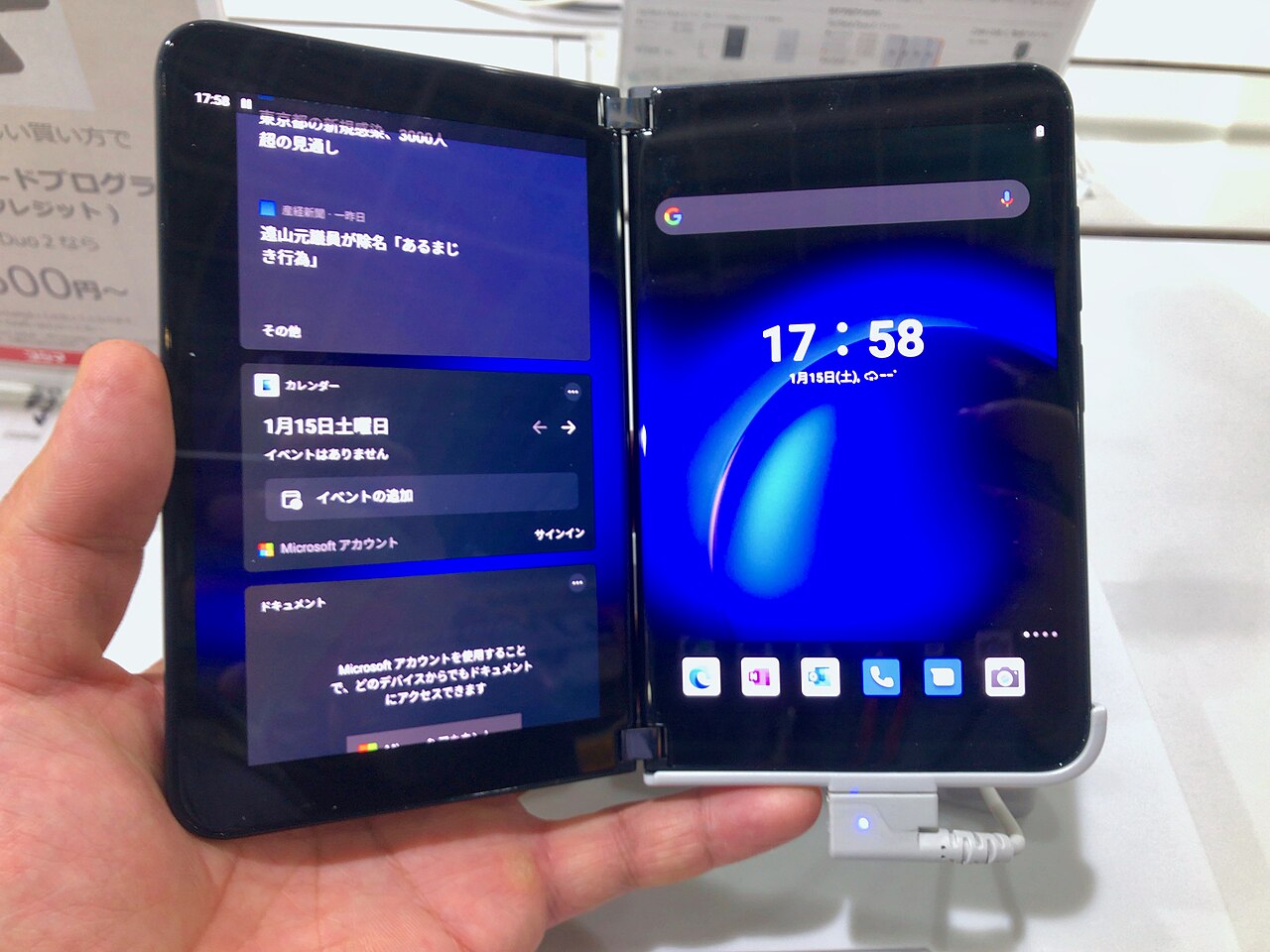
Microsoft's Surface Duo 2 is a two-screen Android phone, and it now has an unofficial second life as a Linux handheld. OpenDuo, a project published on GitHub by developer Andy1210, replaces the stock Android install with Debian 13 "trixie" for arm64. It runs on a mainline Linux kernel rather than the Android vendor kernel, and it comes with its own Wayland compositor built for the device's two panels. The project calls itself a development preview, version 0.1.0-dev. The latest pre-release went up on 19 November, and Hackaday covered the project on 23 November 2026.
A mainline kernel, not an Android one
Phone ports usually run on top of the vendor's Android kernel. OpenDuo doesn't. According to the project README, it runs mainline Linux 7.3.4 (stable) with 136 patches applied, and says there is "no Android kernel and no Android underneath." The README sorts those patches into groups. 82 were written with the aim of going upstream. The rest are marked as BRING-UP work or are patches other developers have already posted. The ratio matters if you care about how long a port will last. Patches that land upstream stop being the maintainer's job to carry. BRING-UP patches are the device-specific scaffolding that keeps a one-off port running.
The README identifies the target hardware as the Snapdragon 888 (SM8350), codename "zeta." Booting goes through the WOA Project UEFI firmware and then systemd-boot, which gives the phone a PC-style boot chain in place of Android's boot image.
How the install changes the phone
The partition layout explains both the risk and the way back. Per the README, Android's user data partition becomes the OpenDuo root filesystem, and the stock system partitions stay where they are. The repository includes restore documentation (docs/RESTORE.md) for going back to Android. Hackaday describes it the same way: OpenDuo replaces stock Android but keeps the file structure, so reverting should be possible. Hackaday also notes that because the stock partitions remain, the device's existing firmware still loads. The README says the image carries no vendor files, and the phone's own firmware is read from its stock partitions at first start.
Users should still read the warnings literally. The README says installing wipes the phone. Taking over the user data partition means everything stored on it is gone.
duo-wc: a compositor for two screens
The main software piece is duo-wc, a Wayland compositor written in Rust on the Smithay compositor library. The README lists windows that snap to a panel or span the hinge, which stretches one application across both panels, along with postures, rotation and XWayland support for legacy X11 applications. "Postures" are the different ways the hinged device can be folded and held. Hackaday says the system supports a laptop mode, dual-screen postures and spanning apps.
On top of the compositor are a touch-first Shell and a Settings app, both written in Python with GTK 4. For Android software, the README points to Waydroid and shows Organic Maps running that way.
What the latest preview fixes
The release notes for the second 19 November build show the kind of problems early users are hitting. The pre-release was published 19 November at 13:16 UTC. Preview builds in the series are dated 17 November through 19 November 2026. Among the changes the notes list:
- Update durability. Updates now sync everything to disk. Before this, a phone that froze right after an update could come back with OpenDuo's own scripts and services empty, with no mobile network and no automatic sleep.
- Test-kernel guard. Settings > Updates says plainly that it does not install while a test kernel is running.
- Wi-Fi link. The link to the Wi-Fi chip had been running at PCIe Gen3, where it reported errors. As a result, Wi-Fi could stop working while still showing as connected, or crash. The link is now held at Gen2, as the stock kernel does, and the driver restarts Wi-Fi firmware that stops answering.
Updates come through the project's own package infrastructure. The OpenDuo project site hosts a signed apt repository for arm64 with two suites, stable and testing. Updates are delivered through Settings > Updates. The site publishes the signing key fingerprint as BD74 373E FEAD C539 E637 1D7D ECA8 EB90 AA92 39CD. Check it before trusting the repository.
What doesn't work yet
The project is open about its limits. The README says everything in its hardware table was tested on one phone, the maintainer's. That's a sample of one, and it says nothing yet about variation between units or firmware revisions. The table lists VoLTE as in progress, no external display output, and no NFC, and it says the fingerprint sensor belongs to the secure world with no realistic path for now. Hackaday likewise reports that some functions are locked behind the secure world, the TrustZone-side environment that the normal OS can't reach, and that networking support isn't fully there yet. Both the README and the project site say OpenDuo isn't affiliated with Microsoft.
What It Means for Makers
OpenDuo is for people who already own a Surface Duo 2, have no further use for it as an Android phone, and are comfortable with an install that wipes the device and has been tested on exactly one unit. In return they get a general-purpose Debian arm64 machine with two touchscreens, a hinge and a Snapdragon 888 SoC. It could serve as a pocket terminal, a dual-pane control surface, a portable development box, or a testbed for compositor and posture-aware UI work. Because the userland is Debian trixie, ordinary arm64 Debian packages and tooling should be usable without a custom SDK. Waydroid covers some Android apps, though the README notes that apps needing Google's Play Integrity do not run in it.
The project is also useful beyond the Duo 2 itself. It documents a mainline Linux bring-up on SM8350 hardware, 82 of its patches are intended for upstream, and it includes a Rust/Smithay compositor written for a foldable form factor. All of that is relevant to anyone working on mainline support for Qualcomm phones or on multi-display Wayland shells.
On price and availability: the README licenses OpenDuo's own code under GPL-3.0-or-later, with exceptions such as MIT for duo-wc and GPL-2.0 for the kernel patches. It is distributed through its GitHub repository and releases, with updates from the project's signed apt repository. The sources list no price. Its status is development preview, 0.1.0-dev, with pre-release builds dated 17 to 19 November 2026. It isn't a stable release, and there's no vendor behind it. Hackaday reports that the incomplete networking and the functions locked behind the secure world are still open problems. Anyone installing it should first read the project's restore documentation for going back to Android.
