
Rapid Analysis PTY LTD, a small Australian company, is crowdfunding two Power-over-Ethernet carrier boards for compute modules in home-lab racks. The Xerxes Home Lab Kickstarter, run by Rob Newport, covers two boards. The Xerxes Pi 2026 is a 120 mm x 40 mm carrier for Raspberry Pi Compute Module 4 and Compute Module 5 boards that fits vertically in 1U. The Xerxes Nano is a 60 mm x 120 mm carrier for NVIDIA Jetson Orin Nano and Turing RK1 modules. The campaign went live at 12:23 UTC on October 11, 2026, nine days ago. It closes at 8:23 AM EST on December 10, 2026, which is 13:23 UTC. It has already passed its AU$10,000 funding goal.
This is the company's second campaign. "Our first Kickstarter was a blast!" Rapid Analysis writes. The new board builds on feedback from the original Xerxes Pi (2025).
Campaign status and pledge levels
As of October 20, 2026, the campaign had raised AU$18,604 from 43 backers with 50 days to go. Kickstarter displays that as about US$12,995 against a converted goal of US$6,985. Funding is all or nothing, and no hardware has shipped. Every reward tier lists an estimated delivery of Dec 2026. That date is an estimate, and Kickstarter notes that rewards aren't guaranteed.
At AU$30,000, a stretch goal upgrades all of the passive metal dual heatsinks to active dual heatsinks with a PWM fan. A second stretch goal is set at AU$70,000, and the creator says more details will come later. These were the reward tiers as of October 20, 2026, with Kickstarter's own USD approximations:
| Tier | Price (AUD) | Kickstarter's USD approximation |
|---|---|---|
| Gadgeteer | AU$69 | About $49 |
| Xerxes Compute Module X | AU$142 | About $100 |
| Ultimate Home Lab | AU$399 | About $279 |
| Agentic AI Studio | AU$399 | About $279 |
| Ultimate Enterprise | AU$799 | About $559 |
Ultimate Home Lab includes six Xerxes Pi 2026 boards with PoE accessories and front and back heatsinks. Agentic AI Studio includes one Xerxes Nano and four Xerxes Pi 2026 boards in a 1U four-slot rack.
Xerxes Pi 2026
Rapid Analysis says the boards are compatible with Raspberry Pi, Turing Pi, Orange Pi, Radxa and NVIDIA Jetson compute modules. The Xerxes Pi 2026 adds M.2 support for the Raspberry Pi CM4 and Radxa CM5. The company describes the M.2 PCIe connector this way: "With the CM5’s PCIe Gen 2 ×1 interface, the link offers a theoretical bandwidth of up to 5 Gbit/s." It puts that at approximately 500 MB/s before protocol overhead, and says actual NVMe performance depends on the drive, compute module and workload. Raspberry Pi's Compute Module 5 product page lists the module's "1 × PCIe x1 root complex, Gen 2 (5Gbps)".
The I/O list below combines the campaign page with CNX Software's October 16 write-up:
- Module interface: two 100-pin mezzanine connectors for CM4/CM5
- Storage: M.2 M-key NVMe socket (PCIe Gen 2 x1) on the underside; microSD for modules without eMMC
- Networking: Broadcom BCM54210PE Gigabit Ethernet with optional PoE/PoE+
- Power: 5V via USB-C or PoE, selected with a PoE-to-USB jumper; USB-C is also used for boot/recovery
- Expansion: SH-series Qwiic connector for I²C and I²S; documented mezzanine connector breaking out CSI and HDMI
- Other: boot jumper, SH-series debug connector, PWM fan connector
- Size: 120 mm x 40 mm, fitting vertically in 1U
Xerxes Nano and Compute Module X
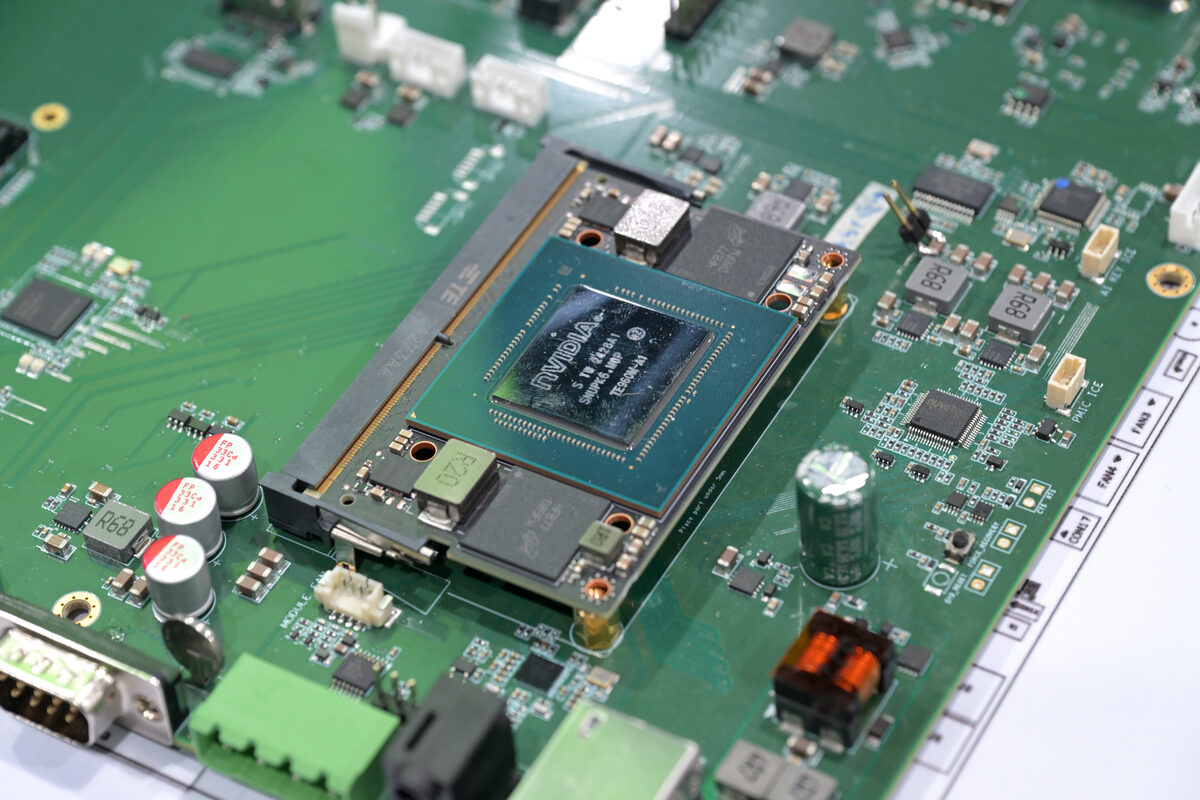
The Xerxes Nano measures 60 mm x 120 mm. According to CNX, it fits horizontally in 1U or vertically in 1.5U. It supports the Jetson Orin Nano Super (up to 16GB) and the Turing RK1 (up to 32GB). The campaign's wording is "up to 16GB of VRAM accessible on NVIDIA Jetson and Turing RK platforms supporting a whopping 32 GB of RAM". Its M.2 connector supports "up to three PCIe Gen 3 lanes, subject to the final hardware configuration". The board also has OCuLink for external PCIe hardware, SPI, UART, I²C and I²S, a fan connector and a USB-to-PoE power selection jumper. CNX lists Gigabit Ethernet with PoE and an SFP+ cage. Rapid Analysis says OCuLink performance and compatibility depend on the available PCIe lanes, the external enclosure, the power supply, drivers and operating-system support. In the campaign's risks section, the company names implementing OCuLink and meeting the Jetson's strict power requirements as challenges.
The optional Compute Module X is the company's own module. It uses a Rockchip RK3566 with four Cortex-A55 cores running at up to 1.8 GHz and an Arm Mali-G52 2EE GPU. Its NPU is specified by Rockchip at up to 1 TOPS, depending on the supported operation and precision. CNX describes it as a "Lite" alternative to the CM5 that drops Wi-Fi, Bluetooth and eMMC. It relies on Ethernet, with storage on NVMe through a carrier board or on microSD. CNX lists an 8GB version as the add-on.
What It Means for Makers
The boards are aimed at home-lab builders who want to power and network each node over a single Ethernet cable from a PoE switch or router. The Xerxes Pi 2026 is for CM4 or CM5 owners who want NVMe storage in a 1U blade. The Xerxes Nano is for Jetson Orin Nano Super or Turing RK1 owners who need OCuLink expansion. Because its M.2 lane count is not final, anyone planning around multi-lane NVMe throughput should wait for the final hardware configuration.
Rapid Analysis has published open-source, 3D-printable rack designs on Printables and Makerworld. Backers can print their own racks instead of buying the company's rack hardware. The boards are offered through the Kickstarter campaign, which runs until December 10, 2026.
