
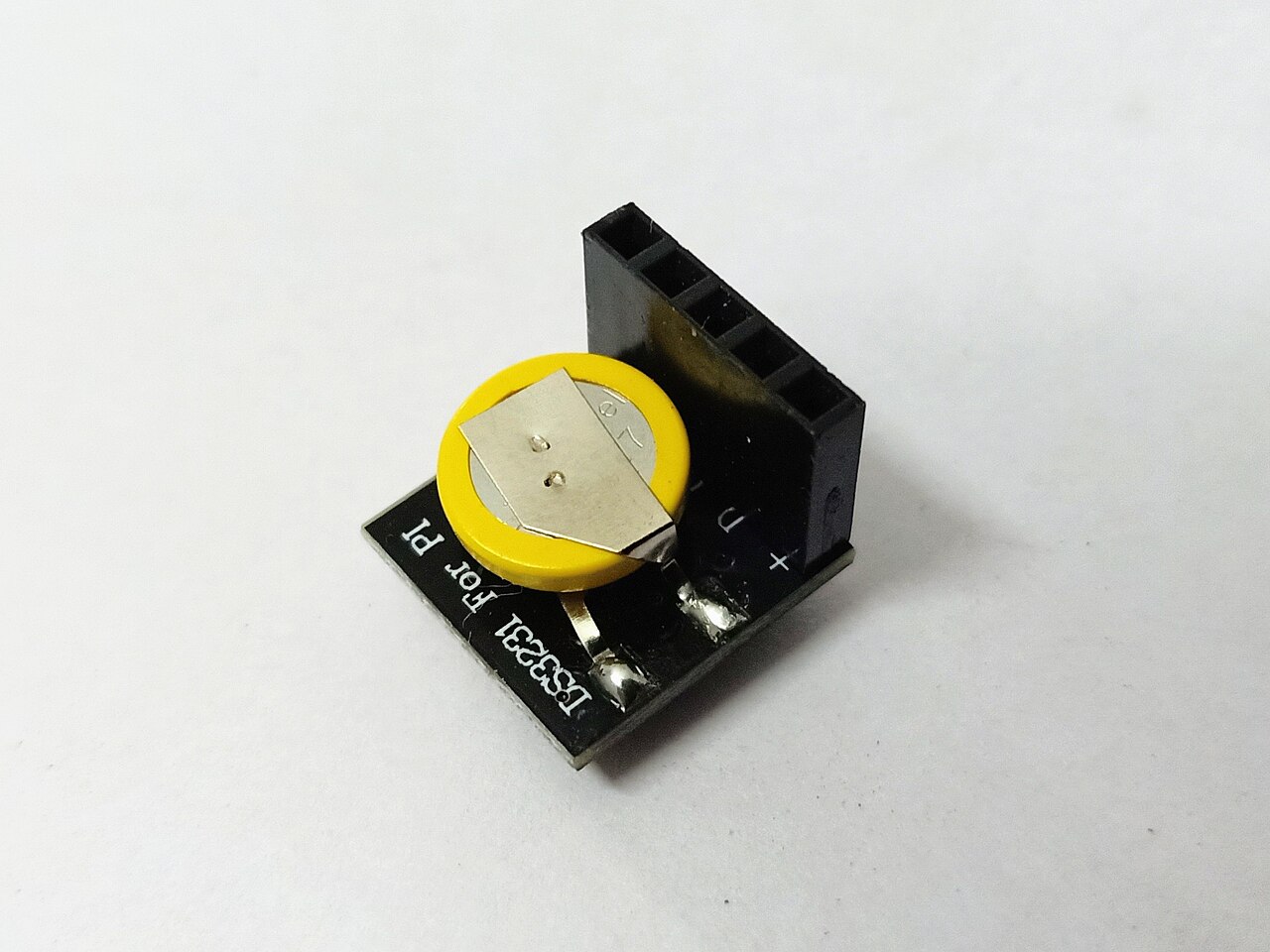
For years, the default answer to "which RTC should I use if I actually care about the time?" has been the DS3231. Adafruit now has a different answer. Its new RV-8803 High Accuracy Real Time Clock Breakout (product ID 6538) is built around Micro Crystal's RV-8803-C7, an I2C real-time clock module with a factory-calibrated, temperature-compensated 32.768 kHz crystal inside the package. Adafruit lists the board at $10.95 and shows it as in stock as of October 24, 2026. Volume pricing is $9.86 each for 10-99 units and $8.76 for 100 or more.
The selling point is accuracy. On its product page, Adafruit rates the board at ±1.5 ppm from 0 to 50 C, ±3.0 ppm from -40 to +85 C, and ±7.0 ppm from +85 to +105 C. It sets that directly against the DS3231's ±2 ppm, which Adafruit quotes for a 0-40 C range, and claims drift of under 50 seconds per year. The arithmetic checks out: a year is about 31.5 million seconds, so 1.5 ppm works out to roughly 47 seconds. That figure only holds inside the 0-50 C band, though. Over the full -40 to +85 C range, the ±3 ppm figure means about 95 seconds a year in the worst case.
What is inside the module
Micro Crystal's RV-8803-C7 datasheet describes a complete clock module that combines an integrated CMOS circuit with a crystal in a hermetically sealed ceramic package with a metal lid, not a bare RTC die that needs an external crystal. The package is 3.2 mm wide with a maximum height of 0.8 mm, and the datasheet notes that the metal lid is tied to VSS (pin 5). Because the crystal ships with the chip and the compensation is built in, there is no external crystal to choose or trim.
Key figures from the datasheet:
- Supply current: IDD0 240 nA typical, 350 nA maximum (headline figure given at 3 V)
- Operating voltage: 1.5 V to 5.5 V
- Temperature-compensated accuracy: ±3 ppm from -40 to +85 C; ±7 ppm from +85 to +105 C
- Interface: I2C bus at 400 kHz
- Clock output: 32.768 kHz, 1024 Hz or 1 Hz
- Functions: timer, alarm, and an external event input with time stamp
- Target applications listed: IoT, metering, industrial, automotive, health care and wearables
Note that the ±1.5 ppm figure for 0-50 C comes from Adafruit's product page. The datasheet facts we checked give the wider-range ±3 ppm and ±7 ppm grades. Also, the 240 nA number describes the RTC module alone. Adafruit doesn't publish a current figure for the whole breakout, so the board's own draw from its coin cell or supply hasn't been characterized in the sources.
The event time-stamp input
The external event input is the least familiar feature here and probably the most interesting one. The datasheet lists an external event input with time stamp, which records the time of an incoming event in hardware rather than leaving it to firmware to read the clock afterward. Adafruit says the breakout exposes this through a built-in button or the breakout pads. That makes the board a candidate for a simple tamper log, door or lid sensor, or event recorder, where the time an edge occurred matters more than when firmware got around to noticing it.
The board also offers a square-wave output and a timer alarm. The module's programmable clock output can produce 1 Hz, 1024 Hz or 32.768 kHz, which could serve as a crystal-derived tick or a low-frequency reference for a host MCU.
Board-level details
Adafruit says the breakout runs on either 3.3 V or 5 V power and logic, which sits comfortably inside the module's 1.5-5.5 V range. It connects over I2C, with SparkFun Qwiic compatible STEMMA QT connectors for chaining without solder. The cable isn't included. The board is meant to be used with a CR1220 coin cell to keep time while main power is off, and Adafruit notes that the battery isn't included either, so budget for one if you want timekeeping to survive a power cycle.
Software support
Adafruit lists three routes on the product page: an Arduino RTC library, CircuitPython, and Raspberry Pi or similar single-board Linux computers through built-in kernel support. The Arduino side is in the official adafruit/Adafruit_RV8803 repository. GitHub's API shows it was created on March 5, 2026 and last pushed on September 16, 2026, and its description still reads "Arduino library for RV-883 RTC", a typo for the part number. For CircuitPython, check Adafruit's guide for the driver details.
What It Means for Makers
The board is for anyone whose project has to keep good time without a network connection: data loggers in the field, off-grid weather and environmental stations, timelapse controllers, irrigation or lighting schedulers, and Raspberry Pi builds that boot without network access. Its obvious competitor is the DS3231 breakout. Going by the figures Adafruit publishes, the RV-8803 is somewhat tighter over a wider temperature band (±1.5 ppm at 0-50 C against ±2 ppm at 0-40 C). It also adds the event time-stamp input and a 240 nA typical module current, which should suit coin-cell backup and battery-powered loggers.
And if your design already uses STEMMA QT or Qwiic, you can add the board without touching a soldering iron, though Adafruit notes the board ships with a small piece of header if you want to use it on a breadboard.
As of October 24, 2026, Adafruit lists the RV-8803 breakout (product 6538) as in stock at $10.95 each, $9.86 at 10-99 units and $8.76 at 100 or more. The CR1220 coin cell and the STEMMA QT/Qwiic cable are sold separately.
