
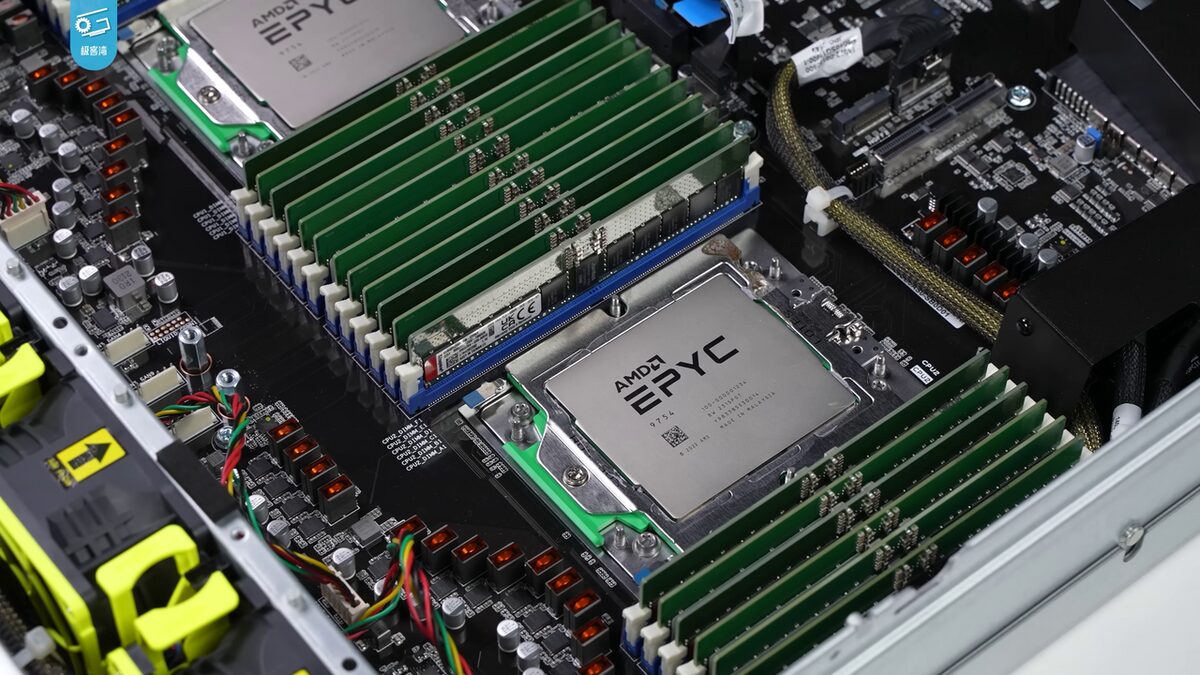
AMD has added Zen 6 to its embedded server line. The EPYC Embedded 9006 Series uses the SP7 socket and is aimed at three kinds of machine that rarely make headlines but sit in a lot of racks: semiconductor automated test equipment (ATE), next-generation firewalls and enterprise storage controllers. AMD announced the family on November 10, 2026, and StorageReview covered it the same day. CNX Software followed with a detailed spec breakdown on November 23.
This is not maker silicon. A single package draws between 400 W and 600 W. But the embedded label carries real weight here, because it comes with a long availability commitment and a set of partner boards aimed at fixed-function appliances. Those are the qualities embedded engineers look for when they choose a platform for a box that has to stay in production for most of a decade.
The lineup: one Zen 6 part, five Zen 6c parts
According to CNX Software, the family has six SKUs split across two core types:
- Zen 6: one part, the EPYC Embedded 9556, with 64 cores and 128 threads.
- Zen 6c: the other five SKUs, ranging from 96 to 256 cores and 192 to 512 threads.
A note on wording: AMD's product page describes the family as offering "up to 256 'Zen 6' cores". CNX Software's breakdown puts the 256-core top end on the density-optimised Zen 6c variant, with full-size Zen 6 cores limited to the 64-core 9556. Anyone reading a datasheet should check which core type a given SKU uses.
Other platform figures reported by CNX Software:
- Process: 2nm for the CPU.
- Clocks: base frequencies from 2.55 GHz to 3.6 GHz, boost up to 5.1 GHz.
- Cache: up to 1 GB of L3.
- Memory: 16-channel DDR5 with ECC. RDIMMs run at up to 8,000 MT/s and MRDIMMs at up to 12,800 MT/s, with up to 8 TB per socket.
- Power: 400 W to 600 W.
- Socket: SP7.
For I/O, AMD's product page lists PCIe Gen 6 and CXL 3.1, with 96 lanes at 64 GT/s from a single socket. AMD also commits to seven years of availability, which matters more than any benchmark to anyone qualifying a test head or appliance chassis.
Why these three markets
The target list explains the I/O-heavy design. A semiconductor ATE system has to move huge volumes of test-vector and capture data between instrument cards and the host, and it has to stay in a validated configuration for years. A next-generation firewall needs packet-processing throughput, and therefore core count, memory bandwidth and many fast NIC lanes. An enterprise storage controller has to feed a large number of NVMe devices and, more and more, CXL-attached memory. In all three cases, 96 lanes of PCIe Gen 6 and 16 memory channels on one socket give designers a lot of I/O and memory bandwidth without leaving the socket.
CXL 3.1 support is the forward-looking piece. AMD's product page quotes Samsung, and that quote mentions a CXL 3.2 CMM-D memory module. That is one revision ahead of the CXL 3.1 listed for the processor, so designers should check the exact feature set the two sides will negotiate rather than assume full 3.2 behaviour.
The performance claims, and how far to trust them
AMD's product page claims gains over the previous EPYC Embedded 9005 family of up to 1.8x in throughput, 2.7x in memory bandwidth and 1.5x in I/O bandwidth. The page footnotes these as AMD internal estimates.
StorageReview reported the basis for the headline number. The 1.8x figure compares an estimated SPECrate2017_int_base score of 4,900 for a two-socket, 256-core EPYC Embedded 9006 system with MRDIMM-12800 against 2,740 for a two-socket EPYC 9965 system running DDR5-6400. Part of the gain therefore comes from the much faster memory configuration, not only from the cores. StorageReview also reported two workload-specific claims comparing the 9756 with the 9755: 1.3x in DPDK L3 forwarding and 1.5x in ISA-L. The reviewer notes that these are AMD's numbers and were not run or audited by StorageReview.
The DPDK and ISA-L figures are the more useful ones for this audience. DPDK L3 forwarding is a reasonable stand-in for a firewall or router data plane, and ISA-L (Intel's Intelligent Storage Acceleration Library) maps onto storage-controller work such as RAID processing and compression. They are still vendor numbers. Treat them as a reason to benchmark your own workload, not as a design input.
Partner hardware
AMD's product page lists partner quotes from Lanner, which names its NCA-6145 network appliance platform, and from Samsung, Portwell and IEI. StorageReview lists the same four partners. Neither source gives ship dates or prices for partner systems.
What It Means for Makers
Who it is for: embedded and systems engineers who build or specify ATE host controllers, network security appliances and storage controllers, plus the board vendors who supply them. Hobbyists and small labs are not the audience. At 400 W to 600 W per socket, with 16 DDR5 channels and an SP7 board, this is rack-scale hardware.
What it replaces or enables: it succeeds the EPYC Embedded 9005 family. The practical changes are PCIe Gen 6 (96 lanes at 64 GT/s, per AMD), CXL 3.1 for memory expansion, a large jump in supported memory speed with MRDIMMs at up to 12,800 MT/s, and up to 256 cores on one socket.
Availability: the 128-core EPYC Embedded 9756 comes first. StorageReview reported that it ships November 15, and CNX Software described it as available now. The other five SKUs, spanning 64 to 256 cores, are due by the end of 2026, according to both outlets. AMD promises seven years of availability for the family.
Price: not disclosed. CNX Software reports that pricing information has not been disclosed.
Status: announced. The 9756 is reported as shipping or available now, and the remaining SKUs are expected by the end of 2026. All performance figures are AMD estimates, and StorageReview notes it did not run or audit them.
Sources
- AMD: EPYC Embedded 9006 Series SP7 Processors (product page)
- CNX Software: AMD EPYC Embedded 9006 Series offers up to 256 Zen 6c cores, PCIe Gen 6, and CXL 3.1 (2026-11-23)
- StorageReview: AMD EPYC Embedded 9006 Brings 256 Zen 6 Cores and PCIe Gen 6 to Test, Storage, and Firewall Systems (2026-11-10)
