
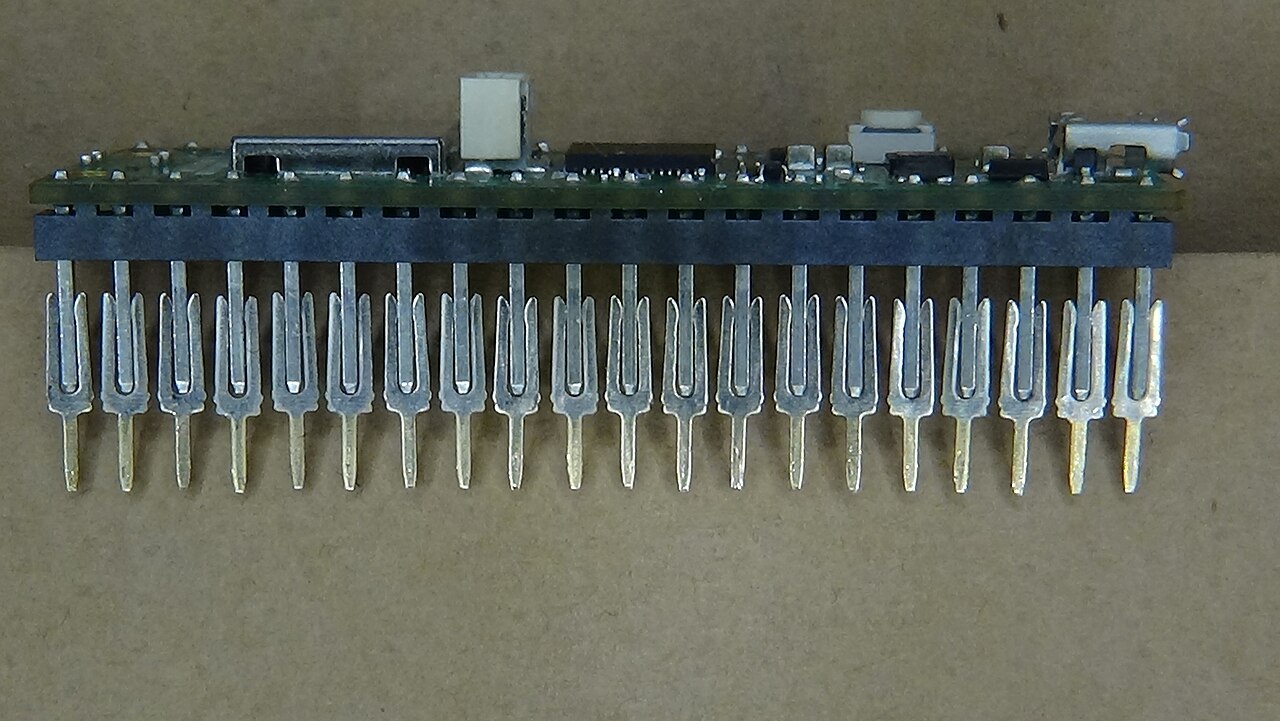
The small Linux camera board segment has mostly belonged to Rockchip's RV1106, thanks largely to Luckfox's Pico boards. ShiMetaPi's new Pico-G1 goes after the same space with a chip most Western makers have never seen: the GOKE GK7206, a camera SoC with two Arm Cortex-A7 cores, a RISC-V coprocessor and a 1.0 TOPS NPU, plus DRAM in the same package. CNX Software reported the board on 27 November 2026 and lists it from $39 on AliExpress.
The hardware is sensible for the price. The harder questions are about the chip's paper trail and how long its software stack will stay current.
The SoC: what the GK7206 is, as reported
We could not read any GOKE vendor page or datasheet for the GK7206. CNX notes that the Smart Vision section of GOKE's website lists only the GK7608, GK7605 and GK7205, not the GK7206. The specifications below therefore come from CNX's write-up and from ShiMetaPi's own SDK repository, not from the silicon vendor. Treat them as the board maker's figures.
- CPU: dual-core Arm Cortex-A7 up to 1.0 GHz
- Coprocessor: RISC-V core up to 400 MHz
- GPU: none
- AI accelerator: 1.0 TOPS NPU
- Video: H.265/H.264 hardware encoder
- ISP: 2F-WDR, AI NR, 3DNR and LDC, with input up to 3840 x 2160 at 20 fps
- Memory (on-chip): 128 MB DDR3L on the GK7206V11A, or 256 MB DDR3L on the GK7206V12A
Both part numbers check out against the maker's GitHub SDK. Version V1.0.0 targets the GK7206V11A and GK7206V12A and has two board configurations: xm7206v11a for the Pico-G1-128M_DDR and xm7206v12a for the Pico-G1-256M_DDR. With no separate RAM chip, your choice of board variant fixes the memory. You can't upgrade it later, so pick the variant for your largest model and frame buffers.
The 20 fps ceiling at 3840 x 2160 deserves attention. The ISP accepts a 4K sensor, but this is not a 4K30 part. Anyone planning a surveillance or dashcam-style build should plan on that frame rate at full resolution.
The board
CNX lists the Pico-G1's board-level features as follows:
- Storage: 16 MB NOR flash, plus a microSD card slot
- Camera: 4-lane MIPI CSI
- Networking: 10/100 Mbps Ethernet on an RJ45 jack
- USB: USB 2.0 Type-C, used for power and flashing/debugging
- Expansion: two 20-pin GPIO headers, carrying 2x TTL UART, 2x I2C, SPI and PWM
- RTC: real-time clock with a battery connector
- Power: 5 V via USB
- PCB: 72.2 x 21 mm, 4-layer
The long, narrow board with two rows of headers looks like the Luckfox Pico family, and CNX compares the two directly. There is no wireless on board. The spec list has no Wi-Fi or Bluetooth, so networking means the 10/100 Ethernet port or whatever you add yourself.
The usable GPIO count and the pin-to-function mapping are not stated in the material we could verify. ShiMetaPi has an English GPIO control page in the Pico-G1 wiki's peripheral interface chapter, so official documentation does exist. Check the pinout there, against your own board revision, before designing a carrier or HAT around it. We are not reproducing pin assignments here.
Software: what ships and how long it lasts
The shimetapi_pico_gx repository is described as a secondary development of the official Guoke Micro (GK) SDK. It contains:
- the build system and board configs
- U-Boot and Linux source
- an
app_sampledirectory with face recognition and motion detection examples
At the time of writing the repository had 25 commits. It's a usable starting point, but not yet a mature community project.
The versions matter more. According to CNX, the SDK is based on Linux 5.10, whose end of life is scheduled for December 2026, and U-Boot 2020.01. So the board launches about a month before its kernel branch reaches EOL. That is common with vendor camera SoC SDKs, whose ISP, encoder and NPU drivers are typically tied to one kernel. But it matters for anything that sits on a network for years, which is exactly what an Ethernet-connected camera board does. Nothing in the verified sources suggests upstream mainline support for the GK7206.
Pico-G1 vs Luckfox Pico Pro
The obvious alternative is Luckfox's Rockchip RV1106-based Pico Pro, which CNX puts at about $25. The Pico-G1 starts at $39 on AliExpress, so ShiMetaPi has to justify a premium of roughly $14 at the entry level.
On paper the Pico-G1 offers a RISC-V coprocessor, a 4-lane MIPI CSI interface, an RTC with a battery connector and a 256 MB option. CNX describes the Luckfox boards as nearly identical in layout, also Ethernet-connected Cortex-A7 boards with a MIPI CSI camera interface and an entry-level AI accelerator. We are not comparing NPU throughput or ISP quality. None of the verified sources include benchmarks, and the TOPS figures from different vendors are not directly comparable.
Prices in China are higher in nominal terms for the larger model: CNX reports 198 CNY (about $29) for the 128 MB version and 375 CNY (about $56) for the 256 MB version.
What It Means for Makers
Who it's for: people building small, wired, single-camera Linux vision devices, such as motion-triggered recorders, face-detection door cameras, inspection cameras or classroom demos of on-device inference. The NPU, H.265 encoder and Ethernet cover the common "detect, encode, stream" pipeline. The two UARTs, two I2C buses, SPI and PWM are enough for sensors, a pan-tilt servo or a status display.
What it replaces or enables: it's a second source for the niche that RV1106 boards fill today. It may also be a way into GOKE's camera silicon for engineers who want a dev board to experiment on. The face recognition and motion detection samples give you a working baseline.
The caveats: CNX could not find the chip on GOKE's website. The SDK is based on Linux 5.10, which is due to reach EOL in December 2026, and U-Boot 2020.01. Memory is fixed at 128 MB or 256 MB on-chip. The board has no wireless. If you need long-term kernel maintenance, the cheaper Luckfox Pico Pro may be the safer default.
Price and availability: according to CNX Software (27 November 2026), the Pico-G1 can be purchased on AliExpress from $39. In China it is priced at 198 CNY (128 MB) and 375 CNY (256 MB). CNX says some bundles add a camera module. The sources don't give a US-dollar price for the 256 MB variant on AliExpress, so check the listing before you order.
