
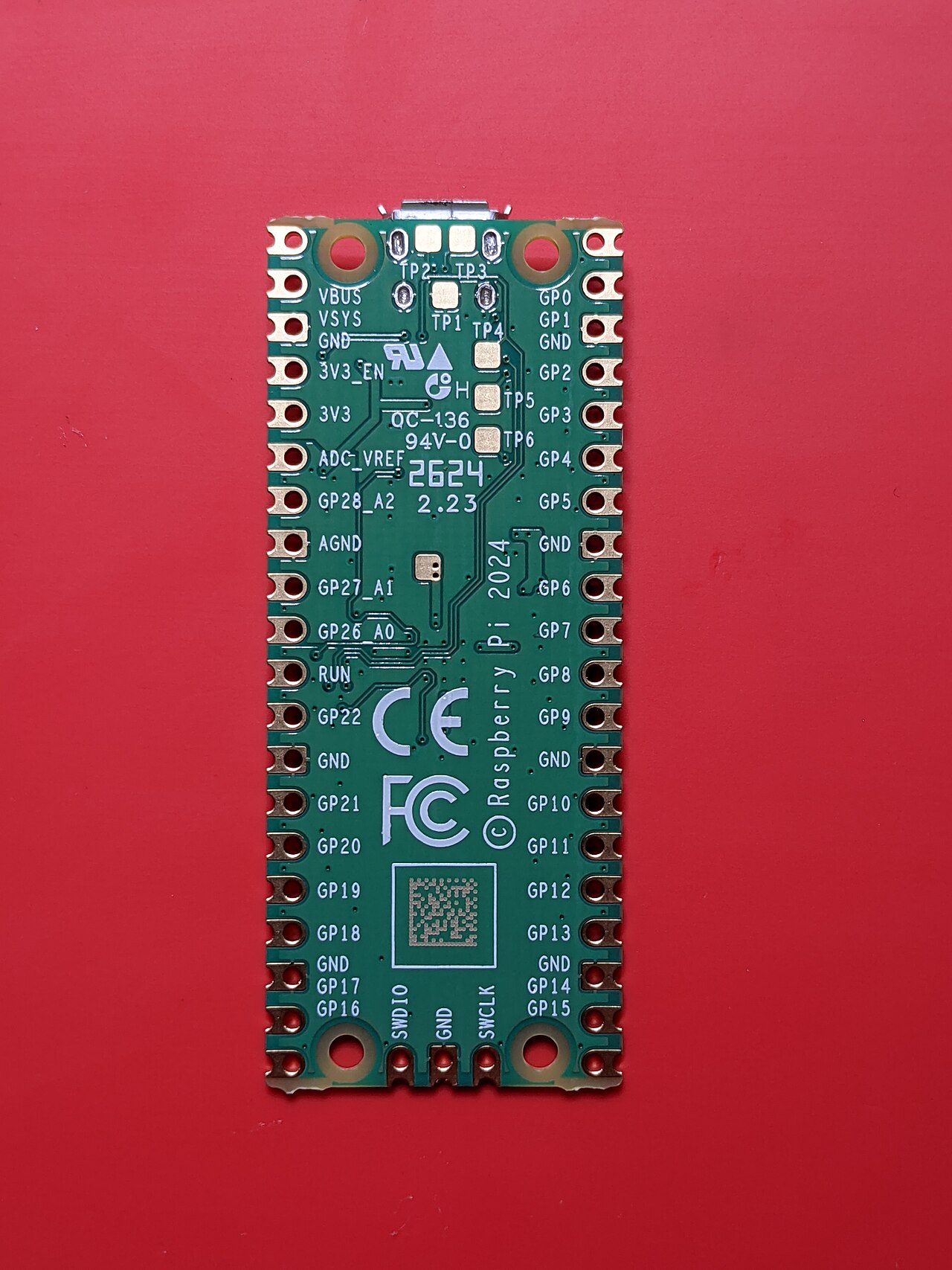
Getting a Raspberry Pi RP2040 or RP2350 board to sleep from the Arduino environment has typically meant calling into the Pico SDK yourself and then fixing the clocks and pins by hand once the chip woke up. Earle Philhower's arduino-pico core now handles that itself. Version 6.4.0, published on GitHub on 2026-11-17 at 17:53 UTC, adds a LowPower library that the release notes say enables "dormant and sleep modes on the RP2350 and RP2040," with documentation and examples.
The power work is the main feature, but it isn't the only change. The release also adds power-off control for the CYW43 WiFi chip on Pico W and Pico 2 W, updates LittleFS so it works under multithreaded FreeRTOS and from multiple cores, and fixes a long list of core, networking and peripheral bugs.
What the LowPower library is
The project documentation calls LowPower a thin Arduino wrapper over the Pico SDK's pico_low_power library. On top of that wrapper it adds the work the core needs after a wake: restoring the CPU clock and pin state. It puts an RP2040 or RP2350 into a low-power state and wakes it from a timer or a GPIO.
The SDK layer it wraps is a set of high-level calls. The SDK documentation for pico_low_power (a third-party mirror of Raspberry Pi Ltd's docs, showing SDK v2.3.0) lists functions including low_power_sleep_until_irq, low_power_sleep_until_timer, low_power_sleep_until_aon_timer, low_power_sleep_until_gpio_pin_state, low_power_set_external_clock_source, low_power_dormant_until_aon_timer, low_power_dormant_until_gpio_pin_state, low_power_sleep_for_ms, low_power_dormant_for_ms and low_power_set_pins_low_leakage_exclude_mask. The sources do not say which SDK version arduino-pico 6.4.0 builds against.
The API
The documented Arduino surface is small:
sleepFor(ms)andsleepUntilPin(pin, mode), the second with an optionaltimeoutMs, for light sleep.dormantFor(ms)anddormantUntilPin(pin, mode)for dormant mode.keepRunning(mask), which takesKR_PWM,KR_PIO,KR_UART0,KR_UART1,KR_ADCandKR_DMAflags to keep selected peripherals running during light sleep.keepPins(mask)andsetPinRestore(bool)to control which pins are left alone before dormant and whether pin state is restored after wake.lastSleepMs()andwakeReason(). The second returnsWAKE_NONE,WAKE_PINorWAKE_TIMER.
Calls return 0 on success, or a negative Pico SDK PICO_ERROR_* code on failure. The documentation says CHANGE is not supported as a wake condition, so a pin wake uses LOW, HIGH, RISING or FALLING instead of the "any change" mode Arduino users may know from attachInterrupt().
One RP2040 limit matters for timed dormancy. The documentation says dormantFor on RP2040 works only with an external 32 kHz-class clock fed into GPIO 20 or 22 and registered with low_power_set_external_clock_source(), and the minimum request is 2000 ms. On RP2350 it uses the always-on timer, with a 10 ms minimum.
Sleep versus dormant, as documented
The two modes trade wake latency against how much of the chip is shut down.
Light sleep keeps the system timer running, so millis() keeps counting through a sleepFor() or sleepUntilPin(). On RP2040 and on the RP2350's ARM cores, the library runs the system from the crystal and stops the system PLL and ring oscillator around those calls, at a cost of about 1.3 ms of extra wake time. Builds compiled with NO_USB also stop the USB PLL, the USB clock and the ADC clock, and pull D+ and D- down. The documentation says the USB PHY's receivers otherwise float and draw about 0.25 mA each.
Dormant stops the oscillators and PLLs. The chip wakes on a GPIO, or on a timer if a suitable low-frequency clock is available. Restart is slower: the documentation gives about 73 ms on an RP2040, because the crystal has to start again. USB is shut down while the chip is dormant, so a board that relies on USB serial will drop off the host and re-enumerate.
One architecture caveat: on the RP2350's RISC-V cores, the library uses the SDK's sleep unchanged, with no clock gating. The clock-stopping behaviour described above applies to RP2040 and to RP2350 running its ARM cores.
The documentation does include measurements. Whole-board current at VSYS, using an INA226 and including the board's regulator, with a NO_USB build on an RP2040 Pico at 133 MHz, was 19.7 mA running a delay loop and 0.8 mA in both sleepFor/sleepUntilPin and dormantUntilPin. The doc says to add the INA226's -0.075 mA zero offset to the Pico figures. On RP2350 at 150 MHz the documentation says to prefer light sleep, because dormant is no lower: it lists 2.2 to 4.3 mA for sleepFor and 3.3 to 3.9 mA for dormant, against 15.6 mA running on a Pico 2. These are the documentation author's figures on specific boards, so measure your own hardware before planning battery life.
The supporting fixes behind it
Several of the LowPower-related pull requests in the release notes deal with the details that usually go wrong around sleep:
keepRunning()keeps PWM, PIO, UART, ADC and DMA running in light sleep, and the first byte is received intact when a UART wakes the chip (#3631).- The processor's deep sleep bit is cleared after a dormant call (#3633).
- RP2350 gets an empty
__persistent_datasection, whichpico_low_powerneeds (#3621). - A new
__applyCoreClockConfig()re-applies the F_CPU, VREG and PSRAM setup (#3623). - The base library itself, "sleep and dormant modes over pico_low_power," arrived in #3624.
Also listed with the power items: the WiFi object gains powerOff(), powerOn() and isPoweredOn() for the CYW43 chip on Pico W and Pico 2 W (#3630). The documentation notes that WiFi.end() leaves the network but does not power the chip off, which the doc measures at about 19 mA.
LittleFS, Updater and core fixes
LittleFS now allows multicore and multithreaded access (#3574). The release overview describes this as support for "multithreaded FreeRTOS operation and multiple core access." Note that the LowPower documentation says sleep and dormant calls are not supported in a FreeRTOS SMP build: they return PICO_ERROR_NOT_PERMITTED and do nothing.
The Updater now closes firmware.bin in _reset(), so a retried OTA update has the full space available (#3613).
Core fixes in 6.4.0:
- The
attachInterrupthandler is placed in RAM (#3632). A shim is used for callbacks (#3628), and theattachInterruptParamcall was fixed (#3627). stdio_flush()now links withNO_USBandUSE_TINYUSB(#3622).- The
analogWriteRange()value is kept when PWM settings are recomputed (#3608). - A potential IRQ deadlock in the SerialUART overflow/break handling was avoided (#3614).
On the networking side, LwipEthernet now locks the CYW43 arch context directly, which fixes a fault in cyw43_arch_deinit() (#3616), and an IPv6 crash with UDP packets was fixed (#3618). The PDM microphone clock check was corrected so that rates up to 48 kHz work (#3619). The release also adds one board definition, the CHIRP Audio Trigger (#3611).
What It Means for Makers
This release is aimed at people building battery-powered RP2040 and RP2350 projects in the Arduino environment, such as data loggers, sensors, button triggers and wireless nodes on Pico W or Pico 2 W that wake, work and go back to sleep. LowPower moves the post-wake clock and pin restoration into the core, adds wakeReason() and lastSleepMs() for bookkeeping, and lets UART, PIO, PWM, ADC and DMA keep running through light sleep when a design needs them. The documentation notes that a kept peripheral makes light sleep cost more current, so a timed wake loop is often cheaper than a continuous peripheral.
When choosing a mode, the documented numbers are the ones to plan around. Light sleep adds about 1.3 ms to wake time and keeps millis() counting. Dormant shuts down more of the chip but takes about 73 ms to restart on RP2040, and it drops USB. On RP2350 the documentation measures no current benefit from dormant over light sleep. CHANGE cannot be used as a wake mode, and RP2350 boards running the RISC-V cores do not get the clock-gating savings. Anyone used to debugging over USB serial should expect the port to disappear while the board is dormant, and the documentation warns that a dormant chip cannot be reached over SWD, so keep a startup delay in setup() to allow re-flashing.
On availability: version 6.4.0 is a released build, published on GitHub on 2026-11-17, with documentation on the project's Read the Docs site. None of the sources state a price.
