
Arduino has tagged version 1.1.0 of ArduinoCore-Zephyr, the Zephyr RTOS-based core it is using to replace its older mbed OS-based core. The release went up on the official Arduino GitHub organization on October 29, 2026, at 14:35 UTC, less than two months after 1.0.0. It is a point release, but a big one. According to the release notes, it adds over-the-air (OTA) firmware updates for four boards, adds PDM microphone support on several boards and shields, enables stack protection and null-pointer detection in the loader, and moves the core to Zephyr 4.4.2.
One caveat before the details. When we researched this story, no outlet had covered 1.1.0 yet. Everything below about this release comes from Arduino's own release notes on GitHub, and we cite pull request numbers where the notes give them. Background on earlier releases comes from CNX Software and the project's README.
The headline: OTA on four boards
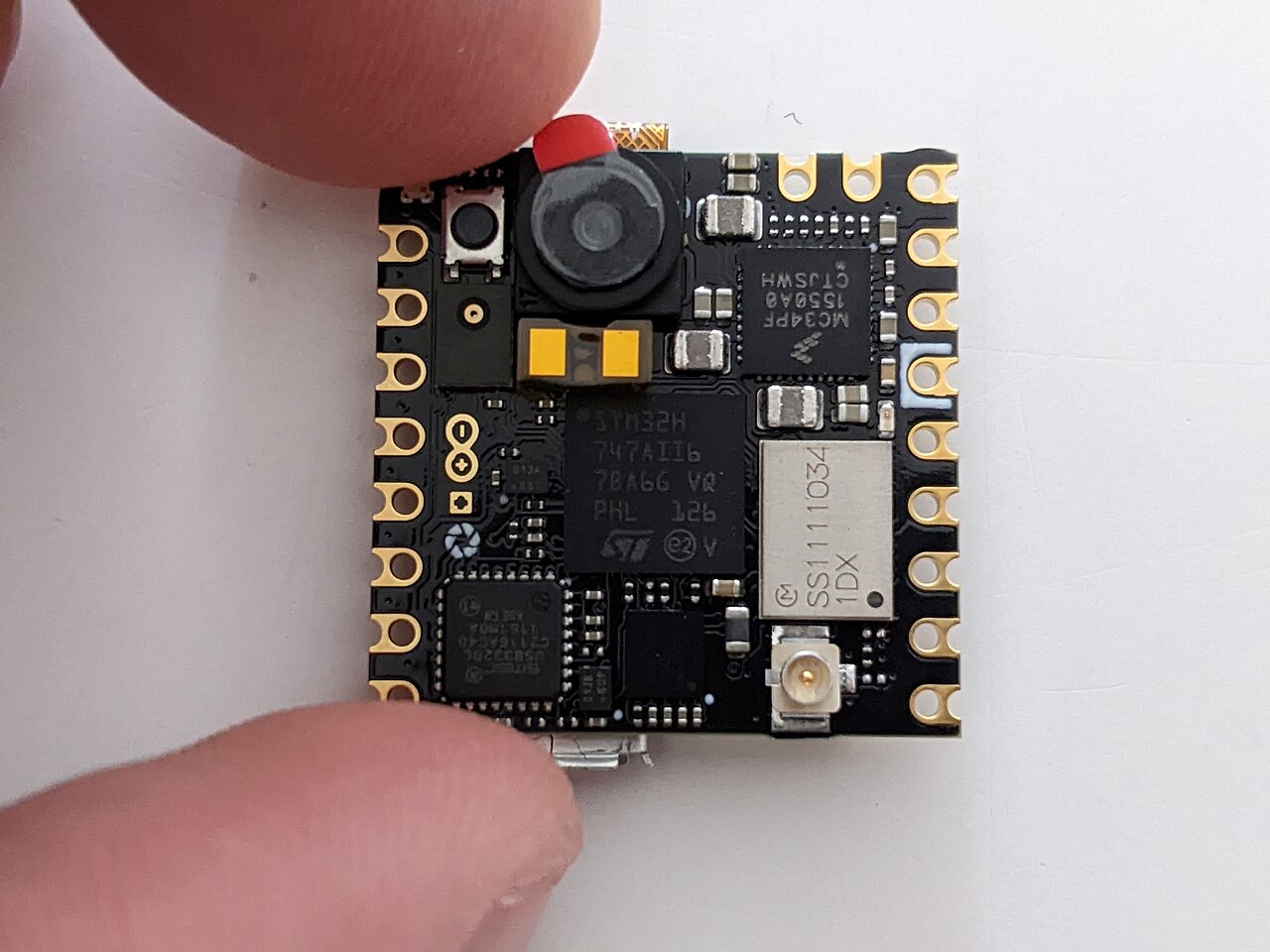
The release TL;DR lists OTA support for the Portenta H7, Opta, Nicla Vision and GIGA R1. The changelog shows how it is built. The loader gains OTA capability (PR #424), and the tooling now produces an OTA bundle containing only the loader and the sketch (PR #639).
That second point follows from how this core is designed. Under ArduinoCore-Zephyr, the Zephyr kernel and a loader live on the device, and the user's sketch is loaded on top of them. An update bundle limited to the loader and sketch fits that split. The release notes do not describe the transport, security model or partition layout for OTA. Anyone planning field deployments should read the linked PRs instead of assuming these boards behave like the mbed-era OTA libraries.
The Opta, which CNX Software lists as an Opta microPLC, is the board where remote updates are most obviously useful, since controllers are often installed out of easy reach. The Portenta H7, Nicla Vision and GIGA R1 round out the list. All four appear among the platforms CNX Software listed as supported at 1.0.0 (the GIGA as "GIGA R1 WiFi").
Zephyr 4.4.2 base
The core now tracks Zephyr 4.4.2. The project's west.yml manifest points at a zephyr-arduino-v4.4.2 branch (PR #656). This is a patch-level step up from the Zephyr 4.4.1 base in 1.0.0. The upstream Zephyr documentation lists a 4.5.0 release version, so Arduino's core is not on upstream's newest version. The release notes do not say why, though staying on an Arduino-maintained branch is a common approach for a core that ships through a board manager.
Audio: PDM microphones and DMIC
The second major item is microphone input. The TL;DR lists PDM support for the GIGA Display shield, the Portenta Vision shield and the Nano RP2040 Connect. The detailed changelog lists PDM additions for GIGA and Nicla Vision (PR #657) and for the Nano RP2040 Connect (PRs #661 and #662), the former described as a PIO-based PDM microphone. It also lists DMIC over SAI on the Portenta H7 (PR #663). The notes do not give sample rates, channel counts or buffer sizes, so we don't either.
A loader that tells you more when it fails
The least flashy changes may help users the most day to day. With PR #692, stack protection and null-pointer detection are now enabled in the loader. The TL;DR adds that failures now dump logs. With PR #693, the loader blinks the error LED on sketch load failures and crashes, and the TL;DR describes these as new blink patterns for troubleshooting.
Anyone who has stared at an unresponsive board, unsure whether the sketch, the bootloader or the USB connection was at fault, will see why this matters. The release notes do not list what each blink pattern means. Check the PR or later documentation before relying on them for diagnosis.
On the GIGA, the notes also say the ARM MPU is now enabled (PR #645). MPU-based protection is how a Cortex-M part can catch stray memory accesses in hardware, and it sits alongside the loader's new checks.
Camera, VENTUNO Q and other changes
The rest of the changelog is a long list of targeted fixes and additions:
- Camera: a camera serial viewer library has been added (PR #650), and the CameraDisplay example has been removed (PR #705). On the GIGA, the camera's DCMI interface moves to a high DMA1 stream (PR #686).
- VENTUNO Q: peripheral initialization is now deferred and CAN instances are exposed (PR #674). The 16-bit timer prescalers have been tuned for low-frequency PWM (PR #638). The VENTUNO Q, an SBC with an STM32H5F5 real-time MCU according to CNX Software, gained support in 1.0.0.
- USB: sketches can now register USB vendor requests (PR #695).
- Clocking:
F_CPUfixes, including for RP2040-based boards (PRs #636 and #673). - UNO Q: uses Arduino_RPClite 0.3.1 (PR #651) and an updated Arduino_RouterBridge (PR #703).
- Wire:
WIRE_HOWMANYis now defined (PR #706).
The TL;DR describes the rest simply as "Maaaaaany fixes for overall system stability."
How we got here
According to CNX Software, Arduino announced its switch from Mbed to Zephyr in July 2024 and released the first beta of Arduino Core for Zephyr in December of that year. Version 0.90.0, released July 29, 2026, was the first stable version. Version 1.0.0 followed on September 4, 2026, with VENTUNO Q support, the Zephyr 4.4.1 base and Nicla Vision camera support. Version 1.1.0 comes about eight weeks later.
The project README describes the repository as a downstream fork of the Arduino Core for Zephyr RTOS-based boards. It mentions Arduino App Lab, and it says the core is designed to replace the mbed OS-based Arduino core.
At 1.0.0, CNX Software listed these supported platforms: UNO Q, VENTUNO Q, Portenta H7, Portenta C33, Opta, GIGA R1 WiFi, Nano Matter, Nano RP2040 Connect, Nano 33 BLE, Nicla Sense ME and Nicla Vision. A separate Zephyr Community Boards package, also maintained by Arduino, covers the Renesas EK-RA8D1 and the NXP FRDM-MCXN947 and FRDM-RW612.
What It Means for Makers
If you have a Portenta H7, Opta, Nicla Vision or GIGA R1 and have been waiting for OTA on the Zephyr core, 1.1.0 is the release to look at. OTA is most interesting for Opta installs that are awkward to reach with a USB cable. Microphone input on the GIGA Display shield, the Portenta Vision shield and the Nano RP2040 Connect is the other headline addition, for anyone doing audio experiments.
For everyone else on the Zephyr core, the loader changes are the reason to look at the update. Stack protection, null-pointer detection, log dumps on failure and blink patterns on sketch-load failures and crashes are all aimed at making a failure easier to diagnose. Library authors get WIRE_HOWMANY and USB vendor-request hooks. VENTUNO Q users get exposed CAN instances and PWM prescaler tuning for low frequencies.
On price and availability: ArduinoCore-Zephyr is an open-source core, and none of the sources give a price. Version 1.1.0 was published on GitHub on October 29, 2026. CNX Software's 1.0.0 coverage said the core installs through the Arduino IDE as "Arduino Zephyr Boards." We have not confirmed when 1.1.0 will appear there, so check the board manager or the release page before you plan around it. The OTA mechanism is new, and we have seen no independent testing of it, so try it on a bench unit before pointing it at hardware in the field.
