
Most microcontroller game projects begin with a framebuffer, a sprite blitter and a lot of hand-written C. Jet Studio, an open-source project by GitHub user fedyfausto, starts from the other end. It gives you a desktop editor that looks and behaves like Godot, then runs the finished scene on an Arduino Nano ESP32 or an STM32F746 board wired to a common ILI9341 SPI LCD. The project is labelled a prototype and has moved quickly. Its 0.6.0 release, published on GitHub on October 30, 2026, adds Godot 4-style tweens, an AnimationPlayer node that runs on the boards, and 2D transform gizmos in the editor.
Hackaday covered the project on November 1, and the GitHub repository had collected 58 stars by the time this article was written. The repository was created on October 25, 2026, so it is about a week old.
What Jet Studio actually is
Three pieces are easy to mix up. According to the project README, Jet Studio is a "Godot-style 3D desktop editor" built with Godot's UI, with an independent C++17 game runtime, a renderer called Jet, and a scripting language called JetScript. Hackaday notes that the editor is itself a Godot application extended with a C++ GDExtension. That explains why it looks so much like Godot: it reuses Godot's editor shell. The runtime that executes your game is not Godot's engine, though.
That runtime is what makes the project interesting. The README says the same runtime runs in the editor, in an SDL2 desktop player, and in the firmware for the Arduino Nano ESP32. So the preview in the editor is meant to be the same code path the microcontroller runs, not a desktop approximation. The README describes JetScript as using GDScript syntax, so developers who already know Godot can carry their habits over. How much of the full GDScript language JetScript implements is not something the sources spell out beyond that.
Supported hardware
The README marks two boards as tested:
- Arduino Nano ESP32, listed in the README with an ESP32-S3R8, 16 MB of flash and 8 MB of octal PSRAM.
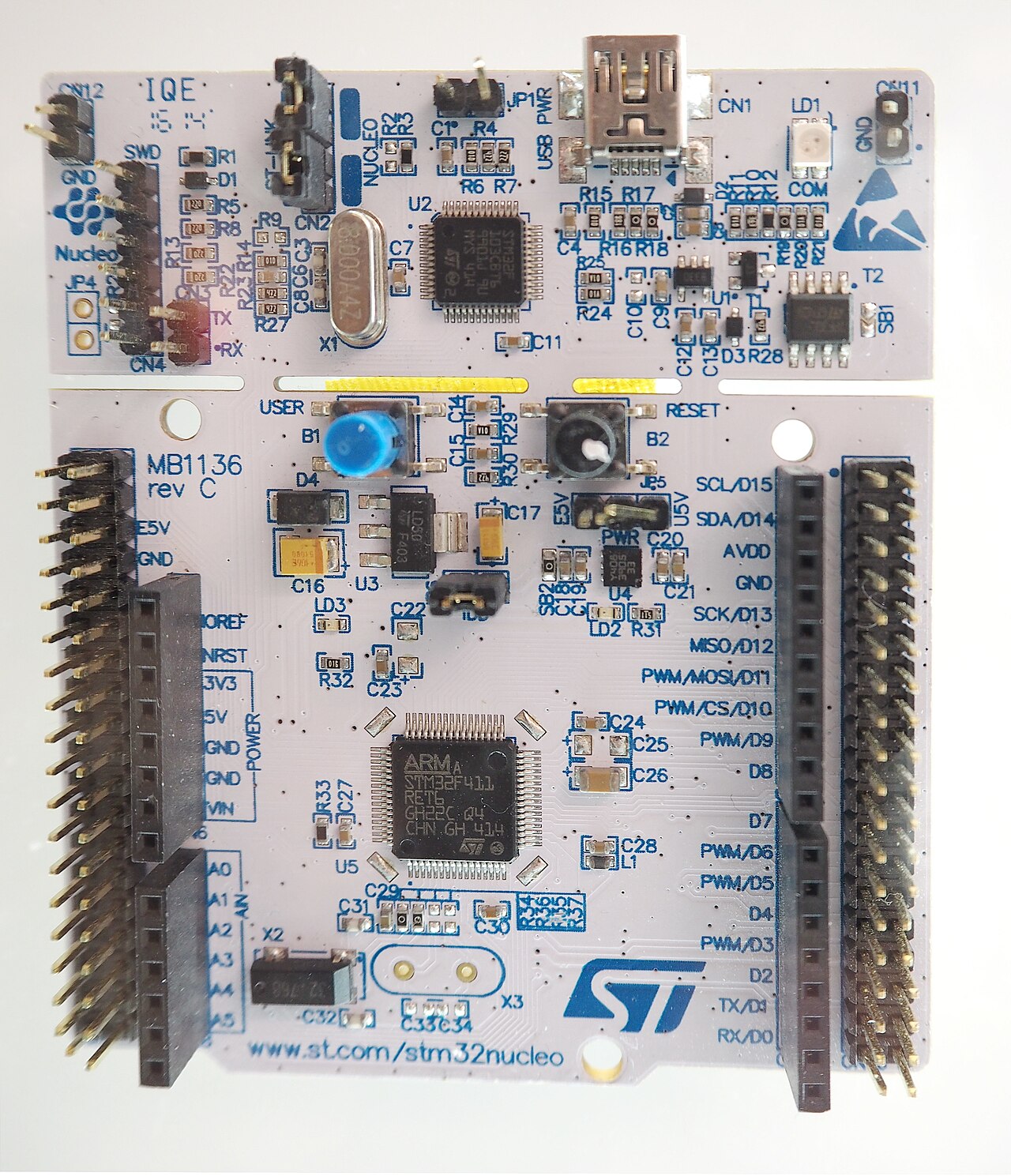
- ST Nucleo-F746ZG, the STM32F746 board used for the README's benchmark figures. The README lists it as a Cortex-M7 at 216 MHz with 320 KB of RAM and 1 MB of flash, tested with an ILI9341 on SPI1 with DMA at 54 MHz. Hackaday describes this target as "STM32F746".
The README's hardware table also lists other STM32 boards (Nucleo-F767ZI, Nucleo-F722ZE and a WeAct Black Pill F411CE) without marking them tested. Hackaday says the supported targets drive the common ILI9341 SPI LCD. The README sets a 1 MiB firmware package limit: a package over that size stops the flash step.
Performance claims, and where they come from
The frame-rate figures come from the README and the release notes. We have not tested them independently.
- Jet Blaster, a 2D shooter demo: about 62 fps on the Arduino Nano ESP32 and about 83 fps on the Nucleo-F746ZG (README; Hackaday reports the same numbers).
- JetRun, an OutRun-style racer: about 60 fps on the Nano (README).
The 0.3.1 release notes explain part of the STM32 story. That release added display DMA on STM32 with SPI up to 54 MHz. With DMA, on a Nucleo-F746ZG with an ILI9341, the textured_boxes test went from 29.5 ms to 12 ms per frame, or 83 fps. The same notes say JetRun now fits in 320 KB of RAM on the Nucleo-F746ZG and runs at about 25 ms per frame, which works out to roughly 40 fps. That is a different board and an earlier release than the README's 60 fps figure for JetRun on the Nano, so the two should not be compared directly. Treat them as snapshots from different points in a fast-moving prototype.
In the author's YouTube demo of JetRun, the description says the road is rendered in 3D and the vehicles are sprites drawn with the new Sprite3D node, a common trick for this kind of pseudo-3D racer. We read only the video's title and description, not the video itself. Hackaday also mentions a 3D physics simulation among the demos.
What's new in 0.6.0
The October 30 release is mostly about animation. The official release notes list:
- Godot 4-style tweens:
create_tween(),tween_propertyandchain(), with Godot's 12 transitions and 4 eases. - AnimationPlayer node, which the notes say runs on the boards, not only in the editor.
- Animation panel with a timeline in the editor.
- 2D gizmos for Select, Move, Rotate and Scale.
Bug fixes cover scenes that showed unsaved changes as soon as they were opened, dragging 2D nodes whose parent was rotated or scaled, and shortening animations. The release notes are upfront about gaps: blending and the RESET animation are not supported yet, and neither is keying @export variables from the Inspector. Anyone porting a Godot animation setup should expect to simplify it.
Earlier releases filled in other parts of the engine. The 0.5.0 release notes describe Godot 4-style signals in JetScript, with emit, connect and a Signals tab in the editor, and the 0.3.1 notes cover the STM32 display DMA described above.
A note on how it was built
Readers have become wary of projects that move this fast, and the question of AI-generated code came up in Hackaday's comments. The author replied that an LLM was used only to help track down an out-of-memory issue, in one reply describing it as an extra pair of eyes on the debug logs of the STM32 port, and said the engine is hand-written. That is the author's own account, and we have no way to check it independently.
What It Means for Makers
Jet Studio is aimed at people who want to design small games or interactive displays visually, with a scene tree, inspector, timeline and gizmos, instead of hand-coding a render loop for each project. Godot users get the most out of it. Node-based scenes, tweens, AnimationPlayer, signals and GDScript-style syntax will all look familiar, and the code that runs on the microcontroller is the same runtime that drew the editor preview. Educators who teach game logic on cheap hardware, and badge or handheld builders already using an ILI9341 panel, are obvious candidates too.
It sits somewhere between bare-metal graphics libraries, where you write everything, and full engines, which do not fit in a microcontroller's memory. The trade-off is scope. You are tied to the boards and display the project supports, a 1 MiB firmware package limit and a feature set that is still growing release by release.
Price and availability: Jet Studio is free, open-source software under the MIT license, available now from its GitHub repository as release 0.6.0 (October 30, 2026). The README calls it a prototype, so expect rough edges and breaking changes. None of the sources list prices for the Arduino Nano ESP32, the Nucleo-F746ZG or ILI9341 modules, so check current prices with distributors.
