
The downloads page at circuitpython.org now carries a round number. Its board browser reads "Displaying 700 boards", which puts Adafruit's Python-for-microcontrollers project at 700 supported boards. The count reached that figure as CircuitPython 11.0.0-beta.0 went up on GitHub. The release is dated 24 November 2026, and its publication timestamp is 20:39 UTC.
Everything below is based on the live downloads page and the other sources listed at the end. PinoutFeed did not use any Adafruit announcement text.
How the count got here
Three dated points from public sources show how the ecosystem has grown:
- January 2020: 100 boards. Hackaday reported on 21 January 2020 that CircuitPython had welcomed its 100th board, the OSHW 2020 badge. The same report noted that more than half of the supported boards at that point were produced outside Adafruit.
- July 2025: more than 608 boards. Wikipedia's CircuitPython entry states that as of 6 July 2025, version 9.2.8 supported over 608 different microcontroller boards.
- November 2026: 700 boards. The circuitpython.org downloads page now reads "Displaying 700 boards."
The arithmetic is simple. The list grew roughly sevenfold in under seven years. Since the July 2025 figure, about 92 boards have been added in roughly 16 months, or around five or six a month. The Wikipedia figure is a floor ("over 608"), so the exact increase over that period may be slightly smaller.
One caveat is worth stating plainly. "Displaying 700 boards" is the count shown by the downloads page's board browser. It is not a formal compatibility matrix. Each entry on the page is a board with its own download listing, and the page does not say how fully each one is supported.
Who the 700 are
The Hackaday observation from 2020 is the more telling statistic. Even at 100 boards, most of the list came from outside Adafruit. The current downloads page, sorted by downloads (its default order), shows the same pattern among its top entries. They include:
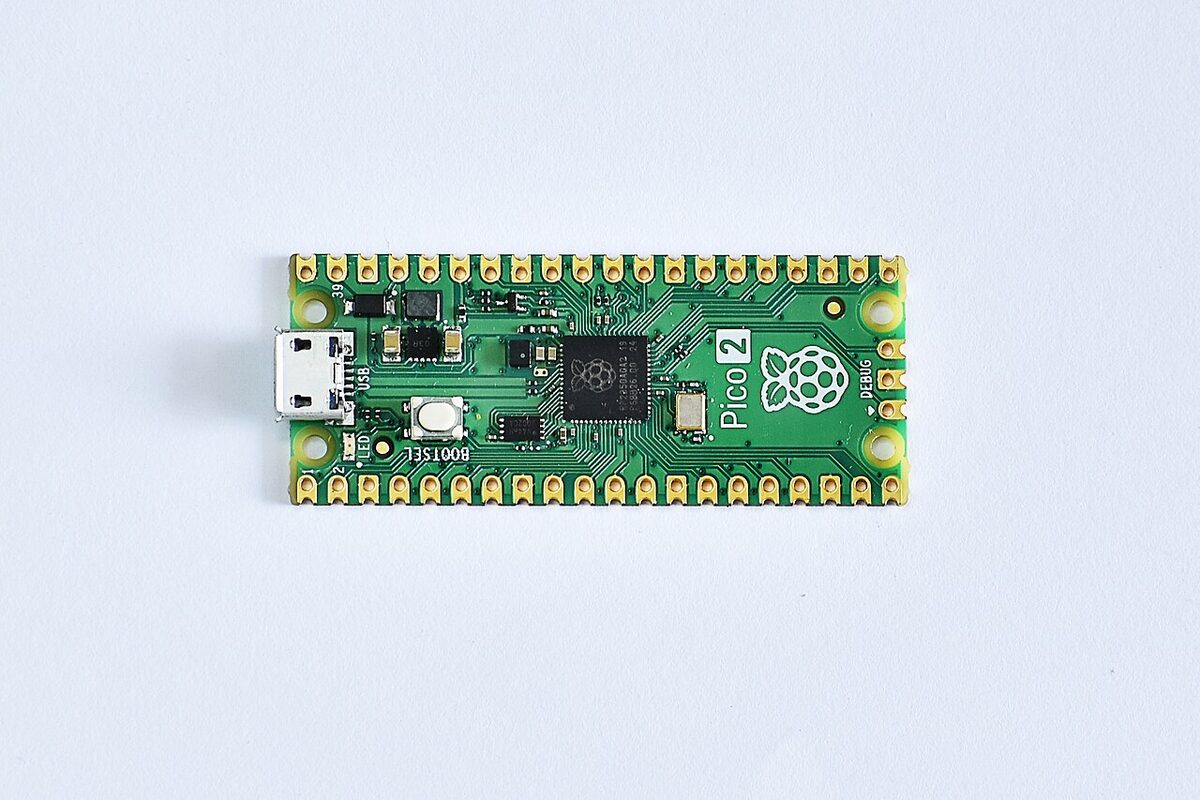
- Raspberry Pi Pico, Pico W, Pico 2 and Pico 2 W
- Waveshare RP2040-Zero
- VCC-GND Studio YD-ESP32-S3 N16R8
- Seeed XIAO RP2040, XIAO nRF52840 Sense and XIAO ESP32S3
- Adafruit Circuit Playground Express and MatrixPortal S3
Of the boards named in that most-downloaded group, only two are Adafruit's own. The rest are Raspberry Pi's reference boards, Seeed's thumb-sized XIAO family, a Waveshare RP2040 module and an ESP32-S3 board from VCC-GND Studio. The downloads page lists these as separate manufacturers' boards, which suggests that much of the download traffic goes to hardware that Adafruit does not make.
Wikipedia's port list (given for version 9.1.0) shows the range of silicon behind those boards. Ports include atmel-samd (Microchip SAMD21 and SAMx5x), cxd56 (Sony Spresense) and espressif, alongside Nordic (nRF52840, nRF52833) and Raspberry Pi (RP2040, RP2350) ports.
Where 11.0.0-beta.0 fits
This is a short summary of the release notes. The beta adds capability on newer Espressif silicon, and it removes some ports.
On the additions side, the GitHub release notes list LVGL-based displayio on the ESP32-P4 and ESP32-S31. They also list a display deinit(), in-place .mpy imports from the CIRCUITPY drive, GIF animation on e-paper displays, and rounded rectangles in vectorio.
On the removals side, the Broadcom, litex and renode ports are gone. The release also makes several behaviour changes that can break existing code:
os.uname().sysnamenow returnsCircuitPython.- On Espressif boards the processor UID values are now in canonical order. According to the release notes, this changes the reported processor ID, the
boot_out.txtvalue and the USB serial number, so code that uses the UID as a device identifier may see different values after upgrading. OnDiskBitmapnow takes a filename only.
The release is explicitly labelled a beta with known bugs. According to the release notes, the 10.x library bundles are still compatible with it.
The release notes list the stable ports as atmel-samd, cxd56, espressif, nordic, raspberrypi and stm. The ESP32-P4 and ESP32-S31 Espressif targets are still classed as alpha. The notes also list two new boards in this beta, the Adafruit Metro CH32V407 and Metro CH32V467, both on Zephyr.
What It Means for Makers
Who it is for: anyone who wants to run interpreted Python on a microcontroller with the drag-and-drop CIRCUITPY workflow. This especially includes educators and beginners whose classroom or bench boards are not Adafruit products. With 700 board definitions listed, there is a good chance that an RP2040, RP2350, ESP32-S3 or nRF52840 board already in a parts drawer has its own firmware build. Check the downloads page for your exact board before assuming a generic build will do.
What it enables: one board-specific firmware image and one library-bundle workflow across hardware from Raspberry Pi, Seeed, Waveshare, other Espressif board makers and Adafruit. The 11.0 beta adds LVGL-based displayio on the ESP32-P4 and ESP32-S31, which the release notes class as alpha-status ports.
What to watch for: if you depend on the Broadcom, litex or renode ports, 11.x is not for you, because the beta removes them. If you identify ESP32 devices by processor UID, the changed UID order may mean re-registering those devices after upgrading. Production projects should stay on stable 10.x until 11.0 leaves beta. The 10.x library bundles keep working with the beta, so testing it does not force a library migration.
Price and availability: none of the sources cited here give board prices. The firmware builds for all 700 listed boards are posted on circuitpython.org/downloads. 11.0.0-beta.0 was published on GitHub on 24 November 2026 as a pre-release beta with known bugs.
