
Researchers Daehwa Kim and Chris Harrison at Carnegie Mellon University have described Object-Agent Twins (OATs), a UIST 2026 research project subtitled "Expressive Micro-Agent Avatars for Inanimate Everyday Objects". OATs are small clip-on devices that give a houseplant, a refrigerator or a space heater an animated character on an e-paper screen, and the character's emotions follow the object's sensor readings. The researchers call it their "very first prototype", and the code is listed as coming soon rather than released. According to Hackster's report on the work, a complete device costs less than $20 to assemble, and optional sensors cost less than $5 each.
The project page calls OATs "a toolkit that enables non-expert users to easily, expressively, and rapidly create small Tamagotchi-like companions for inanimate objects in their everyday lives." Its examples are a sea onion plant named "Green Monster" that becomes tense when it needs water, a shared office refrigerator ("Mr. Refrigerator") that gets bored when no one uses it, and a space heater ("Heater Man") that gets frustrated when heating is wasted.
The hardware
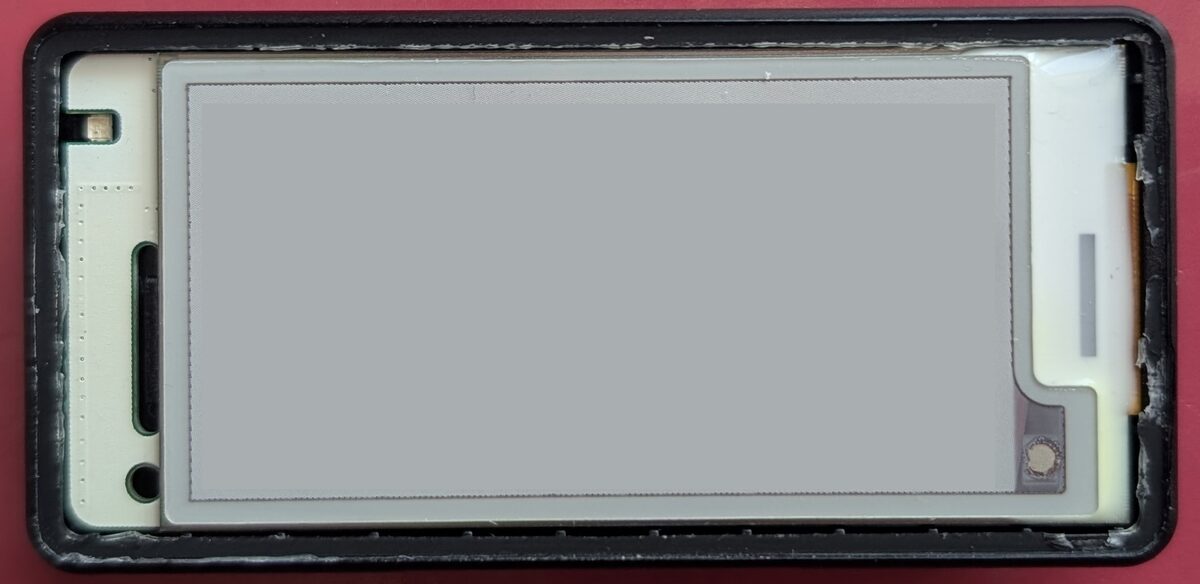
Each OAT is built around a Waveshare ESP32-S3 development board with a 1.54-inch, two-colour E Ink display. The researchers add a microphone for measuring sound levels and a custom expansion board for additional sensors, with modules they developed for motion, occupancy, light intensity and soil moisture. Everything sits in a 3D-printed enclosure and runs from a 1,100 mAh lithium-polymer battery. Hackster gives battery life as approximately one week, depending on sensor configuration; the project page's own disclaimer is more conservative, at about 3–4 days without the sound level sensor and probably only 1 day with it.
The researchers do not specify which variant of the base board they used. Waveshare's product page for the ESP32-S3-ePaper-1.54 lists:
- ESP32-S3, 240MHz, supporting 2.4GHz Wi-Fi (802.11 b/g/n) and Bluetooth 5 (LE), with onboard antenna
- Built-in 512KB Static RAM, 384KB ROM, with integrated 8MB Flash and 8MB PSRAM
- Onboard 1.54inch e-paper display, 200 × 200 resolution, black / white
- ES8311 audio codec chip, supporting voice capture and playback
- Onboard PCF85063 RTC chip and SHTC3 temperature & humidity sensor
- TF card slot
- MX1.25 2PIN lithium battery header and MX1.25 2PIN speaker header
- Programmable PWR and BOOT side buttons
The SHTC3 is the temperature and humidity sensor Hackster lists for OATs. In the setup flow, air temperature and air humidity are the two internal senses. Motion, water/soil, light intensity and occupancy are the four external senses, and those modules plug into the back of the device.
How the character decides how it feels
The work is split between the device and the cloud. The ESP32-S3 wakes every two seconds to collect sensor readings, and local anomaly detection decides when conditions have changed enough to warrant an update, which reduces wireless traffic and saves battery. When an update is needed, the device sends current and historical readings to a cloud server, where Google's Gemini models evaluate them against the object's configured behaviours, pick an emotion and return it for display. Gemini also generates the character itself: a pixel-art figure with 12 emotional expressions, ranging from excited and happy to frustrated and depressed. Outside of environmental changes, an OAT updates its status every hour.
Users describe the object in plain language. In the setup flow, the owner names the device, describes the host object in a "Who am I?" field and generates an avatar, which reflects any appearance details given. They then choose which senses the twin should use and review a generated template of example behaviour, which they can edit. Emotion generation then takes about 10 minutes.
Provisioning is a captive-portal flow. Long-pressing the power button turns the device on; double-pressing the boot button while it is on re-enters setup mode. The user joins a Wi-Fi network named OAT-[device id], browses to http://192.168.4.1 and enters their home Wi-Fi details. The device then reboots, and the rest of the setup happens at oats.daehwakim.com/[device id], which also shows the twin's status and why it feels that way.
The study
The researchers recruited 12 participants, who created OATs for refrigerators, plants, dumbbells, a coffee maker and a 3D printer. All of them configured their devices successfully, taking approximately 15 minutes on average, before a seven-day deployment. Some participants changed their routines to keep their OATs happy, including exercising more, caring for plants and reorganising refrigerators, while others reported feeling guilty when their objects looked unhappy. The team also reported limitations, including confusing emotional expressions and users manipulating sensor readings just to make their characters happy.
What It Means for Makers
OATs is a research toolkit, not a kit or a product. The project page lists its GitHub repository as "coming soon", so the expansion board, enclosure and firmware are not yet available to reproduce; the page offers a mailing list for updates. Behaviour and emotion generation run on Gemini through the researchers' server at oats.daehwakim.com.
The base board is available now. As of October 20, 2026, Waveshare lists the ESP32-S3-ePaper-1.54 at $15.99 to $22.99 (USD), across versions with or without touch control and with or without a bundled 3.7V lithium battery (the -EN suffix omits the battery). For battery handling and board documentation, refer to Waveshare's product page.
