
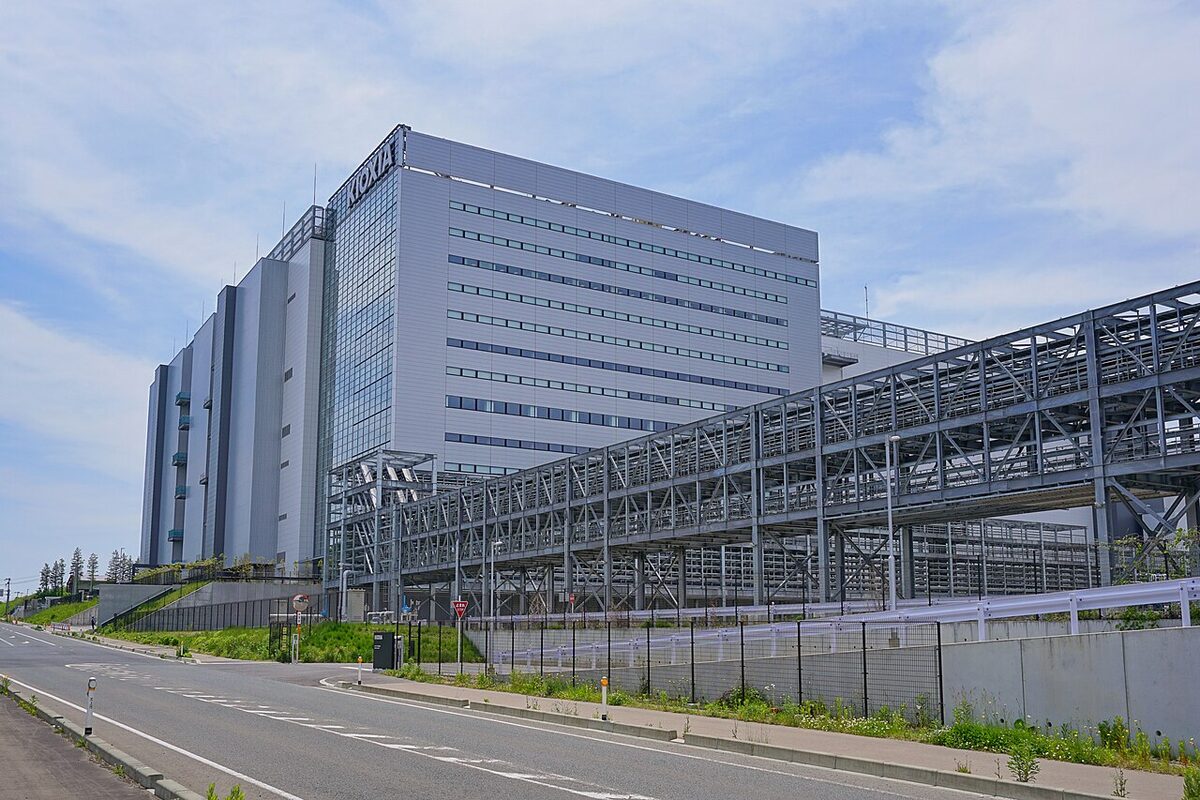
Kioxia announced on November 25, 2026 that it would show a prototype of the third generation of XL-FLASH, its low-latency storage-class flash, at KIOXIA Forum in Tokyo on November 26. The company makes three headline claims: an average read latency of 3 microseconds, about 70% higher bit density than XL-FLASH generation 2, and about 135% better read power efficiency in 512-byte units, also compared with gen 2. Samples for functional evaluation are due to ship to select customers in March 2027.
The part is a prototype, not a product. Kioxia has published no price, no capacity figures for finished devices, and no general availability date beyond the sampling window.
The numbers, and what they are measured against
Each of Kioxia's figures has its own baseline, so it helps to keep them separate:
- Read latency: 3 microseconds average for the prototype. Kioxia says this is less than one-tenth of the latency of its BiCS FLASH generation 8 1Tb TLC, and attributes the comparison to internal testing. The press release does not give the TLC part's absolute latency; Tom's Hardware's comparison table lists 40 microseconds for BiCS8 TLC.
- Bit density: about 70% higher than XL-FLASH generation 2.
- Read power efficiency: improved by about 135% versus gen 2, measured in 512-byte units, based on Kioxia internal testing.
- Construction: CBA, which Kioxia expands as CMOS directly Bonded to Array. The peripheral CMOS logic and the memory array are made separately and then bonded together.
Kioxia's release does not state how many bits per cell gen 3 stores. Tom's Hardware reports that it uses SLC. Treat that as the outlet's reporting until Kioxia publishes a datasheet.
Why 512-byte reads matter
Kioxia describes XL-FLASH as having significantly lower read latency and higher write endurance than typical NAND flash. It is aimed at small, random, latency-sensitive reads, the kind of access pattern a memory tier sees. Tom's Hardware notes that Kioxia's GP drives target 512-byte accesses rather than the typical 4KB. That is why Kioxia quotes efficiency per 512-byte read rather than per gigabyte transferred.
Kioxia names AI servers, data centers, what it calls "Super High IOPS" SSDs, and CXL-enabled memory expansion modules as targets. It describes the memory as able to complement DRAM or replace a portion of it, as a new tier that bridges the gap in performance, capacity and cost between DRAM and conventional storage.
The Optane comparison
Tom's Hardware calls the 3-microsecond figure "Optane-class" and notes similarities to Optane, which used 3D XPoint instead of NAND as a storage-class memory option. Intel exited the Optane business in 2022. XL-FLASH is NAND rather than a new memory physics, and Tom's Hardware points out that 3D XPoint would still outmatch it on write performance because it does not need to erase for new data.
Tom's Hardware also lays out the lineage. XL-FLASH generation 1 arrived in 2019 as SLC with read latency under 5 microseconds. Generation 2, in 2022, added a 2-bit MLC option. Blocks & Files, which says it is working from understanding rather than a Kioxia statement, adds that gen 1 used a 16-plane architecture to get its latency down.
The first product: GP Series SSDs
According to Tom's Hardware, Kioxia's GP2 enterprise SSDs will be the first product to use gen 3, rated for more than 18 million 512-byte random read IOPS.
Blocks & Files reported a different figure in October 2026, before the November announcement. It said an enhanced GP Series SSD using gen 3 XL-FLASH would exceed 20 million IOPS for 512-byte random reads, against about 10 million for the GP1 announced in August. The same report said gen 3 was claimed to triple read performance and raise write performance by about 150%, while energy per I/O was still projected to rise.
The gap between "more than 18 million" and "more than 20 million" IOPS comes from two reports on different dates, and neither number appears in Kioxia's November 25 release. Until Kioxia publishes GP2 specifications, the drive-level figures should be read as reported, not confirmed. The chip-level claims (3 µs, about 70% density, about 135% efficiency) are the ones Kioxia has put its name to.
There is also an apparent tension that buyers should watch. Kioxia claims better read power efficiency per 512-byte operation versus gen 2. The October Blocks & Files report said energy per I/O would still rise, because performance scales faster than efficiency. These are not necessarily contradictory, since chip-level read efficiency and whole-drive energy per I/O measure different things, but the final drive specification will settle it.
What It Means for Makers
Directly, very little for now. XL-FLASH gen 3 is a prototype shown at a trade event. Samples go to select customers in March 2027, for functional evaluation only. Kioxia aims it at AI servers, data centers, high-IOPS enterprise SSDs and CXL memory expansion modules. It is not a hobby part, and nothing in Kioxia's announcement suggests a bare chip on a breakout board or an SPI or eMMC package for a microcontroller project. No price has been announced, and none of the sources gives a date when the GP2 drives will ship.
Indirectly, it matters to anyone who follows the memory hierarchy. Kioxia's own pitch is that a flash tier with DRAM-adjacent read latency can expand memory capacity and reduce total cost of ownership in AI servers and data centers by complementing or partly replacing DRAM. If that pans out, it could ease pressure on DRAM supply, though that is an inference, not something the sources claim. Embedded engineers working on CXL, storage controllers or edge inference appliances should note the March 2027 sampling date. Everyone else can treat this as a signal of where server memory is heading, not something to design around.
Status as of November 27, 2026: announced and shown as a prototype; not shipping; samples to select customers in March 2027; no pricing disclosed.
