
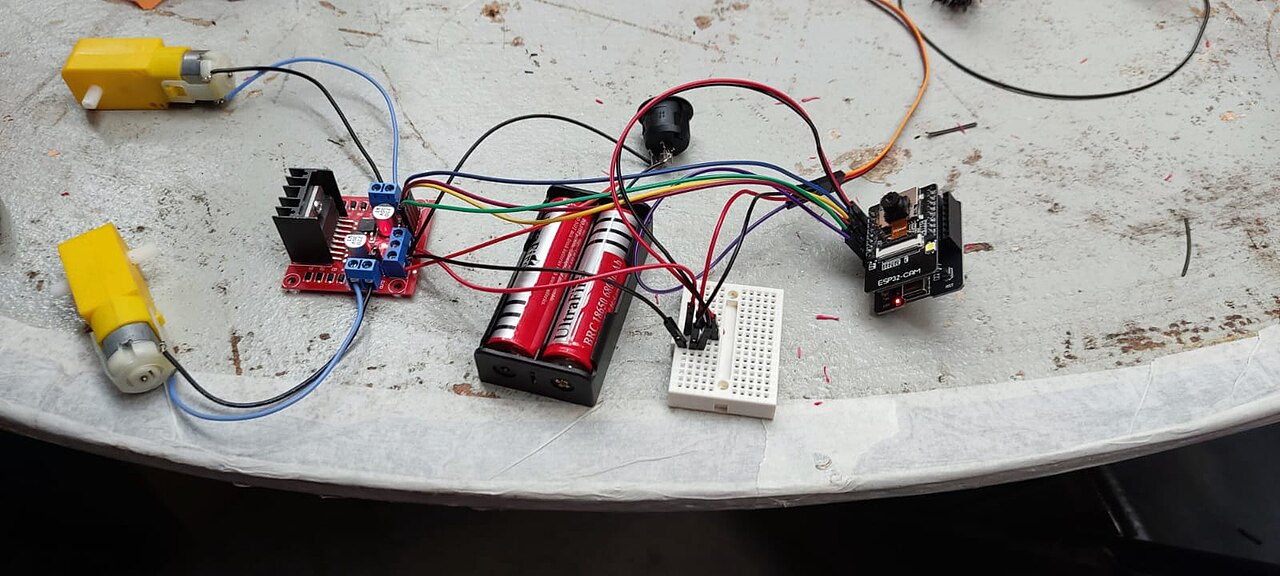
M5Stack has added another handheld-sized controller to its lineup. The Chain Captain (SKU C160) is an ESP32-S3 board with a 1.54-inch colour display, a full audio path, a motion sensor, infrared transmit and receive, a real-time clock and an internal battery. What separates it from the company's other small ESP32-S3 devices is a dedicated Chain port. On that port the Captain acts as bus master for M5Stack's daisy-chainable Chain modules. Every spec below comes from M5Stack's own documentation and store page unless a different source is named.
The core: ESP32-S3R8
M5Stack's documentation lists the processor as an ESP32-S3R8 with an Xtensa LX7 dual-core CPU at 240MHz. Memory is 16MB of flash and 8MB of PSRAM. For wireless, M5Stack's page says only "2.4 GHz Wi-Fi".
That wording matters. CNX Software's write-up lists the radio as "WiFi 4 and Bluetooth 5.0 LE + Mesh". The ESP32-S3 family does include Bluetooth LE, but M5Stack's own page for this product does not mention Bluetooth. Until M5Stack lists it, treat Bluetooth support on the Chain Captain as reported by CNX rather than confirmed by the vendor.
According to CNX Software, you can program the board with the Arduino IDE, UIFlow2 or ESP-IDF.
What is packed around it
For its size, the Chain Captain carries a lot of peripherals. Here is the inventory from M5Stack's documentation:
- Display: 1.54-inch LCD, 240 x 240, JD9853A controller, connected over SPI.
- Audio: ES8311 codec, an analog MEMS microphone, an AW8737A amplifier and a 1W / 8 ohm speaker.
- Motion: BMI270 IMU.
- Timekeeping: RX8130CE RTC.
- Infrared: XL-IRM0038D receiver and MHS153IRCT emitter. The docs give a 6 m figure for the IR link, facing directly.
- User I/O: three user buttons plus a power button, and an RGB LED.
- Power management: M5PM1 and M5IOE1.
- Battery: 3.7V, 800mAh, with 300mA charging.
- Power input: 5V through USB-C, Grove, Chain or the Ext.Port.
M5Stack lists four physical interfaces: USB-C, a Chain port (HY2.0-4P), a Grove port (also HY2.0-4P) and an Ext.Port (2.54mm, 15-pin). The documentation includes a pin map for the Ext.Port, so check it before you plan wiring around it.
The docs give two current figures: 4.2V at 14.39uA in standby and 4.2V at 301.71mA at full load. The enclosure measures 56.0 x 40.0 x 17.0mm and the device weighs 43.9 g.
The Chain bus, explained
The product is named after the Chain port. M5Stack describes the Captain as a Chain Bus master that talks to modules over the Chain port's UART bus. CNX Software describes the topology this way: one master plus several nodes built around the STM32G031G8U6 microcontroller, with each node forwarding data packets hop by hop along the chain.
This differs from the Grove ecosystem, where each sensor usually gets its own I2C address or its own port. On a Chain bus, the nodes are daisy-chained and forward packets to one another, so the master talks to the whole chain over a single UART link. The sources do not give figures for latency or the maximum chain length. Anyone planning a long chain should wait for M5Stack's protocol documentation rather than assume numbers.
CNX Software reports that Chain modules range from $2.80 to $11.50. M5Stack's product page for the Captain does not list which modules are available.
The Captain keeps a standard Grove port next to the Chain port. Existing Grove sensors and actuators can share a project with Chain nodes, and you don't have to pick one ecosystem.
Where it sits
The combination of display, codec, speaker, microphone, IMU and battery puts the Chain Captain in the same general territory as M5Stack's other self-contained ESP32-S3 controllers. M5Stack suggests portable control terminals, smart home controllers, desktop interfaces and portable data acquisition as uses, and you could build a small handheld interface or a sound-event front end with no breadboard needed. The 8MB of PSRAM should give a 240 x 240 framebuffer and audio buffers room to coexist. M5Stack says the RTC supports alarms and interrupt wake-up, and lists a 14.39uA standby figure, which points at battery-powered, wake-on-schedule use.
Built-in IR transmit and receive is less common on boards this size. With a receiver and an emitter in the case, the Captain should be able to capture and send remote-control codes on its own, which suits universal-remote and appliance-automation projects. M5Stack lists infrared remote control as an application.
What It Means for Makers
The Chain Captain is aimed at makers and educators who want a finished, battery-powered ESP32-S3 controller with a screen and audio. It also gives you a direct way into M5Stack's Chain module system. If you already wire an ESP32-S3 dev board to a separate display, audio codec, IMU, RTC, IR LED and receiver, and LiPo charger, this one enclosure replaces all of that. The Chain port is what makes it more than a compact all-in-one: it is a master for daisy-chained STM32G031-based nodes, so you can add modules over one UART port rather than allotting each its own I2C address or port.
Before you commit, note two things. First, M5Stack's page lists only 2.4 GHz Wi-Fi. If your design depends on Bluetooth LE, confirm it, because only CNX Software reports it. Second, the vendor page doesn't publish the module catalogue or bus limits.
Price and availability:
- M5Stack store: the Chain Captain Dev Kit is listed at $35.00 USD and showed "10+ In Stock" when we checked on 22 November 2026, so it is available to order now.
- AliExpress: CNX Software reports the same $35 price there.
- OpenELAB (EU retailer): lists the board as SKU M5-C160 at EUR 47.95 including VAT, as a pre-order. It ships from China within 5–10 working days, and the retailer handles customs and VAT.
The sources do not give a formal launch date.
