
Marlin Firmware 2.1.3 is now a stable release. The MarlinFirmware/Marlin repository published it on GitHub as "Marlin 2.1.3" at 11:07:34 UTC on 26 November 2026. The release is not flagged as a prerelease. The project's own notes open with: "Marlin 2.1.3 has been cooking for a long while and now it's ready!"
Two caveats about this report. We found no independent coverage or third-party testing yet, so everything below comes from the official release notes, the Marlin documentation and the project's web build tool. When we say a feature "is supported", we mean the release notes list it. We have not benchmarked it. Also, the headline motion feature still carries a beta label inside this stable release.
FT Motion: a second motion system, still marked beta
The release notes list FT Motion first among the highlights. It is a "fixed-time motion" system that offers a choice of input shapers and trajectory types, plus smoothing and dynamic frequency. It is enabled with the FT_MOTION configuration option and controlled at runtime with M493 and M494. The notes label it beta. Treat it as an option to evaluate, not a new default.
The official M493 documentation page gives the most practical detail on the feature right now, though the page itself says it is under construction and may be incomplete or out of date. It walks through an input-shaper ringing-tower test. Its example line, M493 S1 XY C2 D0, is commented in the docs as "Enable ZVD Input Shaping". The page also has slicer macros for Kiri:Moto, PrusaSlicer and Cura. These sweep the XY shaping frequency from 15 Hz to 60 Hz using M493 XY A{...} as the tower prints, so you can read the best frequency off the printed part. For CoreXY machines, the docs recommend rotating the Ringing Tower STL by 45 degrees.
Several related motion and extrusion features also appear in the "other new features" list. RESONANCE_TEST runs a sine sweep, which fits the same tuning workflow. The extrusion side gets SMOOTH_LIN_ADVANCE, which the notes describe as removing acceleration limits by building nozzle pressure gradually, and NONLINEAR_EXTRUSION (driven by M592), described as compensation for under-extrusion at high speeds. The notes say little beyond those one-line descriptions, and we will not guess at the internals.
Input shaping reaches Z
Earlier Marlin input shaping worked on the X and Y axes. Version 2.1.3 adds INPUT_SHAPING_Z, which the release notes describe as input shaping now covering the Z axis as well as X and Y. The notes give no tuning guidance or target machine types for it.
CAN bus: groundwork only
CAN support will likely draw the most questions, and the notes are careful about it. They describe "the first stage of CAN support on STM32 boards." In the notes' words, "Marlin can use the CAN port and find Klipper or Katapult nodes. It can't control a CAN toolhead board yet." The options are CAN_BUS and the M960 G-code, which the notes say reports bus status and finds Klipper or Katapult nodes.
That is a narrow capability. On an STM32 board with a CAN port, Marlin 2.1.3 can use the port and find nodes running Klipper or the Katapult bootloader. It cannot yet control a CAN toolhead board, which is the reason most people want CAN. If you plan to run a CAN toolhead under Marlin, this release does not get you there. When we checked, the M960 page on the Marlin documentation site returned a 404. So the release notes are all the public detail we found.
Hardware and peripherals
Prusa's MMU3 multi-material unit is supported through MMU_MODEL PRUSA_MMU3. The notes also list support for the 3D Chameleon Mk4 and the BIQU MicroProbe V1 and V2.
Other hardware-facing additions in the notes:
- Kinematics and extruders:
POLARkinematics andDIFFERENTIAL_EXTRUDER. - Homing and calibration:
PRECISE_Z_HOMING(G28 P),AVOID_OBSTACLES, and least-squares delta calibration viaG33 L. - Thermal:
MPC_PTC,PELTIER_BED,BED_ANNEALING_GCODEandTEMP_SENSOR_SOC. - Drivers and buses: TMC2240 stepper drivers,
RS485_SERIAL_PORT(M485), and an experimentalSERIAL_DMAoption for HC32 and some STM32 targets. - Operation:
SOFT_FEED_HOLD,ONE_CLICK_PRINTandOTA_FIRMWARE_UPDATE(M936).
Displays and languages
The display side gets a lot of work. The notes list new displays from Anycubic, Creality, Elegoo and Sovol, plus PanelDue. DGUS configuration is consolidated under a single DGUS_LCD_UI option with new choices. New UI languages are Hinglish, Indonesian, and French without accents.
The new-board list
The board additions matter most for anyone building a machine rather than reflashing one. The release notes group them by MCU family. The notes name more boards than we list here, so check the full notes for your exact board:
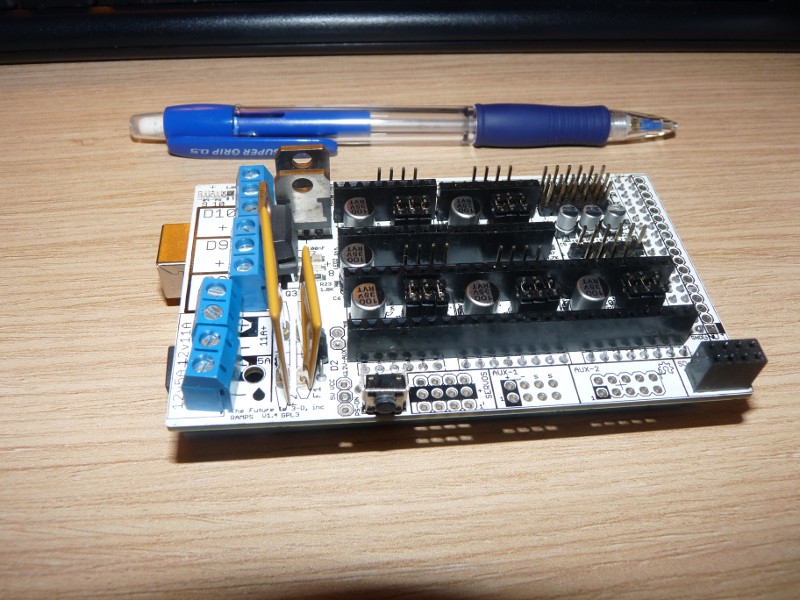
- AVR: includes BigTreeTech RAMPS 1.6+ variants and Creality CR-10 V2/V3 boards.
- STM32 F0/G0: includes BTT SKRat V1.0 and FLY D5, DP5 and D7.
- STM32 F1: new entries listed.
- STM32 F4: includes Mellow Fly E3 V2 and the Creality Ender-3 V3 SE board.
- STM32 H7: BTT Octopus Pro v1.0.1/v1.1, Manta M8P V2.0, Kraken V1.0, Scylla V1.0, and FLY D8 Pro, among others.
- HC32, GD32 (MFL) and AT32: new entries listed for each family.
- ESP32: generic ESP32-S3 and ESP32-S2 targets, MKS DLC32 V2.1, and BTT Rodent.
- Other: BTT SKR Pico 1.x (RP2040), Raspberry Pi Pico, a generic RP2040 test board, and Teensy 4.0.
The generic ESP32-S2, ESP32-S3 and RP2040 entries are the ones to watch if you are building your own controller rather than buying a named one. The notes call the RP2040 entry a "test board" and do not publish pin assignments or peripheral limits for these generic targets. Read the pin files in the source tree before you route anything.
What It Means for Makers
Who it is for: Anyone running Marlin on a 3D printer, laser or CNC who has waited for a stable release with modern motion features. It also suits builders who want to run Marlin on STM32 H7, ESP32-S2/S3 or RP2040 hardware. If you have been running pre-release builds to get these features, you now have a tagged stable release.
What it replaces or enables: FT Motion is a second motion system alongside Marlin's existing planner; the M493 page says it can be enabled and disabled while the machine is running. The notes call it beta, so test it on a calibration print before you trust it on long jobs. The M493 ringing-tower procedure gives you a documented way to do that. Z-axis input shaping and the MMU3 are new. CAN is groundwork only. It can find Klipper or Katapult nodes, but it cannot yet control a CAN toolhead board.
Price and availability: The sources state no price. Marlin 2.1.3 is available now as a published GitHub release. The release notes point to two sources of firmware binaries: the Marlin Firmware Builder web tool and the MarlinBuilds repository's release-2.1.3 branch. The web builder lets you pick a Marlin version and search for your printer. You can then select its example configuration or upload your own config files, and the tool builds firmware for it. Note that the builder's own page says the bugfix-2.1.x branch "has the latest fixes", which can be newer than the 2.1.3 tag.
As usual, back up your current configuration before reflashing. Expect to migrate Configuration.h and Configuration_adv.h rather than reuse old copies as they are. This is especially true if you use DGUS displays, since those options were consolidated.
