
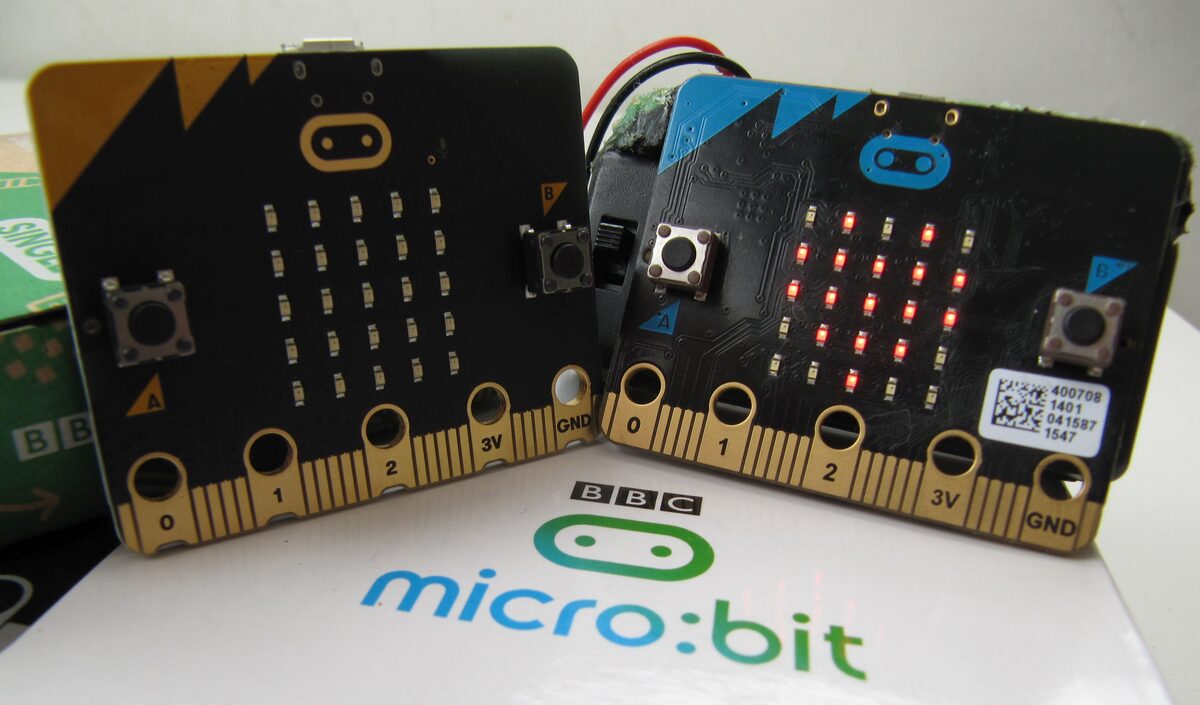
Nordic Semiconductor marked a decade as the wireless silicon supplier for the BBC micro:bit in a press release dated October 13, 2026, from Oslo. The occasion is an anniversary rather than a product launch: no new board, chip or pricing was announced. Alongside it, the Micro:bit Educational Foundation estimates that the micro:bit has helped about 73.5 million young people in more than 85 countries learn coding and digital creativity, and it aims to reach 100 million young people by 2028.
That 73.5 million figure is the Foundation's estimate of young people reached, not a count of boards built or shipped. The hardware figure is smaller: distribution passed 10 million devices in 2024.
Two chips, one supplier
Nordic silicon has powered every micro:bit since 2016, running the child's code, the wireless connection and the board's sensors. Nordic's micro:bit education page lists two generations of that silicon:
| Board | Year | Nordic SoC | Core | Memory |
|---|---|---|---|---|
| micro:bit (original) | 2016 | nRF51822 (Bluetooth LE SoC) | Single 16 MHz Arm Cortex-M0 | — |
| micro:bit V2 | 2020 | nRF52833 (multiprotocol SoC) | 64 MHz Arm Cortex-M4F with FPU and DSP instructions | 512 KB flash, 128 KB RAM |
Nordic was a founding technical partner of the project and supplied the first one million SoCs for the original device. The move to the nRF52833 mattered for more than clock speed: Nordic says the Cortex-M4F's FPU and DSP instructions are what let CreateAI inference run on the V2 within its 128 KB of RAM. CreateAI works with movement data only; the micro:bit does not run computer vision or generative models.
How the decade unfolded
- 2016: The original micro:bit launches on the nRF51822. Up to one million Nordic-powered boards went to UK schoolchildren through the BBC Make it Digital campaign, with the BBC giving a free micro:bit to every year 7 pupil in the UK.
- 2019: 100,000 micro:bits reach Norwegian pupils through the super:bit programme.
- 2020: The micro:bit V2 launches with the nRF52833.
- 2024: The Micro:bit Educational Foundation launches CreateAI.
- 2026: The micro:bit marks ten years.
Nordic followed the announcement by joining Electronic Coast at the Horten Tech Festival in Norway on October 15, two days later, where local pupils and university students could meet Nordic's experts and pitch project ideas using the micro:bit.
What the two CEOs said
The release carries quotes from Nordic CEO Vegard Wollan and Micro:bit Educational Foundation CEO Gareth Stockdale, which Electronic Specifier reproduced on October 13.
"Nordic Semiconductor has been with us from the very beginning," Stockdale said. He pointed to Nordic supplying a million components for the original board as "an extraordinary commitment to a new idea."
Wollan framed the partnership around the developer pipeline. "Interest in technology is often decided early, long before anyone chooses a subject or a career," he said. "Many of tomorrow’s developers will first encounter wireless technology in the classroom with the micro:bit."
What It Means for Makers
Nothing changes for anyone who already owns a board. The anniversary didn't come with a hardware revision, and the micro:bit V2 on the nRF52833 remains the current board.
- Moving past the classroom editors: Nordic's nRF Connect SDK has supported the micro:bit V2 since version 1.9.0, so a V2 can be used with the same SDK as Nordic's other development hardware.
- On-device ML: CreateAI depends on the V2's FPU and DSP instructions, so plan on a V2 for CreateAI projects, and expect motion-based models rather than vision or generative ones.
- Original vs V2: Projects written for the V2 shouldn't be assumed to fit the original Cortex-M0 board. Check which generation a lesson or library targets before handing out older boards.
- Who it's for: Teachers and education programmes remain the main audience, and the Foundation's 2028 target points to continued classroom rollouts.
No pricing was announced. The Micro:bit Educational Foundation sells the device and publishes classroom resources, lesson plans and teacher training.
Sources
- Nordic Semiconductor: Nordic Semiconductor celebrates 10 years at the heart of the BBC micro:bit as global coding reach passes 73 million young people (October 13, 2026)
- Nordic Semiconductor: Nordic at the heart of micro:bit
- Electronic Specifier: Nordic Semiconductor celebrates 10 years at the heart of the BBC micro:bit (October 13, 2026)
