
On a 64-bit RISC-V Linux board, pip install has often meant waiting while a compiler builds the package from source. That is changing. On 18 November 2026 the RISC-V Software Ecosystem project (RISE) published a progress report. It says 1,506 of the 2,076 native-code packages among the 15,000 most-downloaded projects on PyPI now have a riscv64 wheel, either on PyPI itself or on RISE's own package index. NumPy, SciPy, pandas, cryptography, PyArrow, PyTorch and vLLM are all on the list.
The report, "Python on RISC-V: 1500 Packages and Counting," was written by Ludovic Henry of Qualcomm and posted on the RISE blog. It comes three months after CPython itself added RISC-V to its official platform list. Together the two changes cover both the interpreter and the compiled libraries people actually install on top of it.
The numbers, tier by tier
RISE's dashboard divides the native-code packages by download rank. It counts how many have a riscv64 wheel on PyPI, how many have one only in the RISE index, how many are listed as pure Python, and how many have no wheel yet. The figures below are copied from RISE's table as of 18 November 2026:
| Slice of PyPI | riscv64 wheel on PyPI | riscv64 wheel in RISE index | Pure Python | Missing |
|---|---|---|---|---|
| Top 100 | 38 | 54 | 3 | 5 |
| Top 500 | 75 | 363 | 12 | 50 |
| Top 1,000 | 92 | 750 | 25 | 133 |
| All 2,076 native packages (top 15,000) | 117 | 1,389 | 51 | 519 |
Adding the first two columns gives the headline figure: 117 + 1,389 = 1,506 packages with a prebuilt riscv64 wheel, about 72.5 percent of the native-code set. Coverage is better at the top of the rankings. Wheels exist for 92 of the top 100 native packages and 842 of the top 1,000. The rows also show where the work has been done. Only 117 packages publish riscv64 wheels upstream on PyPI, and the other 1,389 come from RISE's own build effort. For most packages, then, a RISC-V user still has to point pip at a second index.
These are RISE's own numbers. PinoutFeed found no independent analysis of the dashboard to compare them against. RISE describes the "pure Python" and "missing" columns only as table categories, so treat the 519 "missing" figure as RISE's count, not an outside audit.
How the wheels are built and served
RISE created the riseproject-dev/python-wheels repository in June 2026. According to the project, it holds the build workflows, package metadata, patches and the source for the package index. The finished wheels are stored in immutable GitHub Releases, each with a SHA-256 digest, so a published artifact cannot be swapped out quietly afterwards.
The RISE post gives this install command for PyTorch:
pip install torch --extra-index-url https://pypi.riseproject.dev/simple --prefer-binaryThe --extra-index-url flag adds RISE's index alongside PyPI. --prefer-binary tells pip to choose a prebuilt wheel over a newer source distribution, which on RISC-V is the difference between a quick install and a long build.
PyTorch and vLLM
The two most notable entries are PyTorch and vLLM. RISE says it built torch 2.13.0 wheels for CPython 3.12, 3.13 and 3.14, plus the free-threaded build of 3.14. The wheels were built on native RISC-V hardware, not cross-compiled, and RISE reports running 212,038 test cases against them.
For vLLM, RISE reports that a CPU build, 0.29.0+cpu, was merged on 21 September and that 0.30.0 followed on 24 September. The "+cpu" suffix matters: these are CPU-only builds, and the post makes no claim of GPU or NPU acceleration on RISC-V.
CPython made it official first
The package work builds on a change to the interpreter. In August 2026 the Python Insider blog announced that "RISC-V is now officially supported by CPython" as a Tier 3 platform. PEP 11, which defines CPython's platform tiers, now lists riscv64-unknown-linux-gnu (glibc, with both clang and gcc) as a Tier 3 target. Stan Ulbrych and Emma Smith are named as its supporters and contacts.
Tier 3 is the lowest official support tier, and the details are in PEP 11. In practice it means core developers are named for the platform and buildbots exist for it. It does not mean every CPython release is blocked on RISC-V test results. The Python Insider post thanks RISE for donating several RISC-V machines for those buildbots. The author also credits a Sovereign Tech Agency fellowship for funding the work, and says the RISC-V ecosystem is projected to quadruple in size by 2032.
What It Means for Makers
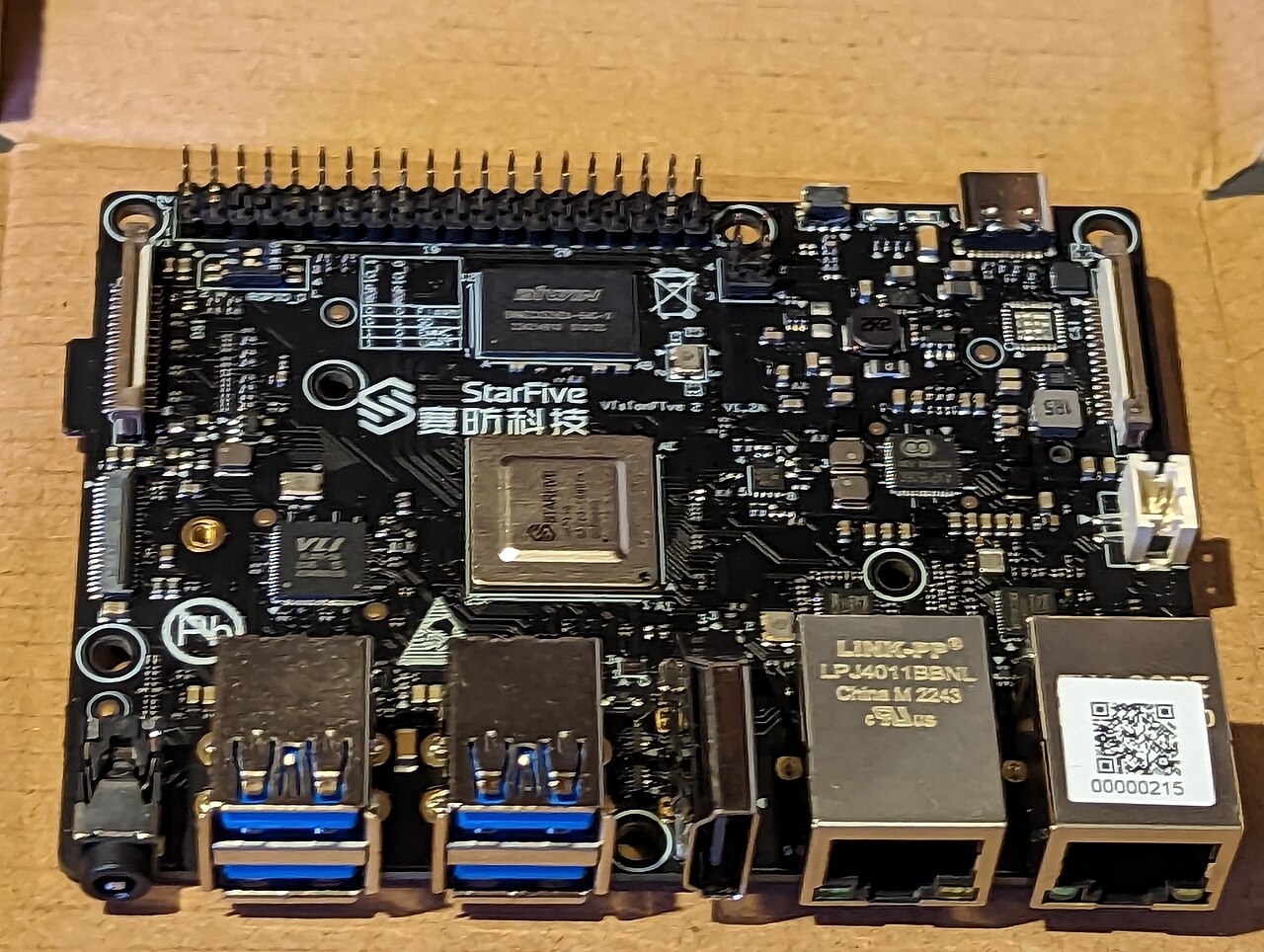
The audience here is anyone running 64-bit Linux on a RISC-V single-board computer and using Python for more than scripting: data logging, computer vision, local inference, or teaching with the usual scientific stack. RISE's own example shows the gap. On a StarFive VisionFive 2, building NumPy from source took about 15 minutes, compared with about 25 seconds to install the prebuilt wheel. When a project pulls in a dozen compiled dependencies, those minutes add up quickly.
Prebuilt wheels remove that step for most of the popular packages. A requirements.txt written on an x86 laptop now has a reasonable chance of installing on a RISC-V board without changes, apart from the extra index flag. PyTorch and the CPU build of vLLM make RISC-V boards a possible, if modest, target for experimenting with on-device models. The RISE post I read gives no inference benchmarks, so it is too early to say how they perform.
Some caveats:
- Most wheels are not on PyPI. 1,389 of the 1,506 come from RISE's index, so you need the
--extra-index-urlline, and you are relying on RISE's build and publication process instead of each package's upstream maintainers. The SHA-256 digests and immutable releases help, but this is a separate supply chain. - About 25 percent still lacks wheels. RISE counts 519 of the 2,076 native packages as missing (25.0 percent), and lists another 51 as pure Python. Five packages in the top 100 still have no wheel.
- The target is glibc Linux. PEP 11 lists
riscv64-unknown-linux-gnu. None of this applies to microcontroller-class RISC-V parts running MicroPython or bare-metal firmware. - Tier 3 is the lowest support level. It is real upstream support, but it gives fewer guarantees than the mainstream platforms.
Price and availability: RISE's index is publicly reachable now, and the build sources are in a public GitHub repository. None of the sources list a price or subscription for the index. The status is shipping: the wheels can be installed today. The RISE post does not give board prices, and PinoutFeed is not quoting any.
A note on sourcing: everything in this article comes from RISE's own write-up and repository, the Python Insider announcement and PEP 11. We found no independent outlet coverage we could read to check RISE's figures, so the coverage percentages above are the project's self-reported numbers.
