
The stm32duino project released Arduino Core for STM32 3.1.0 on GitHub on 12 November 2026 at 16:17 UTC. The release came three days after CNX Software reported on Seeed Studio's XIAO STM32C5 on 9 November. Seeed calls that board its first STM32-powered XIAO, and the new core gives it Arduino support straight away. The release also does more for the STM32C5 family in general. It adds generic STM32H5E/F support, fills out the H5 and C0 board lists, and fixes several peripheral bugs that users of older parts will want.
This article covers the release itself first, then the board that explains its timing.
What's in 3.1.0
STM32C5 bring-up
Most of the new code is for the STM32C5 series. The release notes list these changes:
- Seeed XIAO STM32C5 board support (PR 3048, tagged
feat(xiao)). - USB device support on the STM32C5 HAL v2 (PR 3059).
- UART reset and IRQ handling for the C5 HAL v2 (PR 3060).
- A 48 MHz clock source configuration for C5 (PR 3077,
feat(c5)). - Generic C593 and C5A3 boards (PR 3111).
Two of the PR titles (USB and UART) refer to "HAL v2", ST's second-generation HAL for the C5 series. USB device mode and UART interrupt handling are the two features most sketches need first, for serial-over-USB debugging and for talking to other hardware. The generic C5A3 entry also matters on its own: anyone building a custom board around the same MCU as the XIAO can now target it with a generic entry rather than Seeed's variant.
STM32H5 and C0 additions
Outside the C5 series, 3.1.0 adds:
- STM32H5E/F support (PR 3090).
- Generic H523R(C-E)T and C533RET variants and the Nucleo-H533RE (PR 3069).
- Generic C031K4/K6 (PR 3091), for the small STM32C0 parts.
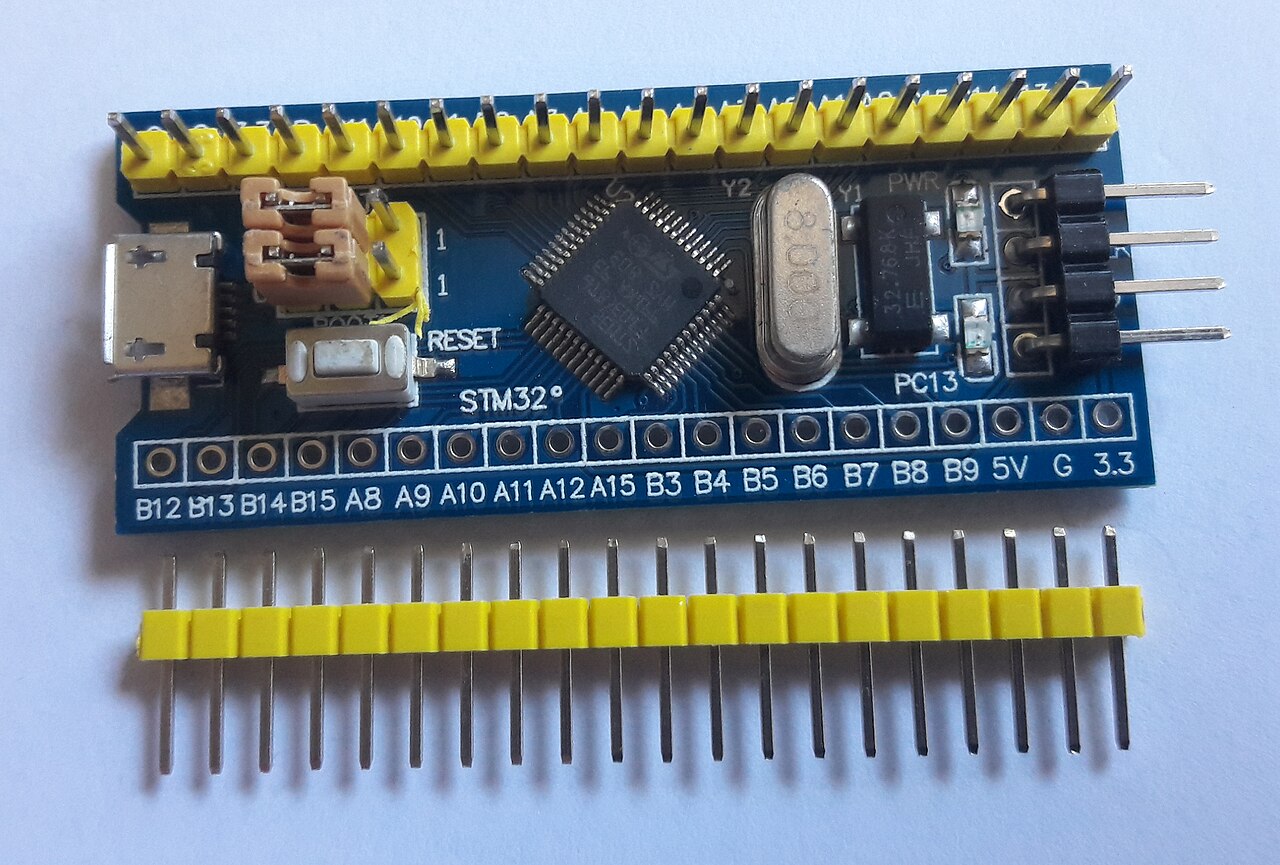
- A WeAct F411 variant using an 8 MHz HSE (PR 3035).
- Phoque1 and Phoque2 variants, which the release notes describe as brushless driver variants.
Bug fixes
Some of the fixes affect behaviour on parts that were already supported:
- SPI: init was never called at
begin()(PR 3049). - I2C: a condition check was corrected (PR 3044).
- USB CDC: the core no longer arms the OUT endpoint with a NULL buffer (PR 3058).
- UART:
Uart::write()no longer spins whenbegin()has failed (PR 3074). The fix title says write() must not spin when begin() failed, so a failed init no longer leaves the program stuck in a write call. - Unique ID: the
DEVICE_ID3value on STM32L0/L1 was fixed (PR 3083).
The SPI and CDC fixes are worth noting for anyone who has added a manual SPI init or a CDC workaround to an existing project. After upgrading, check whether that workaround is still needed.
Middleware, Cube packages and docs
The release moves stm32-mw-usb_device to v2.11.6 and updates STM32CubeF0 and STM32CubeF3 to v1.12.0. It adds an api/itoa.h header. On the documentation side, the project now has gh-pages docs, a Doxygen API reference and documentation for the Arduino IDE Tools menu options. The release also clarifies the license scope and third-party attributions. The notes list seven first-time contributors, one of them the dependabot bot, and link to the full 3.0.0...3.1.0 changelog.
The board behind the timing: XIAO STM32C5
According to Seeed's getting-started wiki, the XIAO STM32C5 uses an STM32C5A3CG, a 144 MHz Arm Cortex-M33 with FPU and DSP instructions. Seeed lists these features:
- Two native CAN FD controllers. One connects to an onboard TCAN3403-Q1 transceiver with CANH/CANL pads. The second needs an external transceiver.
- 16 MB of external flash.
- An LSM6DS3TR-C 6-axis IMU with GPIO-controlled heating resistors, used for warm-up and closed-loop temperature regulation.
- USB-C with onboard battery charging, plus an onboard charging circuit for a compatible lithium battery on the BAT pads.
CNX Software adds memory and clock details: 256 KB SRAM, 1 MB internal flash, a 48 MHz external crystal and USB 2.0 Full-Speed (12 Mbps). It also says which CAN controller has the transceiver. Seeed's wiki also puts the TCAN3403-Q1 on FDCAN2, and its 120 ohm termination is enabled by default through a solder link. This matters on a real bus, because a node placed mid-bus needs that termination disconnected. CNX describes the IMU heater as PWM-controlled. Seeed's wiki describes it as GPIO-controlled, and the two descriptions are compatible.
PR 3077 configures a 48 MHz clock source for C5, which fits the 48 MHz crystal CNX reports on the XIAO board, though the release notes do not say the two are linked.
Zephyr support, and a disagreement over the IMU
The Zephyr Project board page already lists the board as xiao_stm32c5 on SoC stm32c5a3xx, with its status shown as "Not actively maintained". Zephyr's description mostly agrees with Seeed's:
- STM32C5A3CG in a UFQFPN48 package: Cortex-M33 with FPU, up to 144 MHz, 256 KB SRAM and 1 MB flash.
- A 16-pin castellated connector exposing UART, I2C, SPI, ADC and two FDCAN buses.
- 16 MB Puya PY25Q128HA NOR flash on XSPI1.
- USB-C for power, a TinyUF2 bootloader and CDC-ACM serial.
The IMU is where the two sources differ. Zephyr's page says the board has an LSM6DSL. Seeed's wiki and CNX Software both say LSM6DS3TR-C. PinoutFeed treats Seeed's own documentation as authoritative and recommends that Zephyr users verify which IMU is fitted before relying on a driver binding. This is a documentation mismatch to be aware of, and the sources give no indication of a hardware revision.
What It Means for Makers
Who it is for. The main audience is Arduino users who want a small board with CAN FD, either for automotive and robotics bus work or as a cheap way to start with FDCAN. With 3.1.0, the XIAO STM32C5 works in the same IDE and toolchain that STM32 Arduino users already have, with USB serial and working UART interrupts. Engineers building their own C5A3 or C593 boards may also benefit, because the generic board entries should save writing a variant first.
What it replaces or enables. The XIAO STM32C5 has two FDCAN controllers on the MCU, and one already has a transceiver. The release adds the board definition, a 48 MHz clock source configuration and USB device support for the C5. However, none of the sources says whether the core's own CAN FD support is part of this release, so test it yourself before planning around it. The SPI, I2C, CDC and UART fixes help existing STM32 Arduino users on every supported family, and owners of WeAct F411 boards with an 8 MHz crystal now have a matching variant.
Price and availability. Arduino Core for STM32 3.1.0 is available now as a tagged release on GitHub. CNX Software's 9 November report lists the XIAO STM32C5 at $9.90 on the Seeed Studio store ($10.90 for the pre-soldered version), and notes AliExpress listings at higher prices. Those are CNX's figures as of its report; check Seeed's own store listing for the current price. Zephyr support exists, but its board page currently lists the board as "Not actively maintained".
