
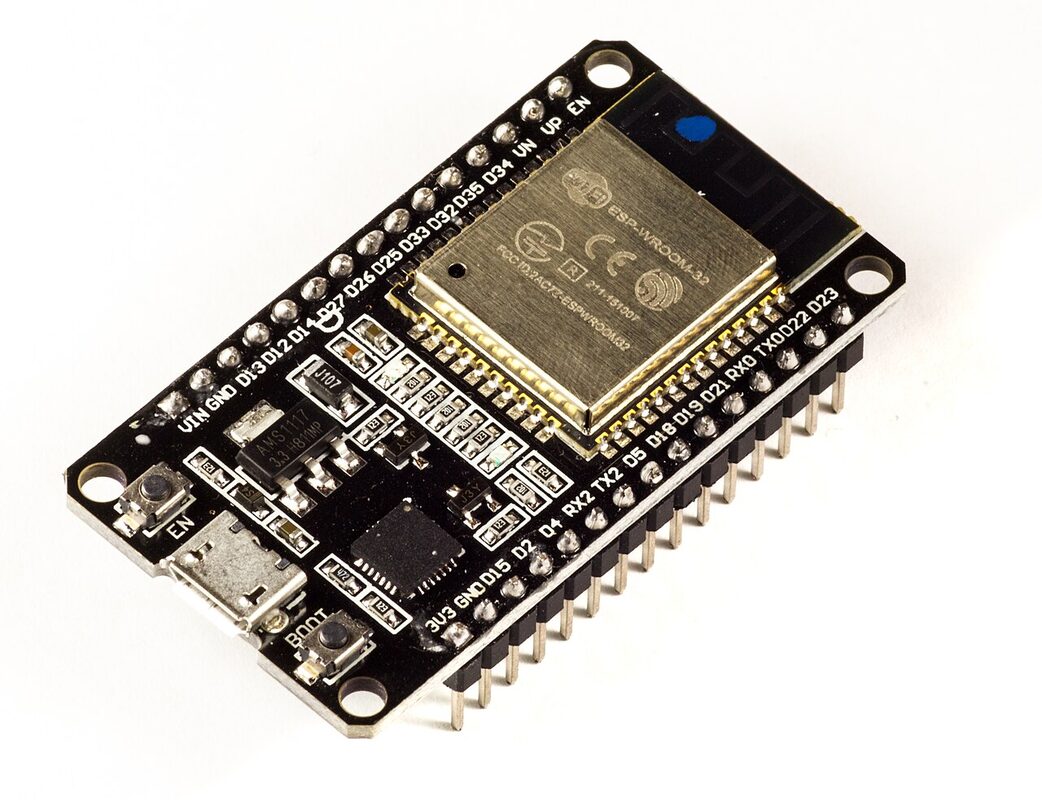
Espressif published ESP-IDF v6.1.1 on GitHub on 16 November 2026 (09:06 UTC) and calls it "a bugfix release for ESP-IDF v6.1". A point release in a stable branch normally means you can pull it without reading the notes. This one you can't. It has a breaking-changes section covering the HTTP server, the BLE Audio and BLE ISO APIs, and hardware security support on three chips. It also changes the default security behaviour of the HTTPS OTA component, the code that decides where your devices get their firmware.
Below is what changed, grouped by what you'd have to check before you move a v6.1 project to v6.1.1.
1. OTA: plain HTTP is now refused by default
The release notes put it in one line: esp_https_ota "now rejects plain HTTP unless HTTP downloads are explicitly enabled." The v6.1.1 HTTPS OTA documentation spells out how that works. Unless CONFIG_ESP_HTTPS_OTA_ALLOW_HTTP is enabled, an unset transport_type in the http_config structure is set to HTTP_TRANSPORT_OVER_SSL. An http:// URL or redirect target then fails. Setting transport_type to anything other than HTTP_TRANSPORT_OVER_SSL is rejected with ESP_ERR_INVALID_ARG.
The redirect case is the one most likely to surprise people. A firmware server that answers on HTTPS but redirects to a plain-HTTP mirror or CDN path will now fail the update. Before, it may have quietly downloaded the image unencrypted.
Two more points from the docs. First, a custom transport supplied in http_config "is used as is", so its security is up to the application. The new check doesn't vet it. Second, the API is blocking: setting is_async in http_config results in an error.
The way back is a Kconfig switch, and Espressif's own label leaves no doubt about how it should be used. In the v6.1.1 Configuration Options Reference, CONFIG_ESP_HTTPS_OTA_ALLOW_HTTP appears under Component config > ESP HTTPS OTA as "Allow HTTP for OTA (WARNING: ONLY FOR TESTING PURPOSE, READ HELP)". The help text says it is highly recommended to keep HTTPS with server certificate validation enabled. It warns that the option means a non-encrypted communication channel and accepting a firmware upgrade image from a server with a fake identity. Nearby options in the same menu are CONFIG_ESP_HTTPS_OTA_ENABLE_PARTIAL_DOWNLOAD, CONFIG_ESP_HTTPS_OTA_DECRYPT_CB and CONFIG_ESP_HTTPS_OTA_VERIFY_SPI_MODE.
Checklist item: grep your OTA code and server configuration for http://, including redirect chains. If a bench setup depends on a local plain-HTTP server, either move it to HTTPS or turn on the test-only option in a build configuration that can't ship.
2. HTTP server: Content-Length fix and a body-size cap
The HTTP server change is listed under breaking changes. The release notes say the server fixes Content-Length truncation to prevent HTTP request smuggling, and adds a Kconfig option, HTTPD_MAX_REQ_BODY_LEN_KB, with a default of 16 MB, to cap the accepted body size. A device that accepts large uploads through esp_http_server (a web-based firmware upload page, for example, or a file-transfer endpoint) needs its expected body sizes checked against the new ceiling.
One caveat. PinoutFeed couldn't find the HTTPD_MAX_REQ_BODY_LEN_KB symbol on the v6.1.1 Kconfig reference page, so we're reporting the option name and its 16 MB default only as the GitHub release notes give them. Check the name in your own menuconfig before scripting against it.
3. BLE Audio and BLE ISO: signatures and byte order change
The Bluetooth LE changes need the most hands-on work. From the release notes:
esp_ble_audio_tmap_set_role()andesp_ble_audio_tbs_register_cb()now returnesp_err_tinstead of void. The notes say calls that ignore the return value need no change.esp_ble_audio_bap_base_get_subgroup_codec_data()andesp_ble_audio_bap_base_get_subgroup_codec_meta()take an extra out parameter for the length.- BLE ISO and BLE Audio addresses are now unified to LSB-first order. The notes say applications using the Bluedroid host must update application-level address conversions when passing addresses between BLE ISO/BLE Audio and native Bluedroid APIs, which use MSB-first order.
esp_ble_iso_tx_cb_info_tnow reports per SDU, withsdu[],framingandversionfields, instead of per packet. Thecompleted_pkts,not_txd_pkts,pkt_cntandpkt[]members are removed. Applications that don't readuser_datain the sent callbacks are not affected.
The struct changes and new out parameters should break the build for code that uses them, so the compiler will catch those. The address byte-order change is different. Code that copies or prints a Bluetooth address in the old order will still compile, and you may find the problem later as failed connections or mismatched peers. If you build LE Audio or isochronous-channel products on Bluedroid, check every place an address crosses between the BLE Audio/ISO APIs and the native Bluedroid APIs.
4. Key Manager removed on ESP32-C5, ESP32-P4 and ESP32-S31
The release notes say Key Manager support is removed on ESP32-C5, ESP32-P4 and ESP32-S31 "as the hardware peripheral needs further design changes before it can be offered as a production feature." The notes don't describe a replacement or give a date for bringing it back. If your security design on any of those three chips relied on the Key Manager, this changes the design, not just a function call. Raise it with whoever owns your threat model before you upgrade.
Other security work in the release is listed under security vulnerability fixes. REE-supplied secure service arguments (REE is the non-secure Rich Execution Environment) are now snapshotted in TEE memory before execution. Wi-Fi supplicant security issues have been ported from upstream. The notes don't list individual vulnerabilities for either item.
5. ESP32-P4: two boot fixes
ESP32-P4 users get two fixes that may already have cost someone a day of debugging:
- ESP32-P4 v3.x applications using PSRAM XIP could fail to boot, resetting repeatedly with
CHIP_LP_WDT_RESET, when the bootloader had been built with ESP-IDF v5.5.2 to v5.5.4. That points to a mix of an older bootloader and a newer application, which matters for field devices, where the bootloader often isn't updated along with the app. - Boot problems caused by stale flash data remaining in L1 cache after bootloader remapping are fixed. The notes mention failures during
esp_mmu_map_initandpmu_init.
6. 802.15.4 EUI-64 byte order on ESP32-C5 and ESP32-H21
The last breaking change: the byte order of MAC_EXT is fixed on ESP32-C5 and ESP32-H21 to ensure a proper IEEE 802.15.4 EUI-64 format. The release notes don't say how existing devices are affected. If you build Thread or Zigbee devices on either chip, check whether your commissioning records or allow-lists store EUI-64 values in the old order.
The small additions
The release also lists two enhancements. The image signal processor (ISP) can now take RAW image input from memory, allowing it to process images without a sensor interface, which could help with offline processing or testing a pipeline without a camera attached. The RGB_LCD driver can now draw bitmaps on RGB LCD panels using DMA2D.
On tooling: four days before this release, on 12 November 2026, Espressif's developer blog announced that Espressif-IDE v4.5.0 is the Eclipse-based IDE's final feature release. It adds support for Eclipse 2026-09 and Java 25, then enters maintenance until 14 October 2027. Espressif recommends that new projects use the ESP-IDF extension for VS Code.
What It Means for Makers
Anyone on the v6.1 branch should take v6.1.1, but plan for it. It's not a drop-in update. Hobbyists running OTA from a Raspberry Pi or laptop over plain HTTP will find updates failing until they switch to HTTPS or enable an option Espressif labels "ONLY FOR TESTING PURPOSE". Product teams get a stricter OTA default, plus an HTTP server fix for request smuggling. People building BLE Audio on Bluedroid have API and byte-order changes to work through. ESP32-P4 developers get fixes for real boot failures. Developers on ESP32-C5, ESP32-P4 or ESP32-S31 who planned around the Key Manager need a new plan.
Status and availability: v6.1.1 is a published release, out now as of 16 November 2026. The release notes give two install routes: the ESP-IDF Installation Manager (eim install -i v6.1.1) or a recursive git clone of the v6.1.1 tag. The sources don't list a price. The GitHub release links a full changelog on Espressif's release-notes site, but we didn't read that page, so this article covers only what the GitHub release page itself says.
