
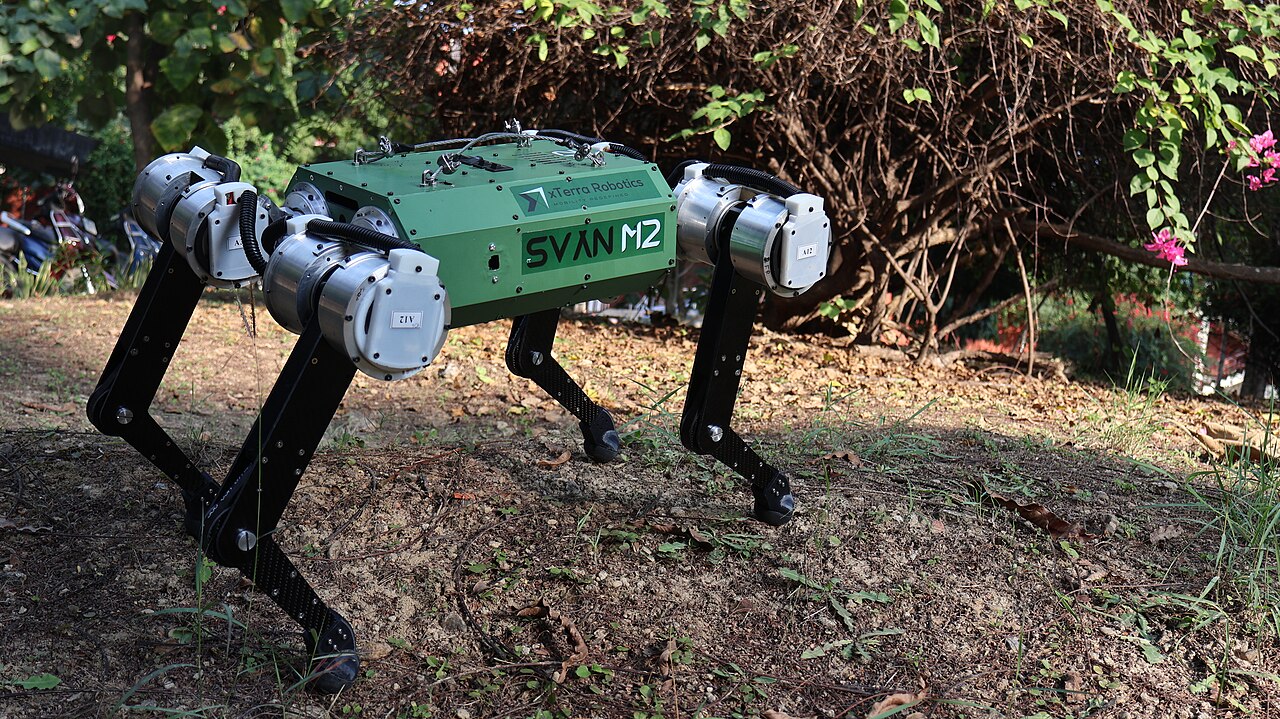
Hobby quadrupeds tend to come in two kinds. Some are cheap and run open-loop, so the controller sends a servo a position and has no way of knowing whether the leg got there. The others use smart serial servos that report their position, and those cost several times as much per joint. The TNY-360 from TNY Robotics sits between the two. It takes the inexpensive MG996R hobby servo and adds position feedback with a small circuit, so the legs close the loop. The maker has now opened preorders for a second-generation version, the TNY-360 V2, in three kit tiers.
This article covers what the sources confirm about V2, what is still missing, and one licensing detail that buyers who care about "open source" should check first.
What is actually on sale
The TNY-360 V2 product page is in French. It describes the robot as an open-source robot dog you can build, repair, modify and program. Three kits are listed at launch:
- BareBones, EUR 289: you print the structural parts yourself. The kit includes what the maker calls the full PCB ecosystem, its custom motors, and the screws, cables and components.
- Maker, EUR 399: adds what the page describes as solid, lightweight mechanical parts. The maker labels this tier its best offer.
- Ready2Run, EUR 599: arrives assembled and calibrated. The page marks it "bientôt disponible" (coming soon), so it may not be orderable yet even though it has a price.
The product page says the TNY-360 is available for preorder and suggests ordering now to have it before the holidays. The repository banner is more specific: it says the V2 kits are in preorder, shipping early December. That is the maker's stated date. No independent shipping confirmation exists yet, and the kits should be treated as unshipped preorders.
How the servo trick works
The project's founding idea is explained on the Hackaday.io project page, which Paul Loisil created on 18 February 2026. He describes the TNY-360 as a fully open-source, 12-DOF platform built on the ESP32-S3.
Every hobby servo already has a potentiometer inside that its own control circuit uses to find the output shaft's position. The TNY-360 reads that potentiometer directly. Loisil's write-up says he modifies $5 digital MG996R servos with a micro-PCB carrying an op-amp voltage buffer, and adds a software low-pass filter on the controller side. According to the project page, this gives clean 200 Hz position polling across all 12 joints.
Loisil explains that reading the potentiometer directly draws current and destabilizes the servo's internal control loop, and that the long wires pick up motor interference. The buffer gives the servo a high-impedance load and sends a low-impedance signal down the cable. The low-pass filter handles the remaining noise. The sources do not give ADC resolution, filter constants or measured positional accuracy, so we cannot say how good the feedback is. The architecture, though, is clear. The GitHub README confirms that the 12 MG996R servos must be modified for analog feedback. Stock servos will not do.
The hardware, as the repository lists it
The spec list in the official GitHub repository is the most detailed one available. It is also the version-one list (see the next section). As written in the README:
- MCU: ESP32-S3 N16R8 module
- Power: 3S LiPo battery built from 6x Samsung INR18650-25R cells, with an INA219 voltage and current monitor
- Leg actuators: 12x MG996R servos, modified for analog feedback
- Ear actuators: 2x SG90/MG90D micro servos
- Servo driver: PCA9685 16-channel PWM driver
- Camera: OV2640
- Ranging: VL53L0X time-of-flight sensor
- IMU: MPU6050 or LSM6DS3 6-axis
- Display: SH1106/SSD1306 128x64 OLED
- Audio: I2S MEMS microphone and speaker
The Hackaday page says the electronics are split into modular Brain, Sensor, Motor and Power PCBs, joined by JST-PH cables. The V2 product page also mentions JST-PH connectors, along with clip-on armor, a dorsal expansion port, a face display, motorized ears, a speaker, a microphone and a camera.
The firmware is C++ on ESP-IDF, built with PlatformIO. The README says the work is split across the S3's two cores. Core 1, called "Reflex," runs the 200 Hz kinematics and control loop, and Core 0, called "Brain," handles WebSockets, the user interface and orchestration. The product page describes this as a dual-core architecture running a 200 Hz inverse-kinematics loop and says most hobby robots refresh at about 50 Hz. That comparison is the maker's own claim. The sources include no benchmark data behind it.
What is still missing
The banner at the top of the repository says the V2 kits are in preorder for early-December shipping and that the repo "will be updated with V2 files in a couple of days." When we checked, the BOM, CAD and PCB entries were still marked "coming soon" for V2. The spec list above therefore describes the earlier design, and some parts may change in the V2 kits. Anyone who needs the exact V2 bill of materials, or wants to build BareBones parts from published CAD, will have to wait for those files to appear.
The repository showed 365 stars, 28 forks and 215 commits when we checked. That is real activity for a small hardware project, though the community is still modest. The Hackaday.io page showed 470 views and 6 followers and listed its last update as seven months ago, so the GitHub repository is the more current of the two sources.
"100% open source" and the license
The product page says the mechanics, electronics, firmware and software are all in the maker's GitHub repositories, and calls the project 100% open source. The repository's license is CC BY-NC-SA 4.0. That is a Creative Commons license with a NonCommercial clause, which means it does not meet the usual open-source definitions such as the OSI's, or the OSHWA definition for hardware. The README says you are free to share and adapt the material for non-commercial purposes, with attribution and share-alike. In practice that means you cannot sell derivatives, such as your own kits or printed part sets, without separate permission. For hobbyists and classrooms this rarely matters. For anyone who planned to build a product on the platform, it decides the question.
Software and programming
According to the product page, the robot can be driven from a gamepad or phone, programmed with graphical blocks in the maker's apps, scripted through Python or JS/TS SDKs, or integrated with ROS 2. The README names the block-based web app TNY-Coder. The page also describes an autonomous behavior tree, with which you choose how independent the robot is, and active safeguards meant to prevent falls.
What It Means for Makers
The TNY-360 is aimed at makers who want a quadruped they can take apart and understand, and who find open-loop servo walkers too limited. The main thing it offers is closed-loop joint feedback on cheap commodity servos. It is not a replacement for research-grade quadrupeds with brushless actuators. It is a way to experiment with gait, inverse kinematics and sensor fusion in C++ on ESP-IDF, or at a higher level through Python, JS/TS or ROS 2, on hardware that costs less to repair when a servo strips.
For educators, the block app and the onboard camera, ToF sensor, IMU, microphone and display make it a reasonably complete platform for teaching. For firmware developers, the documented split between the Reflex and Brain cores is a useful reference design in its own right.
Pricing at launch, according to the maker's product page, is EUR 289 for BareBones (print your own parts), EUR 399 for Maker and EUR 599 for the assembled Ready2Run, which is marked as coming soon. All three are preorders, and the repository says shipping starts in early December. Before you order, keep two caveats in mind. The V2 BOM, CAD and PCB files are not public yet, and the published specs are from V1. The license is also non-commercial, despite the open-source marketing.
