
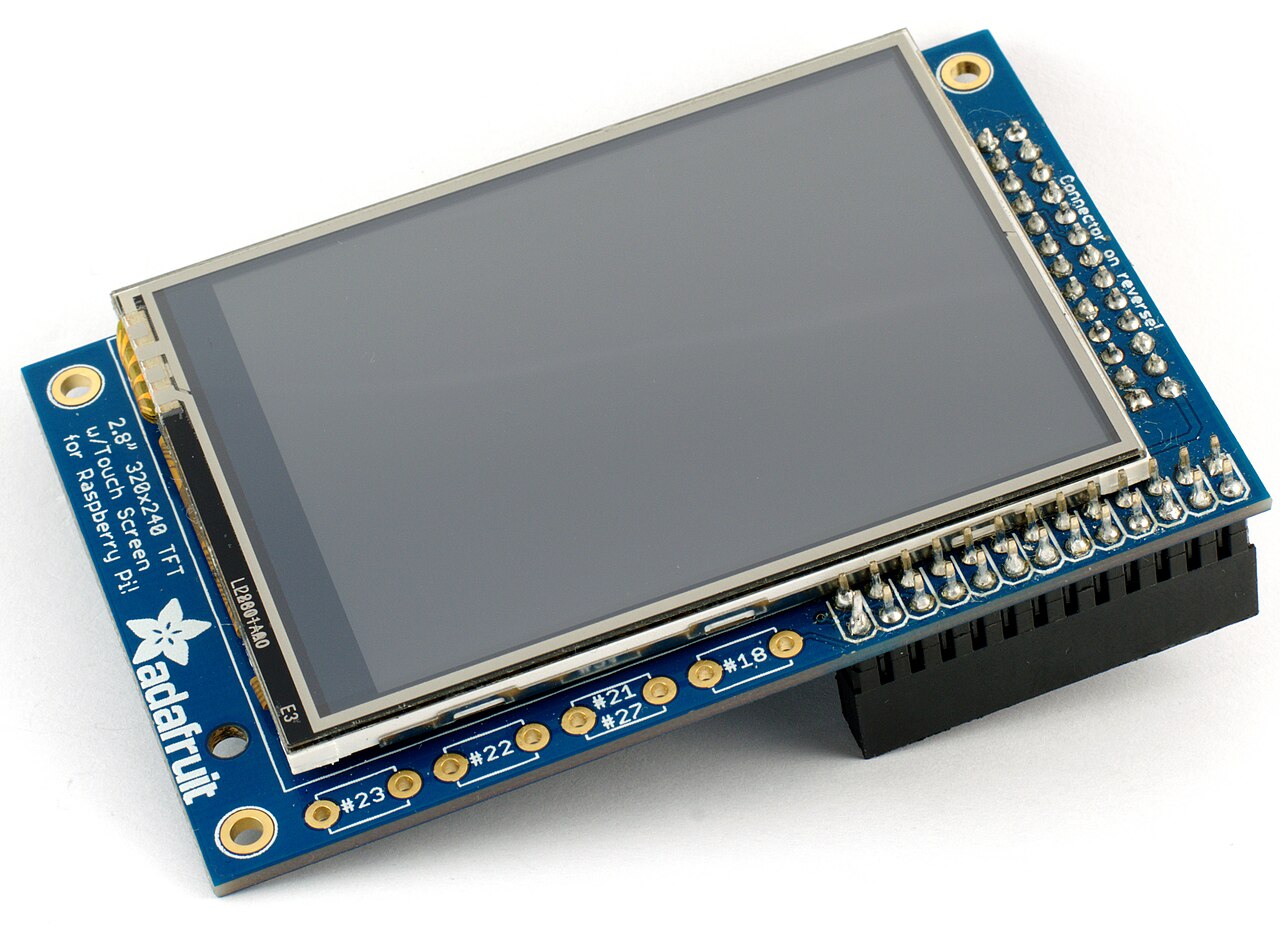
Adafruit has listed the Fruit Jam Touch Deck (product 6562). Adafruit describes it as the first add-on attachment designed to fit its Fruit Jam board. The Deck is a fully assembled 2.8-inch resistive touchscreen module that plugs into the 32-pin block header on the Fruit Jam. This one also comes with a short design confession. The first revision was made with a button on a pin the Fruit Jam can't use while WiFi is active, so Adafruit is selling Rev A on clearance until the batch sells out, after which it says it will revise the board to use different pins.
A note on timing first. The Adafruit product page has no launch or release date. We found the Deck in Adafruit's New Products listing, and this article is based on the product page as we fetched it on 28 November 2026. We couldn't read the Adafruit blog post or the Hackster coverage, so everything below comes from Adafruit's own product page, Texas Instruments' page for the touch controller and Adafruit's GitHub repository for the Fruit Jam host board.
What's on the board
Here is the spec block as Adafruit's product page states it:
- Display: 2.8-inch TFT, 320x240, RGB colour
- Display controller: ILI9341 chipset, SPI interface
- Touch: resistive touchscreen with a TSC2007 I2C controller
- Buttons: UF2 and Reset
- Connection: plugs into the 32-pin block header on the Fruit Jam
- Dimensions: 85.8mm x 55.0mm x 14.3mm
- Weight: 42.9g
- Build: fully assembled
Adafruit's page doesn't list a refresh rate, backlight current, touch resolution or a pin-by-pin map of the header, and we haven't added any. If your design depends on any of those, check the Deck's documentation once Adafruit publishes it.
Why the interface choice matters
The useful detail is how the Deck connects. Adafruit says it uses the Fruit Jam's onboard SPI port for the display and I2C for touch, "so you can use this while DVI is also plugged in." Adafruit pitches it as a colour TFT with touchscreen for people who don't want to plug in a full DVI monitor, but because it runs over SPI and I2C it can be used alongside DVI rather than instead of it.
Texas Instruments' product page describes the TSC2007 as a "very low-power touch screen controller" that works with a supply voltage as low as 1.2V. It contains a complete, ultra-low power, 12-bit analog-to-digital resistive touch screen converter, including drivers and the control logic to measure touch pressure. TI adds that the TSC2007 preprocesses touch screen measurements to reduce bus loading, supports I2C standard, fast and high-speed modes, and offers programmable 8- or 12-bit resolution. It comes in a 12-lead WCSP (1.555 x 2.055 mm, with a tolerance of 0.055 mm on each dimension) or a 16-pin TSSOP package and is characterized for the -40 to +85 C industrial temperature range. Adafruit's page doesn't say which package the Deck uses.
The GPIO 9 problem
Adafruit's own wording on Rev A is blunt. The board "was made with a button on GPIO 9 by accident." According to the product page, GPIO 9 is not available while WiFi is active on the Fruit Jam, so that button is not placed on Rev A boards. The UF2 and Reset buttons listed in the spec are unaffected. The missing part is the extra tactile button that would have been wired to GPIO 9.
The fix is a new revision. Adafruit says that after this batch sells out it will revise the board to use different pins, and that anyone who needs the extra buttons should wait a bit for Rev B. Until then, Rev A is on clearance. The product page doesn't give a date for Rev B or say anything else about it, such as whether other parts will change.
The bug is narrow. Adafruit's own advice is that if you don't need the extra tactile button, you're good to go with Rev A, and the UF2 and Reset buttons are both present. The missing button only matters if you were planning a physical shortcut key on the Deck.
Installation and mechanical fit
Adafruit's installation note is brief. You remove the Fruit Jam's top plate to fit the Deck. The Deck is not screwed into place because the SMT headers may be slightly offset, so Adafruit says to use the standoffs as a mechanical support.
The host board
The Deck is only useful if you have a Fruit Jam, and stock is the catch right now. When we fetched the page on 28 November 2026, the Touch Deck page listed the Adafruit Fruit Jam itself as out of stock. The same page showed the ADABOX 022 Fruit Jam Kit at $60.00, with an in-stock indication. For a buyer starting from scratch that day, the AdaBox kit looked like the available way to get the host board. That could change as Adafruit restocks.
The Fruit Jam main board's design files are public. Adafruit keeps them in a GitHub repository, Adafruit-Fruit-Jam-PCB (EagleCAD schematic and board layout), which GitHub's API shows was last pushed on 7 August 2025. That repository covers the Fruit Jam host board, not the Touch Deck. We found no published design files for the Deck at the time of writing.
What It Means for Makers
Who it's for: Fruit Jam owners who want a local screen and touch input without giving up the DVI output. Adafruit's own pitch is "lil all-in-one builds" where you get direct interaction with the apps you have loaded onto the Jam. The Deck plugs into the existing header and is fully assembled, so it needs no wiring.
What it uses: The Deck uses an ILI9341 display controller and a TSC2007 touch controller. Adafruit says both have excellent support in Arduino, CircuitPython and C/C++, so you can get going quickly.
Price and availability: Adafruit's page lists the Fruit Jam Touch Deck Rev A as on sale for $14.95 (USD), down from $24.95, as of 28 November 2026. It's a clearance price that lasts only while the Rev A batch does. It's for sale now with the GPIO 9 button not fitted, as Adafruit describes above. Adafruit says it will revise the board with different pins after this batch sells out, but hasn't given a date or price for Rev B. The Fruit Jam host board was out of stock on the same page, while the ADABOX 022 Fruit Jam Kit was listed at $60.00.
Rev A or Rev B? If you don't need the extra tactile button, Rev A at $14.95 is, in Adafruit's words, good to go. If you want every button the design intended, wait for Rev B.
