
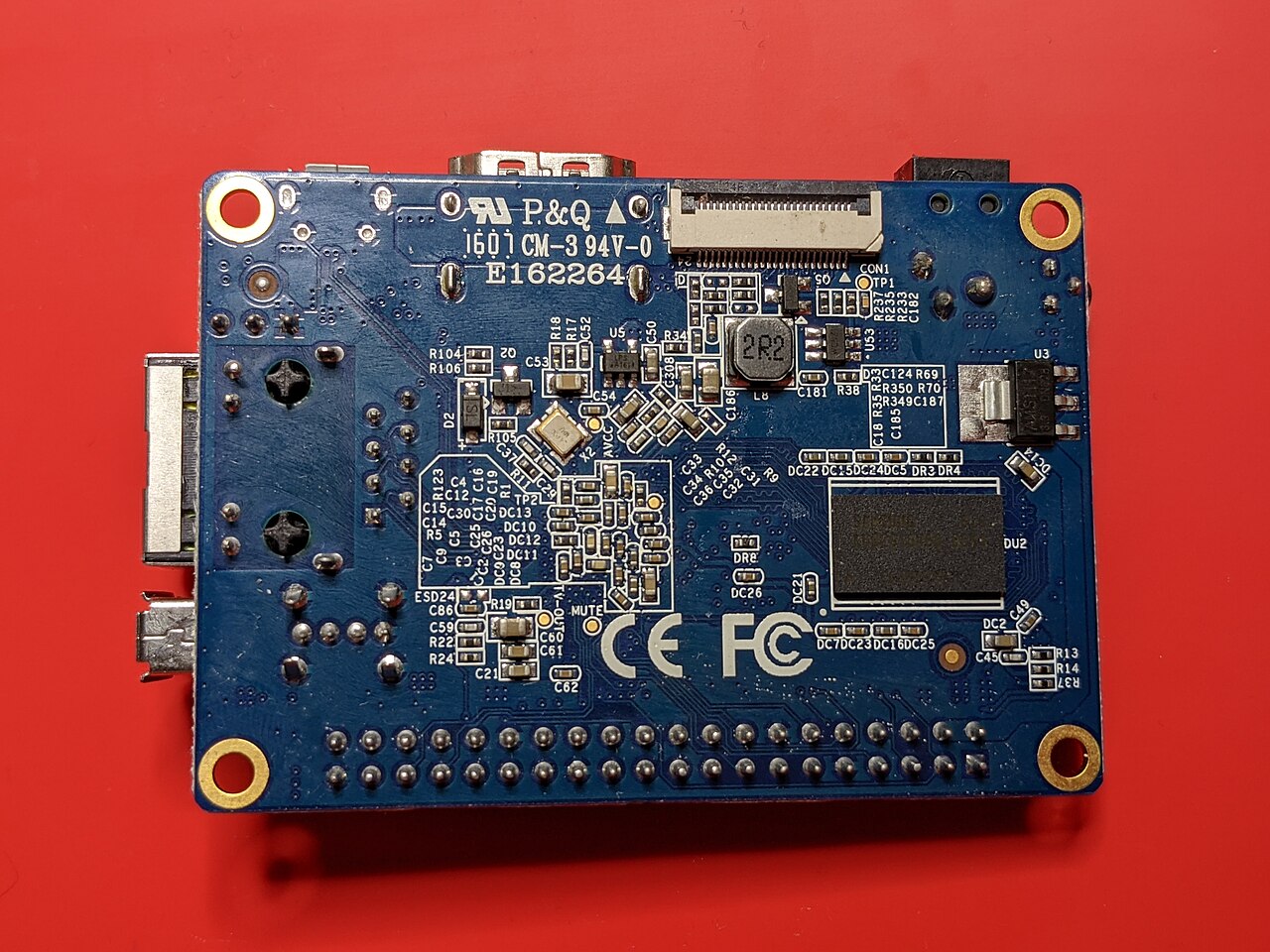
Shenzhen module maker Graperain has a system-on-module built on Allwinner's A733, called the GR_A733_CV1, and a matching carrier, the GR_A733MB_V1.1. The hardware is not new. LinuxGizmos covered the same gold-finger SoM and carrier on 30 September 2026. It came back into view this week, when CNX Software reported it on 25 November and embedsbc published its own write-up on 26 November. Two months on, the main unknowns are the same: none of the coverage gives a price, and CNX reports that the board support package has not been released publicly.
This piece goes through what the maker's pages actually specify, where the secondary coverage adds to them or disagrees, and which questions are still open.
The SoC: what Allwinner says the A733 is
Graperain did not design the chip, so it is worth starting with the vendor's own numbers. The Allwinner A733 datasheet (V0.93) is hosted on Radxa's download server and does not mention Graperain. Its first pages list:
- A dual-core Arm Cortex-A76 plus a hexa-core Cortex-A55, "up to 2.0 GHz"
- An NPU of up to 3 TOPS
- External 32-bit LPDDR4/LPDDR4x/LPDDR5 memory, up to 16 GB
- A single-core RISC-V E902 coprocessor at up to 200 MHz
- 1x 2-lane UFS 3.0
- PCIe 3.0 (RC/DM)
- eDP1.4b/DP1.4
- 4K video input and output, plus a secondary display of up to 2K
The datasheet gives a single "up to 2.0 GHz" figure for the CPU cluster. CNX and embedsbc split it by core type: the Cortex-A76 cores run at up to 2.00 GHz and the Cortex-A55 cores at up to 1.80 GHz. Graperain's product page also just says "up to 2.0 GHz" (listed as "main frequency max up to 2.0GHz"), and it gives the process as 12 nm. Read 2.0 GHz as the A76 peak, not the speed of all eight cores.
The GR_A733_CV1 module
The form factor is a 260-pin gold-finger edge connector at 0.5 mm pitch. CNX and embedsbc describe it as SO-DIMM style. The module measures 69.6 x 38 mm and uses an 8-layer immersion-gold PCB, per Graperain.
Memory and storage. Graperain lists 2GB of LPDDR5 as standard, with 4, 8 and 16GB as options. Storage options are 8, 16, 32, 64, 128 or 256GB of eMMC, and the page says UFS 3.0 is also supported. CNX's lede says "DDR5", but its own spec list and the maker's page both say LPDDR5, and that is the correct figure.
Graphics and media. The GPU is an Imagination BXM-4-64 MC1 that Graperain lists with OpenGL ES 3.2, Vulkan 1.3 and OpenCL 3.0. Video decode is listed at 8K@24 for H.265, VP9 and AVS2, and 4K@30 for H.264. Encode is 4K@30 in H.265 and H.264. The ISP handles up to 24MP at 25 fps.
Interfaces on the edge connector, as Graperain lists them:
- 1x GMAC, 1000 Mbps
- HDMI 2.0b, 4K@60
- DP1.4/eDP1.4b, 4K@60
- 2x MIPI DSI, one dual-channel LVDS (1080p60), RGB
- Camera: 2x 4-lane plus 1x 2-lane MIPI CSI
- 5x I2S
- USB 3.1 Gen2 DRD (shared with DP1.4/eDP1.4), plus USB 2.0 DRD and USB 2.0 host
- PCIe 3.0
- 9x UART, 16x TWI, 5x SPI, 3x 10-channel PWM, 7-channel GPADC
The USB 3.1/DP sharing matters for carrier design. Graperain says the USB 3.1 Gen2 port and DP1.4/eDP1.4 reuse the same signals, so the two cannot be treated as independent resources when you assign connectors. Embedsbc flags the sharing as something to evaluate carefully, and adds that the available information does not establish which simultaneous-use combinations are possible.
Environment and OS. Graperain specifies an operating range of -25 to 75 °C. The OS options it lists are Android 15, Buildroot and Debian 11.
Power. Graperain's module page lists "DC 12V" as the power entry. CNX lists the SoM input as 12V and marks it TBD, noting that 12V is unusual for a module and probably applies to the carrier board only. Embedsbc likewise says the 12V figure should not be read as confirming that the SoM itself needs 12V. Treat the module's actual power rails as unconfirmed until you have Graperain's hardware documentation.
The GR_A733MB_V1.1 carrier
Graperain's development board page describes the kit as the gold-finger SoM plus a carrier. The assembly measures 130 x 90 mm, and the carrier is a 4-layer board. According to the maker, the ports are:
- RJ45 gigabit Ethernet
- TF (microSD) card slot
- HDMI 2.0
- USB Type-C carrying DP1.4
- USB 2.0 host
- DC 12V input and a 5V fan header
- Two MIPI camera interfaces and two MIPI LCD interfaces
- Earphone jack, left/right speaker outputs, two microphone inputs
- UART2/3/4 and a debug serial port
- An M.2 SSD interface, a GPIO expansion interface, and a Wi-Fi/BT module with an antenna slot
- Power, reset, custom and upgrade keys, plus an RTC battery slot
CNX gives more detail on several of these items:
- An M.2 2280 socket for NVMe SSDs
- A Wi-Fi 6 and Bluetooth 5.4 module with an external antenna connector
- A 3.5 mm earphone jack
- Three UART connectors
- A 20-pin GPIO header
- A 12V DC barrel jack
No source names the wireless module part, and none gives a pinout for the 20-pin header. We have not guessed them.
Software: the open question
For most readers this decides whether the module is usable. CNX reports that a BSP, Linux kernel and drivers are available to customers, "but nothing has been released publicly." Embedsbc likewise says the unpublished BSP resources need careful evaluation. The OS list (Android 15, Buildroot, Debian 11) tells you which images Graperain supports. It does not tell you which kernel version they use, how the NPU toolchain is delivered, or whether the GPU runs on open or vendor drivers. None of the sources answers those questions.
Embedsbc also points out that no application-level performance figures are specified: no FPS numbers for NPU workloads and no power-draw measurements. The 3 TOPS figure is the chip vendor's peak NPU rating. It is not a measured result on this module.
What It Means for Makers
Who it's for. The GR_A733_CV1 targets product builders, not weekend tinkerers. You could use it in a custom carrier for an HMI panel, a camera-based edge-AI device, or a multi-display kiosk, where an edge-connector module lets you change memory and storage SKUs without re-spinning the main board. The display options are the strongest part of the spec sheet: HDMI 2.0b, DP/eDP 1.4b, dual MIPI DSI, dual-channel LVDS and RGB. The camera side is strong as well, with 2x 4-lane plus 1x 2-lane CSI and a 24MP ISP. The RISC-V E902 coprocessor (up to 200 MHz per the Allwinner datasheet) is a separate core from the Linux cores, which suits real-time or always-on housekeeping.
What it enables. Graperain pitches the module as letting customers develop application-specific carrier boards without designing the processor section from scratch, which includes the LPDDR5 memory. The 130 x 90 mm GR_A733MB_V1.1 carrier works as an evaluation platform with an M.2 SSD slot, GbE, a Wi-Fi/Bluetooth module and a GPIO header.
What to verify first. Before committing to the module, check four things: the SoM power input (Graperain's DC 12V, flagged TBD by CNX), the USB 3.1/DP signal sharing, the 20-pin header pinout, and above all the terms on which you can get the BSP and how current it is. Without a public BSP you cannot assess Linux support independently. That is the main reason to hesitate.
Price and availability. None of the sources gives a price, in any currency, for the SoM or the carrier. CNX notes that Graperain does not typically provide public pricing. None gives an order, pre-order or shipping date either. Graperain lists the products on its own site, and CNX describes them as launched. The software is available to customers only, with no public release. If you're interested, the next step is to ask Graperain directly for pricing, minimum order quantities and BSP access.
Sources
- Allwinner A733 System on Module (Graperain product page)
- Allwinner A733 Development Board (Graperain product page)
- Graperain launches Allwinner A733 system-on-module and development board for Edge AI applications (CNX Software, 25 Nov 2026)
- Graperain GR_A733_CV1: Octa-Core A733 3 TOPS 16GB LPDDR5 (embedsbc, 26 Nov 2026)
- A733 development board with LPDDR5, PCIe storage and RISC-V coprocessor (LinuxGizmos, 30 Sep 2026)
- Allwinner A733 Datasheet V0.93 (hosted by Radxa)
