
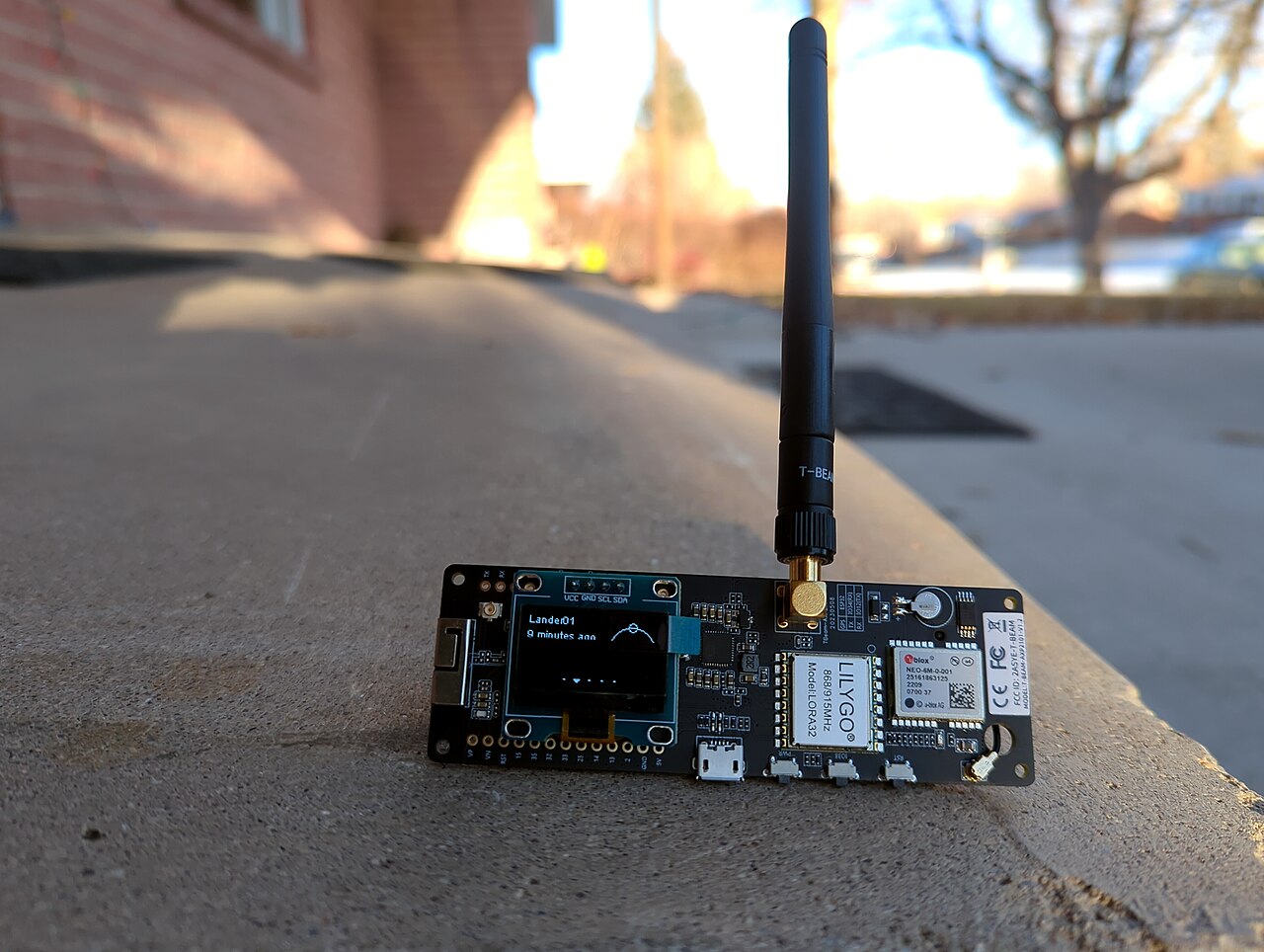
LILYGO has listed a revision of its T-Beam 1W, the ESP32-S3 LoRa and GNSS board that keeps the T-Beam form factor. The new T-Beam 1W2 drops the Semtech SX1262 transceiver used on the original and uses the LR2021 instead. That part belongs to Semtech's LoRa Plus family, which Semtech calls its fourth-generation LoRa IP. LinuxGizmos reported the board on November 26, 2026. LILYGO's store lists one variant, "LR2021 830-945Mhz [H768-B]", at $56.41 USD. When PinoutFeed read the listing in late November 2026, the page said "Sold out" and "Variant sold out or unavailable".
The radio is the story here. The store page needs some care, though, because the specifications printed on it don't all describe the board being sold.
The spec table is the old board's
The spec block on LILYGO's T-Beam 1W2 product page is headed "SX1262 -- T-Beam 1W Specifications". The table appears to have been copied over from the earlier SX1262 board. The variant selector and the product name both say LR2021, so the heading doesn't match the radio on the board. Until LILYGO updates the page, treat the radio line in that table as stale. LinuxGizmos' coverage and Semtech's own product page are the better references for the transceiver.
The rest of the block matches what LinuxGizmos describes for both boards, so the platform specs look reliable. LILYGO's page lists:
- MCU: "ESP32-53FN8 Dual-core LX7 microprocessor" (that is the page's spelling, and it is almost certainly a typo for ESP32-S3FN8). LinuxGizmos describes the chip as an ESP32-S3 with a dual-core Tensilica LX7.
- Flash: 16MB
- PSRAM: 8MB
- Wireless (MCU side): 2.4GHz Wi-Fi and Bluetooth 5 (LE)
- Buttons: Boot (IO00), Reset, Power and IO03
- Development: Arduino and PlatformIO, with sample code on LILYGO's GitHub
LinuxGizmos says the 1W2 keeps the front OLED, the GNSS receiver and GPIO headers along both long edges. Product images show two SMA connectors, a cooling fan on the rear and an integrated battery holder. Neither source gives a GPIO count, a GNSS module part number or a fan specification, so PinoutFeed isn't quoting any.
What the LR2021 adds
Semtech's product page describes the LR2021 as fourth-generation LoRa IP for both terrestrial and non-terrestrial (NTN/SATCOM) networks. It covers sub-GHz, the 2.4 GHz ISM band and licensed S-band. Its modulation list goes well beyond LoRa:
- FLRC-Burst at up to 2.6 Mbps
- LoRa at up to 125 kbps
- FSK, OOK, O-QPSK and LR-FHSS
Semtech rates the transmitter from +22 dBm down to -10 dBm. It lists receive sensitivity down to -141.5 dBm at SF12/125 kHz. The company also says the part:
- is backward compatible with earlier LoRa and LoRaWAN devices
- supports a multi-region, single-SKU front end
- tolerates enough frequency offset that a TCXO isn't needed
Semtech's product page lists a datasheet for LR2021/22/12 as v2.2, dated August 8, 2026. Semtech also points to third-party stacks for Amazon Sidewalk, W-MBUS, Wi-SUN FSK and Z-Wave.
LinuxGizmos also gives the FLRC figure as up to 2.6 Mbps and describes it as a transceiver-level figure, so it is not a measured board throughput. Neither source publishes link-level or range results for the T-Beam 1W2.
Reading "1W" against "+22 dBm"
The name needs a spec check. Semtech rates the LR2021 transmitter to +22 dBm, and 1 W is +30 dBm. If the 1W2 really transmits at 1 W, as the "1W" naming implies, the board must have an external power amplifier after the transceiver. That is PinoutFeed's inference from the two figures, not a published spec. Neither LILYGO's page nor LinuxGizmos names a PA, gives a rated conducted output power or says how that power changes across 830-945 MHz. Anyone planning a link budget or checking regional EIRP limits should wait for a schematic or a corrected spec sheet.
The listing also gives only one band: 830-945 MHz. The LR2021 can work at 2.4 GHz and in S-band, and the board has two SMA connectors. Neither source says whether the 1W2 brings out the transceiver's 2.4 GHz path or what each connector is for. The 1W2's 2.4 GHz Wi-Fi and Bluetooth come from the ESP32-S3, not the LoRa radio.
What It Means for Makers
The T-Beam line is common in mesh-messaging and GNSS-tracker builds because it puts an MCU, a LoRa radio, a GNSS receiver, a display and a battery holder on one board. The 1W2 keeps all of that. It changes the radio and nothing else in the sources' descriptions. That matters most to:
- LoRa firmware developers who want to test the LR2021's extra modulations (FLRC, LR-FHSS, O-QPSK) on familiar ESP32-S3 hardware. Semtech says the higher FLRC data rate enables larger payloads such as images, alongside conventional telemetry and positioning data.
- Existing T-Beam 1W users who want a pin-and-case-compatible path to a newer transceiver. This depends on LILYGO keeping the layout identical, which the sources suggest but don't spell out pin by pin.
- Educators and lab builders who want one board that covers LoRa, FSK and OOK experiments.
One caution for firmware: the LR2021 is a different transceiver from the SX1262. Semtech says it is backward compatible at the LoRa/LoRaWAN protocol level. That doesn't mean code written for an SX1262 driver will run on it without changes. Check whether your stack supports the LR2021 before you assume your SX1262 firmware will work. LILYGO points to its LilyGo-LoRa-Series GitHub repository for Arduino and PlatformIO examples.
Price and availability: LILYGO lists the T-Beam 1W2 LR2021 830-945 MHz variant (H768-B) at $56.41 USD, as read on LILYGO's store in late November 2026. LinuxGizmos reports the same price. The variant was listed but sold out/unavailable when checked, and LILYGO gives no restock date. The store's shipping estimates are 25-30 days for Standard Express, 10-20 days for YunTu, and 10-17 days for DHL/FedEx.
Until LILYGO fixes the spec table, use Semtech's datasheet for radio figures and LILYGO's GitHub for board-level behavior. Don't rely on the SX1262 block on the store page.
