
A board with 16 GB of RAM should not be able to run a model whose weight files add up to more than 400 GB. Jim Bruges did it anyway. His Arduino Project Hub guide, 700B Parameter LLM on the VENTUNO Q!, is dated October 20, 2026 and released under the MPL-2.0 license. In it, a large mixture-of-experts (MoE) language model runs on an Arduino VENTUNO Q fitted with a 1 TB PCIe Gen4 NVMe SSD, using the open-source Colibri inference engine. His own summary of the result, as quoted by CircuitDigest, is short: "working does not mean fast."
The guide's subtitle states the idea: streaming the model from storage with an NVMe SSD and Colibri lets the VENTUNO Q run cloud-sized models. CircuitDigest covered the project on October 26 and put the numbers on it. On GLM-5.3, a 744-billion-parameter model, generation ran at about 0.030 tokens per second. On the much smaller Qwen3.6-35B-A3B it reached about 0.74 tokens per second.
A note on sourcing. When PinoutFeed fetched the Project Hub page, only the header rendered: title, author, date, license and parts list. The body of the guide could not be read. The benchmark figures below therefore come from CircuitDigest's write-up and are attributed to it. Readers who need exact numbers should check them against Bruges' guide directly.
The hardware
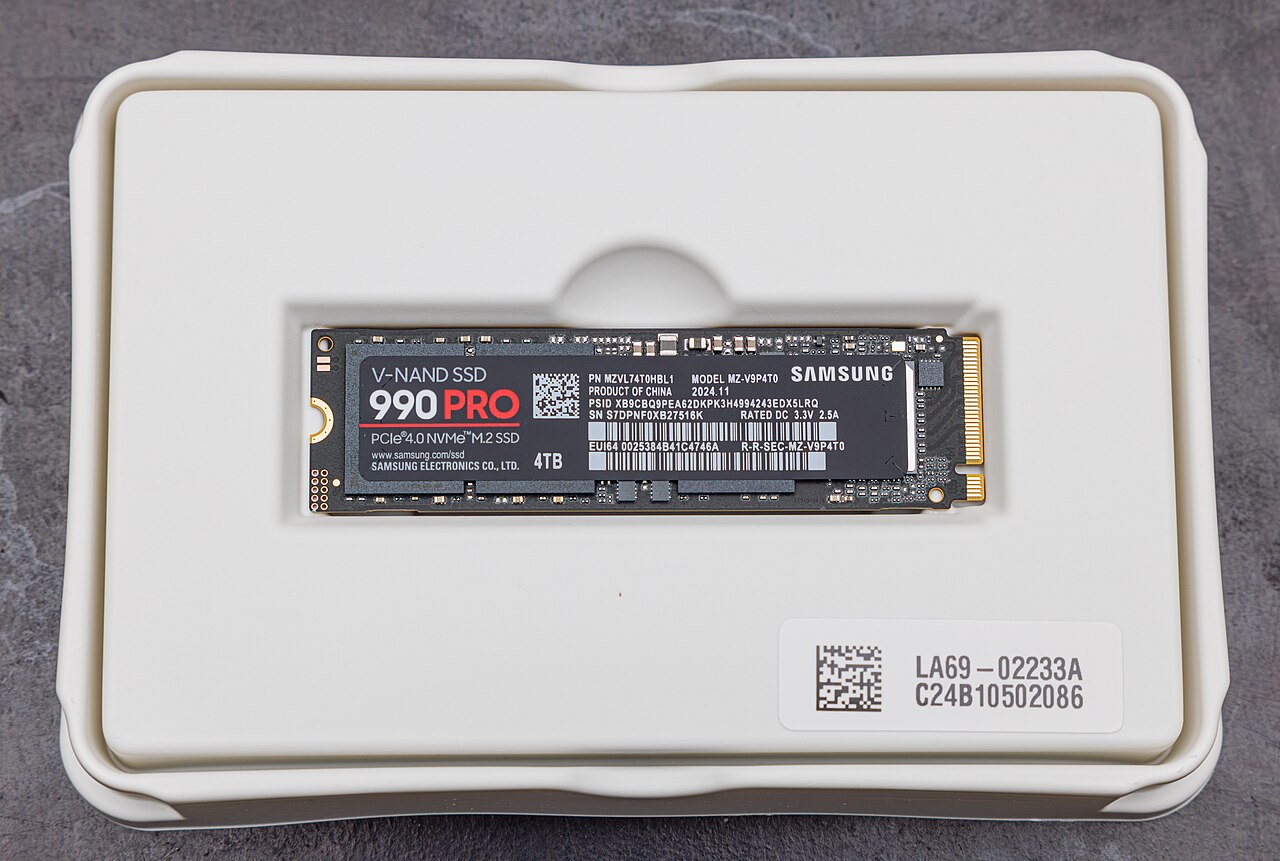
The Project Hub parts list has two items: an Arduino VENTUNO Q and a 1 TB SSD, listed as PCIe Gen4 NVMe in the 2230 M.2 form factor. The only software listed is Colibri. CircuitDigest identifies the drive as a 1 TB Crucial NVMe SSD.
CircuitDigest describes the VENTUNO Q this way:
- Application processor: Qualcomm Dragonwing IQ8 (QCS8275), running Ubuntu Linux
- Microcontroller: an STM32H5 alongside the Qualcomm SoC
- Memory: 16 GB LPDDR5
- Storage expansion: M.2 NVMe Gen 4 slot
- NPU: 40 TOPS, which sat idle for this test
The NPU sat idle because Colibri has no Qualcomm backend yet. The reported results ran on the CPU; the one early GPU test was slower. That is the main caveat for anyone reading the results as a measure of what the board can do.
How Colibri fits 419 GB into 16 GB
It doesn't fit, and Colibri isn't trying to make it fit. According to its GitHub README, the engine runs very large MoE models by keeping the always-used part of the model in RAM and reading the experts from disk as they are needed. In an MoE model, each token passes through only a small subset of expert sub-networks, so most of the weights are unused at any given moment. Colibri keeps those inactive weights on the SSD instead of in memory.
The README describes Colibri as pure C with no GPU required, free and open source. It lists support for GLM-5.2 and GLM-5.3, Kimi K3, DeepSeek V4 Flash, Qwen3.6 and OLMoE, among others. The minimum is 8 GB of RAM, with 16 GB or more recommended, plus 22 GB of free disk space for the smallest model. The README's example banner reads "colibri v2.0.0 · GLM-5.2 · 744B MoE · int4 · streaming CPU" and "resident 9.9 GB". That suggests the resident in-RAM share of a 744B model is under 10 GB at int4, which leaves room within the VENTUNO Q's 16 GB.
Version discrepancy: CircuitDigest says Bruges ran GLM-5.3. The Colibri README's example uses GLM-5.2. The README lists support for both, and PinoutFeed could not check the version against the unrendered guide body. The guide's own title says "700B". The 744B figure comes from CircuitDigest and the Colibri README.
The numbers
All figures in this section are as reported by CircuitDigest.
Qwen3.6-35B-A3B (about 23.1 GB)
The smaller model is still larger than the board's 16 GB of RAM, so it also needs streaming. With 96 cache slots per layer, Bruges measured about 0.74 tokens/s. Switching to performance CPU governors raised that to about 0.77 tokens/s. Time to first token was about 35 seconds. Raising the cache slots from 32 to 96 made Qwen about 48 percent faster, which fits a workload limited by how often experts must be fetched from the SSD.
GLM-5.3 744B (about 419.3 GB across 148 files)
The large model ran at about 0.030 tokens/s. Asked to name three planets, it spent 252 seconds processing the prompt and then 167 seconds generating five tokens. Five tokens in 167 seconds works out to the reported 0.030 tokens/s. The total of 419 seconds is the "7 minutes to name three planets" in CircuitDigest's headline.
Threads and GPU
CircuitDigest reports that four threads on the Cortex-A78C performance cores were faster than both two threads and all eight cores. Using all eight cores was slower than using four. An early test using the GPU through Vulkan was slower than the CPU path.
Reading the results
This is a feasibility demonstration, not a usable chatbot. At 0.030 tokens/s, even a 100-token answer would take close to an hour, and a longer one would take hours. The more practical result is Qwen3.6-35B-A3B at about 0.74 tokens/s. That is slow, but it is a model larger than the board's RAM running offline on CPU cores.
The tuning data shows where the limits are. Cache slots had a large effect on speed, going from four to eight cores hurt, and the Vulkan GPU path lost to the CPU. Taken together, these point to a workload limited mostly by memory and storage traffic, not by raw compute. The idle 40 TOPS NPU is the obvious unknown. Colibri has no Qualcomm backend, so nobody can yet say what the accelerator would add.
What It Means for Makers
This project suits people who own or are considering a VENTUNO Q and want to see how far local, offline inference can go on it. It also suits anyone curious about SSD-streamed MoE inference on small Linux boards. Colibri needs no GPU and is plain C, so the same approach should apply to other boards with enough RAM to meet the README's 8 GB minimum and a fast NVMe drive. PinoutFeed has not tested that, and the sources do not claim it.
What the project makes possible is running models whose weights far exceed system RAM, without a cloud connection. It does not replace a cloud API or a desktop GPU for interactive use. The reported speeds rule that out for the 744B model, and even the 35B model takes about 35 seconds to produce its first token.
Price and availability: none of the sources PinoutFeed verified gives a price or availability status for the Arduino VENTUNO Q or the Crucial SSD, so we are not quoting either. The software is free: Bruges' project is MPL-2.0, and the Colibri README describes the engine as free and open source. To reproduce the GLM run you need storage for about 419.3 GB of model files, which is why the build uses a 1 TB drive. The Qwen model needs about 23.1 GB.
