
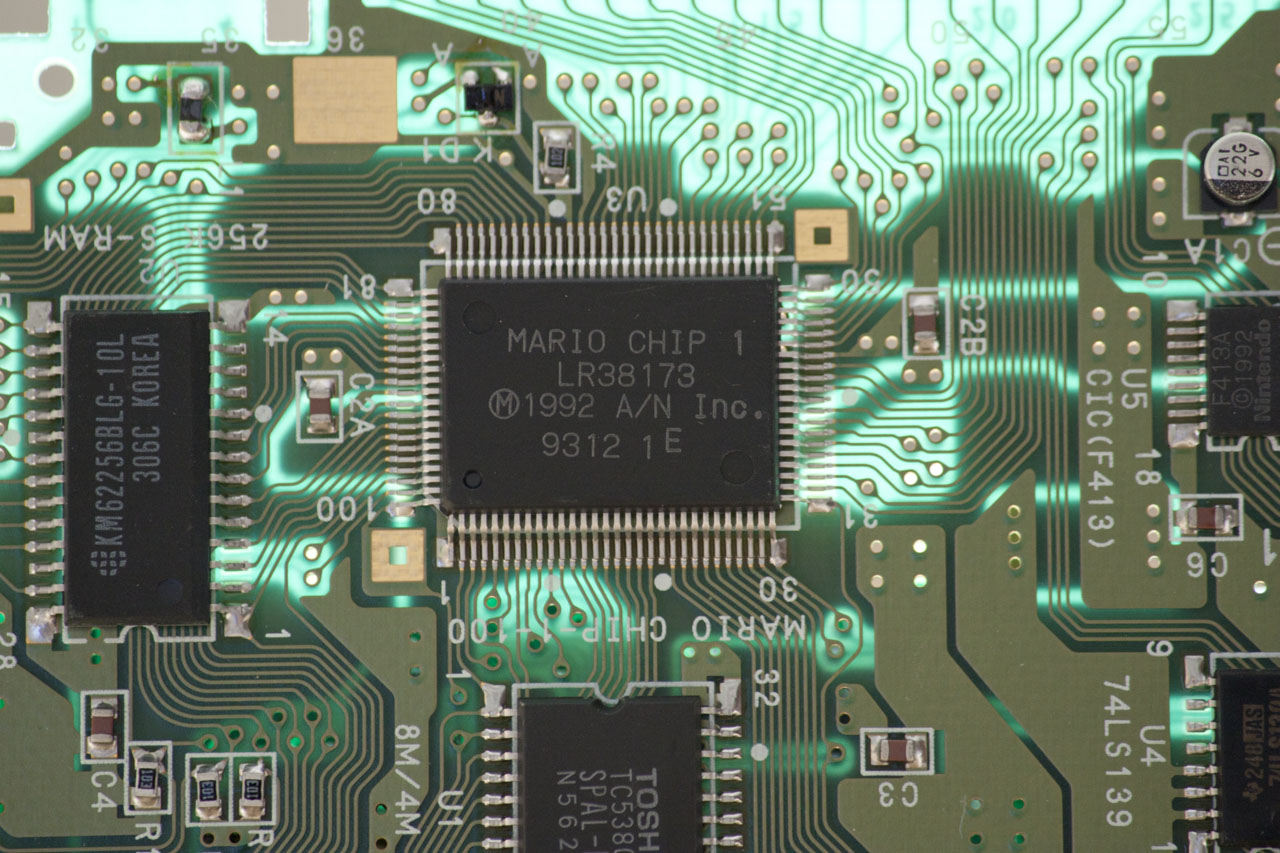
A language model now runs on a Super Nintendo. The model runs on a cartridge's Super FX 2 chip. On 19 November 2026 Benj Edwards announced ChatGPT for SNES, an unofficial ROM. In it, a chatbot of about 2.2 million parameters generates replies on the Super FX 2 coprocessor, the same chip family Nintendo once put in game cartridges to speed up 2D and 3D graphics. The project page at BX Foundry states "This is version 0.7 (2 November 2026)." It also says the project was designed by Edwards and coded by AI agents, and that OpenAI and Nintendo do not endorse it.
Nobody is claiming you can run a frontier model on a 16-bit console. The project is a constraint exercise: how small can a conversational model get and still produce sentences, and which piece of Super NES silicon can carry the arithmetic?
Why the Super FX 2, and not the SNES CPU
The console's main processor is a poor fit for matrix maths. According to Tom's Hardware, the SNES main CPU is a 16-bit Ricoh 5A22 running at 2.68 MHz. The Super FX 2 contains a RISC CPU clocked at 21.47 MHz. Tom's Hardware notes that the chip had to be installed in the cartridge by the manufacturer, and that the Super FX 2 debuted with Yoshi's Island and also sits in the Doom cartridge.
The BX Foundry page says the model runs on the Super FX 2 and produces its output one word at a time. Edwards gave The Register a further detail. The pure version of the model could run from a real custom SNES cart and does not strictly need the Super FX chip, but "without the extra processing power the answers are not as good." In other words, the coprocessor doesn't make the project possible in principle. It makes the output acceptable in practice.
The model: small vocabulary, distilled origins
The figures published by the creator are modest by design:
- Parameters: about 2.2 million (BX Foundry)
- Vocabulary: knows about 8,000 words (BX Foundry)
- Generation: one word at a time on the Super FX 2 (BX Foundry)
- Training data: training conversations written by gpt-oss-120b (BX Foundry). Edwards told The Register the model is a distilled offshoot of GPT-OSS-120b.
The "ChatGPT" in the name comes from that lineage and the chat interface, not from any tie to OpenAI's hosted service. The project page states plainly that OpenAI does not endorse it. Edwards also says the chatbot is not a useful assistant. Tom's Hardware reaches the same verdict, describing its usefulness beyond curiosity as very limited.
Two builds: pure model and fact book
The project ships in two forms, and they have different hardware requirements:
| Build | Size (per BX Foundry) | What it adds | Real-hardware requirement |
|---|---|---|---|
| Pure model | About 4 MB | The language model alone | Flash cart with Super FX support |
| Fact book | About 19 MB (17 MB zip containing .sfc and .msu files) | An MSU-1 "fact book" of the opening sentences of 150,000 Simple English Wikipedia articles | Flash cart with Super FX support and MSU-1 |
The fact-book build gets around the obvious limit of a 2.2M-parameter model, which is that it can't hold much knowledge in its weights. It pairs the model with a large block of reference text served through MSU-1. The Register describes MSU-1 as an aftermarket Media Streaming Unit that adds CD-ROM-like features to the SNES. The project page also lists the v0.7 ROM zip itself at 1.5 MB.
Running it
The quickest route is in the browser. Tom's Hardware reports that the project's web page includes an emulator offering both the 4 MB and 19 MB models, and the BX Foundry page says it runs in the Snes9x emulator. No hardware is required for that path.
For real hardware, the BX Foundry page lists these requirements:
- A flash cart with Super FX support: an FXPak Pro or an sd2snes with current firmware
- SuperFX speed set to Normal in the cart's settings
- For the fact-book build, MSU-1 support. The Register notes that both the FXPak Pro and the sd2snes support it.
That SuperFX speed setting matters. The project specifies Normal, so anyone testing on real hardware should match that setting instead of assuming that a faster or overclocked mode will help.
Built by agents
The other notable part of the story is how the software was written. Both the project page and The Register say the coding was done by AI agents, with Edwards as designer. So the result is a model distilled from a large open-weight model, trained on conversations written by that model, and run by code written by AI agents on a Super NES cartridge coprocessor. BX Foundry also points to Séance, a separate Edwards project that runs a tiny language model on a real NES.
What It Means for Makers
Who it is for: retro-hardware enthusiasts, demoscene-minded programmers, and anyone teaching how inference works under tight constraints. For an educator, an 8,000-word, 2.2M-parameter model on a 21.47 MHz RISC coprocessor is a concrete way to show what parameter count, vocabulary size and compute budget each cost, and what a lack of any of them looks like in the output.
What it enables: it shows that an existing cartridge enhancement chip can carry a tiny neural network's inference loop, and that MSU-1 can serve as a bulk lookup store next to the model. That split between small model weights and a large external text store is a pattern embedded developers will recognise. Edwards' remark that the pure model could run from a custom cart without the Super FX is a useful data point for anyone thinking about custom SNES board designs.
What it does not replace: any practical assistant. The creator says so himself.
Price and availability: the sources do not state a price. As of the project page, version 0.7 (dated 2 November 2026) is published, announced on 19 November 2026. It can be played in the browser emulator on the project site or downloaded as a ROM zip (1.5 MB for v0.7; the fact-book build is a 17 MB zip). Running it on real hardware requires a Super FX-capable flash cart, which the project names as an FXPak Pro or an sd2snes with current firmware, plus MSU-1 for the fact-book build. It is an unofficial project and is not endorsed by OpenAI or Nintendo.
