
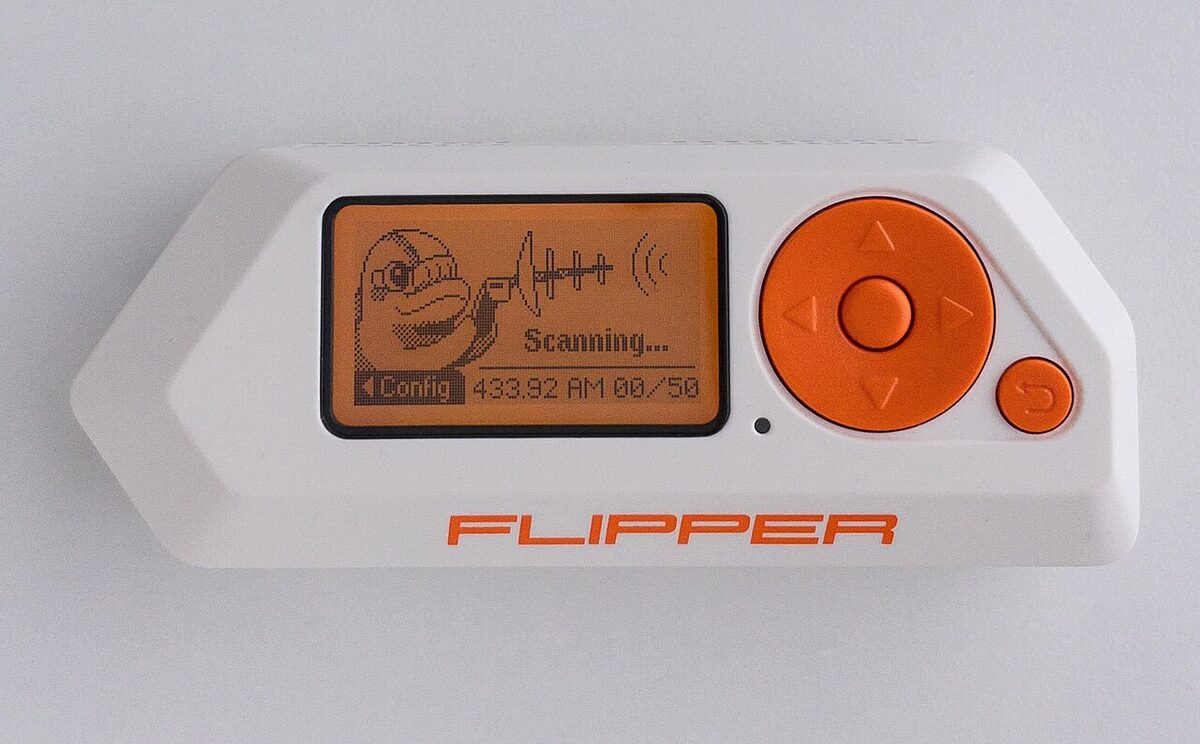
Flipper Devices' Flipper One is no longer a pre-order coupon or a verified-but-unlaunched Kickstarter page. The campaign went live on 2026-11-17 at 16:00 UTC, and a Wayback Machine snapshot of the campaign page taken just over two hours later, at 18:11 UTC, shows about $5,765,946 pledged against a $300,000 goal from 11,470 backers. That works out to about 1920% funded. The campaign is set to run 30 days and closes on 2026-12-17.
We covered the $20-coupon pre-order and the Kickstarter verification earlier. This piece covers what the live campaign shows: the pledge tiers, the bundles and add-on modules, and the estimated delivery date. All figures come from that one snapshot and will have changed by the time you read this. The Kickstarter page itself returned HTTP 403 to our fetch, so the snapshot is the record we used.
The hardware, as Flipper describes it
Flipper's product page calls the Flipper One an "Open Linux multi-tool" built on "a powerful ARM processor," and describes a two-chip design:
- Application processor: a Rockchip RK3576, which Flipper describes as an 8-core ARM SoC. It runs Linux, networking, USB3 and PCIe, includes an NPU and GPU, and drives HDMI and DisplayPort output.
- Co-processor: a low-power Raspberry Pi RP2350 microcontroller. It handles the LCD display, buttons, status LEDs, the power sub-system and Linux boot parameters.
The split matches what Flipper Zero owners will recognise. The always-on, low-level parts of the device (screen, input, power) belong to a microcontroller, and the RK3576 runs the heavier Linux work. Liliputing describes the result the same way: a Linux PC with an RK3576 chip, plus an RP2350 microcontroller for low-level operations.
For networking, the product page lists built-in Wi-Fi 6E and Gigabit Ethernet, a multi-WAN toolkit with up to 5 uplinks, a network scanner and a power meter. Liliputing gives more detail: 2 x Gigabit Ethernet, Wi-Fi 6E, an optional M.2 4G LTE or 5G modem, and USB Ethernet up to 5 Gbps. The port count and the USB Ethernet speed come from Liliputing, not from Flipper's product page.
Expansion goes through M.2 modules. Flipper's page names a 5G cellular modem and an SDR radio "and more," and the Kickstarter page adds a LoRa module (see below). One USB cable carries both host access and charging: Flipper says the device can simultaneously emulate a virtual network adapter, a serial adapter (COM port) and a mass-storage device, so you can SSH into it over the same cable that charges it.
The sources we used for this article do not give RAM, storage, display size or battery capacity. We are leaving those out rather than guessing.
The software pitch: mainline, no blobs
Flipper's product page promises an "open Linux platform" with a mainline kernel, no binary blobs and no vendor-locked BSP. It also names a partnership with Collabora, which Flipper says is working on bringing the RK3576 into the mainline kernel. For anyone who has stayed stuck on a vendor's frozen kernel tree with Rockchip or other Arm SoCs, this is the most consequential claim on the page. It is also the one a Kickstarter snapshot can't verify. Watch the upstream kernel work over the coming months, not the campaign updates.
Tiers, bundles and modules
The snapshot's embedded page data lists the following reward tiers. All prices are in US dollars, as shown at launch on 2026-11-17:
| Tier | Price (launch day) |
|---|---|
| Pre-order Special | $349 and $359 (two entries) |
| Early Bird | $379 |
| Kickstarter Special | $399 |
| Flipper One (add-on) | $399 |
| LoRa Bundle (F1 + LoRa Module) | $439 |
| SDR Bundle | $539 |
| 5G Bundle | $599 |
| Ultimate Bundle (F1 + 5G + SDR + LoRa) | $759 |
Add-on modules are priced separately:
| Module | Price (launch day) |
|---|---|
| LoRa | $59 |
| SDR | $149 |
| 5G | $219 |
| All Modules Pack | $369 |
Two points about the low end. First, the $349, $359 and $379 tiers appear in the page data, but the snapshot doesn't tell us how many slots each had or whether any were still open. The Pre-order Special name suggests these tiers are tied to the earlier coupon pre-order, but the sources don't confirm that. Liliputing reports pledge levels "starting at $399," which suggests the cheaper tiers were not generally available to new backers. So treat $399 as the realistic entry price at launch. Liliputing notes that this is more than twice the cost of a Flipper Zero.
Second, the module prices let you check the bundle maths. Kickstarter Special plus the All Modules Pack comes to $399 + $369 = $768, so the $759 Ultimate Bundle saves $9. The LoRa Bundle at $439 is $399 plus $40, against $59 for the LoRa module bought separately. The 5G Bundle at $599 is $399 plus $200, against $219 for the module alone. The SDR Bundle at $539 is $399 plus $140, against $149 separately. If you already know which modules you want, the bundles are cheaper, but not by much.
Delivery, shipping and taxes
The campaign page gives an estimated delivery of July 2027 (listed as 2027-07-01). That is about six and a half months after the campaign closes, and like any crowdfunding date it is an estimate, not a commitment. The reward data lists shipping as "Only certain countries," so check whether your country is on the shipping list before you back. The pledge price should not be assumed to be your landed cost: shipping and taxes are not part of the listed prices.
The project's status is crowdfunding (live on Kickstarter). It is not shipping, and it is not a retail pre-order with a fixed ship date. The snapshot also showed 198 comments and no posted updates yet.
What It Means for Makers
Who it is for. The Flipper One is aimed mainly at network work, not the sub-GHz and RFID tinkering the Flipper Zero is known for. Wi-Fi 6E, Gigabit Ethernet (two ports, per Liliputing), multi-WAN with up to 5 uplinks, a network scanner and an optional cellular modem make it a pocket network toolkit for field engineers, homelab builders, security researchers and anyone who now carries a mini PC, a USB Ethernet dongle and a travel router to a site visit. The SDR and LoRa modules extend it into radio work, and the RP2350 co-processor will interest people who want to see how Flipper divides real-time and Linux duties.
What it replaces or enables. In practice it competes with a Linux single-board computer in a case, plus a portable router, plus an SDR dongle. What the Flipper One adds is integration: a screen, buttons and power management handled by the RP2350, SSH and charging over a single USB cable, and M.2 expansion in a handheld enclosure. If Flipper and Collabora deliver mainline RK3576 support with no binary blobs, that work should also help other RK3576 boards, not only this device.
Price and availability. As of launch day (2026-11-17), the Kickstarter Special is $399 and bundles run from $439 (LoRa) to $759 (Ultimate). Lower tiers at $349 to $379 appear in the page data, but Liliputing gives $399 as the starting level. Shipping goes only to certain countries, and shipping and taxes are not included in the listed prices. The campaign closes on 2026-12-17, and delivery is estimated for July 2027. The usual crowdfunding caveat applies: a backing is not a purchase, and specs, dates and module availability can change before anything ships.
