
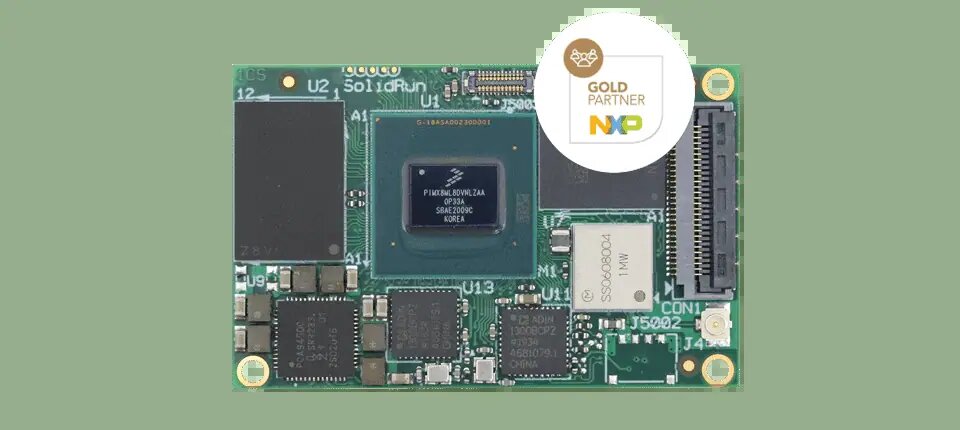
Forlinx has listed a system-on-module and development board built on NXP's i.MX 952 applications processor. The module is the FET-MX952x-C and the carrier kit is the OK-MX952x-C. It is a board-to-board (B2B) module, not a standard form factor. Its product page puts the features vehicle and industrial designers care about up front: up to three CAN FD controllers, two Gigabit Ethernet ports with Time-Sensitive Networking (TSN), an NPU, and support for ISO 26262 ASIL-B and IEC 61508 SIL-2 functional-safety work.
This is not the first i.MX 952 module. Vantron already has a SMARC design on the same chip. CNX Software's coverage mentions it, describing it as an 82 x 50 mm SMARC 2.1 board with Gigabit and 2.5GbE connectivity. Forlinx's version is its own 68 x 50 mm B2B format. CNX notes that this is the same size as Forlinx's existing FET-MX9596-C.
The silicon: what NXP put in the i.MX 952
The cores are the same in every source. Forlinx lists four Arm Cortex-A55 cores at up to 1.7 GHz, one Cortex-M7 at 800 MHz and one Cortex-M33 at 333 MHz. CNX Software reports the same clocks. Both list an Arm Mali-G310 GPU (OpenGL ES 3.2, Vulkan 1.2, OpenCL 3.0), and CNX describes an NXP eIQ Neutron NPU rated at "up to 2 eTOPS". Forlinx's page lists the video engine as H.264/H.265 decode up to 4K60 and H.264/H.265 encode up to 4K30 (CNX lists the encoder as H.264 only).
NXP's product page for the chip returned "Page not available" to our automated fetch. We relied on an archived snapshot dated 25 October 2025, which marked the part as Preproduction at the time. That page shows how much the SoC offers before any module maker decides what to expose:
- Memory: up to 6000 MT/s x32 LPDDR5 or 4266 MT/s LPDDR4X, with inline ECC
- Networking: one 2.5 Gbps and two 1 Gbps Ethernet controllers, with TSN
- Expansion: one PCIe Gen 3 lane, two USB 2.0 ports, three uSDHC controllers
- Low-speed I/O: 8x UART, 8x LPSPI, 8x LPI2C, 2x I3C, 3x CAN-FD
- Packages: 19 x 19 mm and 15 x 15 mm FCBGA
- Safety and security: IEC 61508 SIL 2 / ISO 26262 ASIL B, EdgeLock Secure Enclave, and post-quantum cryptography (PQC)
The Forlinx module uses only part of this. It ships with LPDDR4X, not LPDDR5. Its Ethernet line lists two 1 Gbps ports, not the SoC's 2.5 Gbps MAC. Anyone comparing NXP's chip brief with the module datasheet should know that the module offers a subset of the chip's features.
The module: FET-MX952x-C
Forlinx offers 2 GB, 4 GB or 8 GB of LPDDR4X RAM and 64 GB of eMMC storage. The module connects to a carrier through four 80-pin B2B connectors with 0.5 mm pitch and 2.0 mm mating height. CNX Software gives the module size as 68 x 50 mm, and both sources give the operating range as -40 to +85 °C.
The SoM interface table on Forlinx's page lists:
- UART: up to 8, at up to 5 Mbps
- SPI: up to 8
- CAN-FD: up to 3
- SAI (audio): up to 5
- ADC: 1x 12-bit, 8-channel, 1 MS/s
- Ethernet: up to 2x 1 Gbps with TSN, plus 1x SGMII that shares pins with PCIe
- USB: 2x USB 2.0
- PCIe: Gen 3 x1
- Display: 4-lane MIPI-DSI (the SoM table gives 4K@60 or 3840x1440@60), plus LVDS at 1080p@60
- Camera: MIPI CSI-2, as 1x 4-lane or 2x 2-lane
The SGMII/PCIe sharing matters for carrier design. If you want a third Ethernet path over SGMII, you give up the single PCIe Gen 3 lane, and the reverse is also true. Forlinx's page also gives conflicting DSI figures. The SoM table says 4K@60, but the dev-board section says the carrier's MIPI DSI supports "up to 4K@30fps". We report each figure as Forlinx gives it. Check the hardware manual before you commit to a 4K60 panel.
The carrier: OK-MX952x-C
The development board brings out the interfaces most likely to matter for vehicle and factory work. Forlinx lists:
- Two RJ-45 Gigabit Ethernet ports
- Three CAN FD ports, at up to 5 Mbps
- Two RS485 ports
- A PCIe 3.0 x1 slot that works in both Root Complex (RC) and Endpoint (EP) mode
- A Mini PCIe socket for a 4G module compatible with the Quectel EC20
- An AW-CM358SM module for dual-band Wi-Fi and Bluetooth 5.0
- MIPI DSI up to 4K@30fps
- Seven keys, four LEDs, and an RTC backed by a CR2032 coin cell
CNX Software says the carrier takes 12 V DC and describes the 4G LTE as optional. Endpoint mode on the PCIe slot means the board can act as a PCIe device attached to a larger host, as well as hosting cards itself.
Software and documentation
Forlinx lists Linux 6.18 as the operating system. You can flash images from a TF (microSD) card or over USB OTG. CNX Software reports that kernel source, schematics and carrier design files are "available to customers only". Neither source mentions Android, an RTOS image for the Cortex-M cores, or ready-made NPU model examples. Treat those as unknown until Forlinx documents them.
What It Means for Makers
This is an industrial and automotive part, not a weekend board. The people it suits are:
- engineers building vehicle gateways or telematics units who need three CAN FD buses on one board
- developers of factory controllers who want TSN Ethernet alongside RS485
- teams whose products will need an ASIL-B or SIL-2 safety case later
The mix of cores supports a common pattern: Linux runs on the Cortex-A55 cluster while real-time control or safety monitoring runs on the Cortex-M7 and Cortex-M33. The NPU's "up to 2 eTOPS" rating is a vendor figure, and neither source includes benchmarks. It is enough to suggest small vision or anomaly-detection models at the edge, but no source says how well specific networks run on it.
The B2B connectors mean the module goes into a custom carrier you design yourself, not an off-the-shelf SMARC baseboard. If you want a module you can swap between vendors, Vantron's SMARC i.MX 952 board is the more standard option. Forlinx's design matches its own FET-MX9596-C in size, which may simplify things for teams already using that platform.
Price and availability: Forlinx has not published a price. Pricing is by quote only, on the product page and according to CNX Software. Forlinx lists sample lead time as 5 working days and bulk orders as 6 weeks. It names Alibaba and DigiKey as sales channels. NXP's chip page was still marked Preproduction in the October 2025 snapshot we used, so ask Forlinx about silicon revision and long-term supply before designing it in. Without a list price, hobbyists cannot compare it with mainstream single-board computers. The engineers it targets will likely be getting quotes anyway.
