
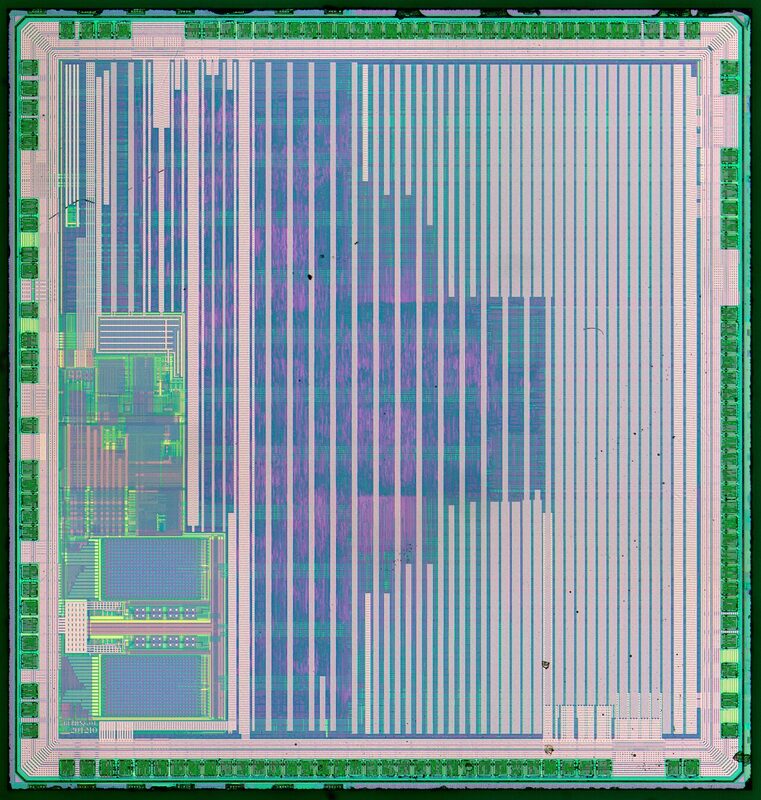
GigaDevice announced a new generation of its GD32H7 Cortex-M7 microcontrollers in Munich on November 10, 2026. Like the 2023 GD32H7, it is a high-clock industrial MCU, but this time GigaDevice is building application-specific variants on top of it. According to the GigaDevice press release, the lineup covers robotic servo joints, human-machine interfaces (HMI), motion control and general-purpose industrial work. Depending on the variant, the parts add an integrated EtherCAT slave controller with on-chip PHYs, a native MIPI DSI display interface, or a 14-bit ADC.
This is an announcement, not a shipping product. GigaDevice says full sample availability is targeted for January 2027 and mass production for April 2027. Neither GigaDevice nor CNX Software, which covered the launch on November 17, gives a price; CNX says pricing for the MCUs has not been announced.
The common core
Every part in the new portfolio uses an Arm Cortex-M7. The press release gives two clock grades: 600 MHz for GD32H77x devices and 750 MHz for GD32H78x devices. GigaDevice quotes a maximum CoreMark score of 3,736 and 640 KB of zero-wait-state tightly coupled memory (TCM).
The memory figures differ by source, so here is what each one says:
- GigaDevice press release: unified storage specifications of 2 MB high-speed executable Flash, 8 MB large-capacity storage Flash and 1.2 MB high-speed SRAM, stated as family figures.
- CNX Software: up to 9,728 KB of on-chip flash, with SKU options of 1,664 KB, 5,632 KB and 9,728 KB (the GD32H77R has 5,632 KB only), and 896 KB or 1,152 KB of SRAM depending on SKU, with the 640 KB TCM counted in the 1,152 KB figure.
- GigaDevice's Chinese-language GD32MCU release for the GD32H78E/77E and GD32H789/779: up to 2 MB of execution flash plus 8 MB of storage flash, and 1.2 MB SRAM. That page does not state the 9,728 KB figure.
Read together, the press release's "1.2 MB SRAM" looks like a rounded version of the 1,152 KB that CNX reports. The 9,728 KB ceiling is a per-SKU figure from CNX that we could not find verbatim on GigaDevice's own pages. Until datasheets are published, treat it as the top SKU option CNX reports, not as a confirmed datasheet number. For comparison, CNX notes that the earlier GD32H75E topped out at 3,840 KB of flash and 1,024 KB of SRAM.
The shared peripherals, per the press release:
- dual OSPI at 200 MHz with DTR
- dual 10/100 Mbps Ethernet
- three CAN-FD controllers
- USB HS/FS
- SDIO
- AES, SHA-256, a TRNG and a unique UID
The GD32MCU release adds a 16/32-bit EXMC external memory controller and two SDIO ports on the H789/779. It also says the USB HS and FS controllers there have on-chip PHYs. CNX lists hardware math/DSP accelerators, secure boot, authenticated updates, anti-rollback protection and a 1.71 V to 3.6 V supply range, and the press release gives the same supply range.
On functional safety, GigaDevice cites IEC 61508 SC3 (SIL 2/SIL 3) certification from TÜV Rheinland. The GD32MCU release says that certification applies to GigaDevice's MCU safety test library (STL), and CNX likewise says the GD32H7 STL received it. Engineers planning a safety case should keep that distinction in mind.
Four variants, one platform
GD32H7xR: robotic joint servo
The servo variant has what may be the most notable integration in the launch. GigaDevice says it puts an EtherCAT slave controller and two 100 Mbps Ethernet PHYs on a single die, removing the need for external PHY components. The press release quotes latency "below 50 ns" and support for the FSoE safety protocol. The target applications are collaborative robots, humanoid robot joints and servo drives. CNX lists the part as GD32H77R and, like the press release, gives its package as a 9 mm x 9 mm BGA169.
GD32H7xD: HMI
The HMI variant adds a native 2-lane MIPI DSI interface, which the press release says covers resolutions from QCIF to XVGA. GigaDevice pairs the DSI interface with an Image Processing Accelerator. On the audio side, it lists four SAI and four I2S interfaces plus S/PDIF, and CNX adds a PDM microphone input. GigaDevice says the part works with LVGL, emWin, Embedded Wizard and ThreadX GUIX. The press release names the HMI parts GD32H78D (750 MHz) and GD32H77D (600 MHz).
GD32H7xE: motion control
The motion-control variant also carries an EtherCAT slave. The press release describes its distributed-clock (DC) sync accuracy as "up to 62.5 μs". CNX describes the same figure as a DC sync cycle "as short as 62.5 μs", and the GD32MCU release calls it DC sync cycle precision. The three descriptions are worded differently, so check the datasheet before relying on any one reading.
For encoders, the press release lists EnDat, BiSS-C, Tamagawa and HIPERFACE DSL. The GD32MCU release names EnDat 2.2 and adds Nikon A-format. There is also a resolver-to-digital module, which CNX confirms. The press release names these parts GD32H78E and GD32H77E.
GD32H7x9: general purpose
The general-purpose parts, named GD32H789 and GD32H779, add a 14-bit ADC and an HPDF digital filter block for sigma-delta front ends. They keep the Ethernet, CAN-FD and USB complement described above.
Packages and evaluation boards
The GD32MCU release lists BGA176 and BGA100 packages, plus LQFP176, LQFP144 and LQFP100, for the H78E/77E and H789/779 together. CNX breaks them out by variant: BGA176 for the GD32H78D/77D, BGA176 and LQFP176 for the GD32H78E/77E, and the full BGA176, BGA100, LQFP176, LQFP144 and LQFP100 set for the GD32H789/779. CNX gives a single GPIO figure of up to 132, depending on model and package, but no per-package counts, so we are not quoting any.
According to CNX, there are three evaluation boards:
- GD32H77DI-EVAL, built around the GD32H77DIWK7
- GD32H77EI-EVAL, built around the GD32H77EIWK7
- GD32H779I-EVAL, built around the GD32H779IWK7
CNX says GigaDevice has released GD32H77x/H78x Demo Suites v1.0.0 for the first two boards, with SEGGER J-Link debugging support documented for both. Board pricing and availability were not given.
A note on dates
The timing information differs between releases. The English press release dated November 10, 2026 targets full sample availability for January 2027 and mass production for April 2027. A Business Wire copy of the release was timestamped 16:00 EET on the same day and carries the same dates. CNX reports the same January and April dates. GigaDevice's Chinese-language GD32MCU release, dated January 2026 and covering only the H78E/77E and H789/779, is an earlier announcement. It describes the parts as in an early market-introduction stage, with samples requested through GigaDevice sales, and says mass production starts in June 2026. We are going with the newest English-language statement: samples in January 2027 and volume in April 2027. Anyone planning a design-in should confirm the dates with GigaDevice or a distributor.
What It Means for Makers
Most of this launch is aimed at industrial OEMs, such as robot-arm builders, drive vendors and panel makers, rather than hobby benches. Still, a few parts of it are worth watching if you work near that space.
The EtherCAT integration is the headline for servo work. An EtherCAT slave node commonly needs an MCU, a slave controller and PHYs, and the GD32H77R puts the controller and two PHYs on the MCU die. That could make open-hardware servo drives and robot joint controllers simpler to lay out, though that is our inference, not a claim from the sources. CNX notes the earlier GD32H75E already paired an EtherCAT controller with two Ethernet PHYs, so the new part's gains are the higher memory options and compact BGA169 package. Whether GigaDevice's tools and EtherCAT stack are practical outside large-customer channels is not something the sources settle; CNX lists the GD32 Embedded Builder IDE, a firmware library with examples and motor-control reference projects.
The HMI variant matters for a different reason. A native MIPI DSI interface on a Cortex-M7, combined with LVGL support, could let MCU projects drive DSI panels without a parallel RGB bridge, though panel compatibility is not covered by the sources. The large on-chip flash may also let firmware, fonts and image assets fit on the chip without external QSPI memory, depending on the SKU.
For existing GD32H7 users, CNX's figures put the new 9,728 KB flash option at about 2.5 times the earlier GD32H75E's 3,840 KB, and the 750 MHz grade is above the 600 MHz of the GD32H75E.
Status: announced, not shipping. GigaDevice targets samples in January 2027 and mass production in April 2027. No pricing has been announced for the chips or the three evaluation boards. Before committing a board design, check the final datasheet figures, especially the per-SKU flash sizes and the meaning of the 62.5 μs EtherCAT figure.
Sources
- GigaDevice Launches New-Generation GD32H7 High-Performance MCU Portfolio for Full-Scenario Industrial Applications (GigaDevice, Nov 10 2026)
- 750 MHz GigaDevice GD32H7 Cortex-M7 MCU family gets up to 9.5MB Flash, EtherCAT for industrial applications (CNX Software, Nov 17 2026)
- GigaDevice GD32H7 press release, Business Wire distribution (STT Info, Nov 10 2026, via mirror)
- GD32H7 series expansion: GD32H78E/77E EtherCAT and GD32H789/779 (GD32MCU.com, Chinese-language, January 2026)
