
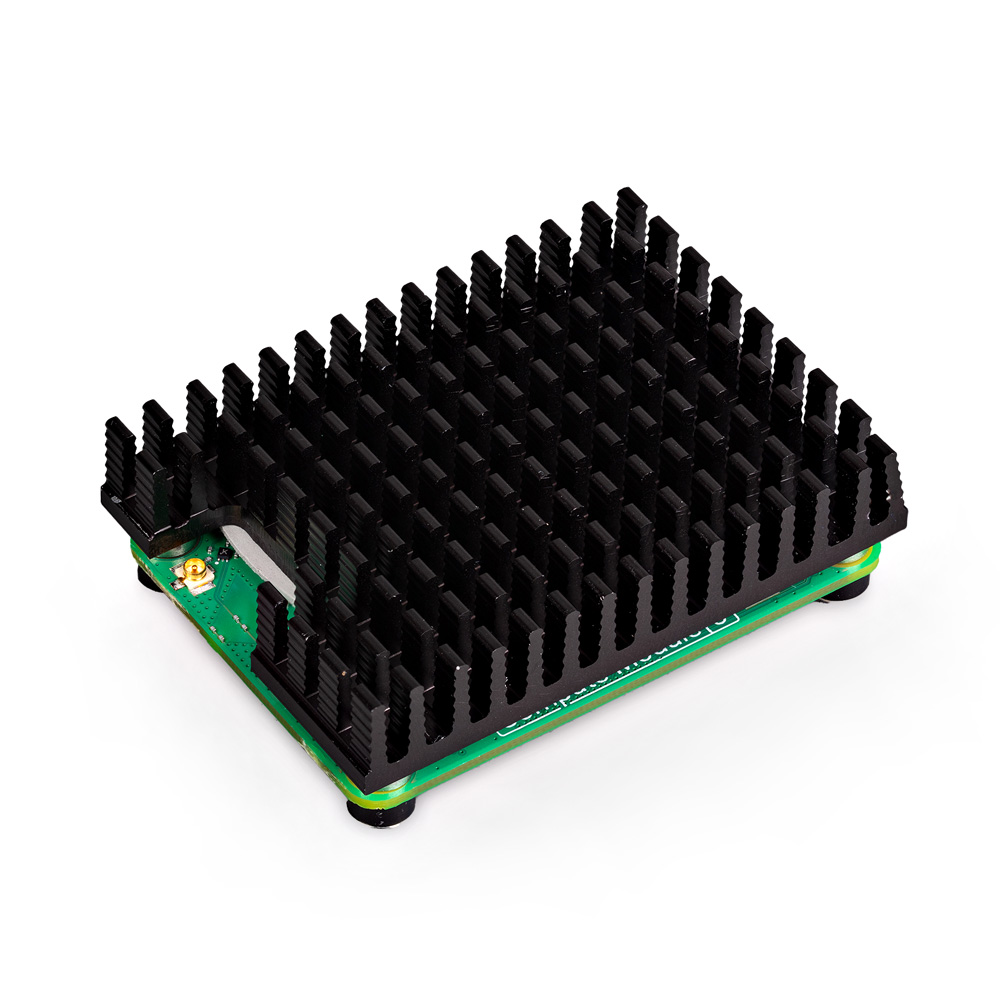
Building a Raspberry Pi vision rig usually means buying the parts one at a time: a compute module, a carrier board, an AI accelerator, a camera, a case and a power supply, then getting them to work together. Hellbender sells all of that as one product, which it says is engineered and built in Pittsburgh, Pennsylvania. Its Tendryl Camera is a fanless edge AI camera built on a Raspberry Pi Compute Module 5 and a Hailo-8 accelerator. It also has a Raspberry Pi Camera Module 3, a microphone, a speaker, an IMU and an environmental sensor. CNX Software covered the device on 25 November 2026 and reported a price of $599 on Hellbender's site, with a 27W USB PD adapter included.
Hellbender's own v2.0 product documentation and the CNX report list different physical specifications. We describe the differences below. Where the two disagree, we treat the maker's documentation as the primary source.
What is inside
The compute module is a Raspberry Pi CM5. CNX gives the part number as CM5104016: a Broadcom BCM2712 with four Cortex-A76 cores at 2.4 GHz, a VideoCore VII GPU at 800 MHz, 4GB of RAM and 16GB of eMMC. Hellbender's GitHub repository gives the same core configuration: "Raspberry Pi CM5 Quad Core Cortex-A76 @ 2.4GHz (4GB RAM, 16GB eMMC)" as the main compute, with the Hailo-8 as the AI co-processor.
The Hailo-8 is rated at 26 TOPS in both the maker's documentation and CNX's report. Neither source gives benchmark figures for specific models, so we have none to report. The TOPS rating is a peak figure and does not tell you the frame rate for any given network. Hellbender's quick-start guide does show a YOLOv6 object-detection demo running through rpicam-hello on the Hailo-8.
The camera is a Raspberry Pi Camera Module 3. Hellbender's documentation lists it as an 11.9 MP autofocus sensor. The CNX headline calls it a 12MP sensor, which is a rounding of the same part. Both sources list two optics options. The standard lens has a field of view of 66° horizontal by 41° vertical, and the wide lens has 102° by 67°. CNX says the camera is sold with either the standard or the wide-angle camera.
I/O and sensors
- Networking: Gigabit Ethernet with PoE+. Wireless is 2.4/5 GHz 802.11 b/g/n/ac (Wi-Fi 5), plus Bluetooth 5.0 and BLE (maker's docs and CNX).
- USB: three USB-C ports. CNX describes their roles as power, data and boot (flashing).
- Display: HDMI. CNX says it supports up to 4Kp60.
- Audio: an on-board microphone and speaker.
- Sensors: a 6-axis IMU and a temperature/pressure/humidity sensor. The maker's docs call the latter an "environmental sensor".
- Indicator: a programmable RGB LED (maker's docs).
- Mounting: two 1/4-20 mounting points, one on the bottom and one on the rear. The maker's docs add that they have anti-rotation pinholes.
The audio is less common than the rest of the list. CNX notes that Arducam's CM5-based IMX500 camera kit lacks the audio support the Tendryl has. The Tendryl can also listen and play sound, so one box could detect an event, react to an audio cue and play an alert without a USB sound card attached.
Power and connection modes
CNX gives the power input as 5V/3A or higher over USB PD, or PoE+ at 15W or higher. Hellbender's documentation states the USB-PD adapter must provide at least 1.5 A at 12 V or greater, and says that if both USB-PD and PoE+ are connected the device defaults to PoE+. The box includes a 27W USB PD adapter. The documentation describes four connection methods:
- USB-PD power plus Ethernet
- Standalone use with USB-PD, USB-DATA and HDMI
- PoE+ alone
- USB-PD plus USB-DATA
The documentation also lists a static IP address of 192.168.72.98. Note this before you connect the camera to an existing network.
Where the specs disagree
The CNX report and Hellbender's v2.0 documentation give different figures for three physical specifications:
| Spec | Hellbender docs v2.0 | CNX Software (25 Nov 2026) |
|---|---|---|
| Dimensions | 210 mm x 63 mm x 62 mm | 85 x 82 x 58 mm |
| Weight | 680 g | 415 g |
| Recommended operating temperature | -5 °C to 35 °C | 5 °C to 35 °C |
The differences are too large to be rounding. A 210 mm length and an 85 mm length describe different enclosures, and the weights are 265 g apart. The sources do not explain why. We could not confirm which is correct, so we give both. If you are planning an enclosure, a mounting arm or a weight budget, take the figures from Hellbender's documentation and ask the company to confirm them before you cut any material.
Both sources give 35 °C as the top of the recommended range. That limit matters more than the low end for most deployments, particularly for a fanless, passively cooled box. The documentation advises mounting the camera without constricting airflow around the heatsink. The sources call the range "recommended", and neither gives an absolute limit.
Software: Raspberry Pi OS first
The camera runs Raspberry Pi OS, which the documentation says is altered only to incorporate the integrated peripherals. Hellbender's GitHub repository, which describes itself as holding "Tendryl Camera artifacts and examples", had 10 commits when we checked. Its firmware table lists one release, v2.0, dated 2026-09-01, with the release note "Initial public release". The repository says the camera ships with rpicam-apps. For AI application development, it points users to Hailo's own GitHub rather than to a Hellbender SDK.
When CNX wrote its report, the repository held only the Raspberry Pi OS-based firmware image and a link to the documentation. The documentation covers getting started with the rpicam tools, the Hailo software, and standard Linux tools for the microphone, speaker, sensors and LED. When we looked, the repository did not appear to hold a set of Tendryl-specific code examples. Support is through a forum and [email protected], according to the repository.
Hellbender's documentation calls the device "fully programmable" and says documentation that applies to Raspberry Pi OS should also apply to the Tendryl. That points to a standard Raspberry Pi OS environment, though we have not tested it, and any workload is subject to the 4GB of RAM.
How it compares
CNX places the Tendryl alongside products it has covered before: Arducam's CM5-based kit built around a 12.3MP Sony IMX500 AI vision sensor, and EDATEC's CM4-based AI camera (ED-AIC2020). The approaches differ. The IMX500 is itself an AI vision sensor, while the Tendryl pairs a conventional Camera Module 3 with a separate 26 TOPS accelerator. Compared with the EDATEC unit, the Tendryl uses a CM5 rather than a CM4. We have not tested any of the three, and the sources do not include benchmarks comparing them.
What It Means for Makers
The Tendryl is aimed at people who want a working Raspberry Pi vision node without building one. Hellbender says it is meant to bridge the gap from benchtop prototype to deployed product. That could suit educators who need identical units for a lab, engineers building a proof of concept for a monitoring or inspection job, and makers who want PoE+ powering and tripod-thread mounting without designing a carrier board and case. One PoE+ cable can carry power and data, and the camera, accelerator, audio and sensors arrive already integrated in one enclosure. That replaces a CM5 carrier, an accelerator module, a camera ribbon, a USB audio dongle, a sensor breakout and a case.
What you give up is flexibility and, compared with a self-built rig, possibly money. At $599 you pay for integration, and the configuration is 4GB of RAM and 16GB of eMMC in the version the sources describe. That RAM ceiling may matter if you plan to run large models on the CPU next to the Hailo pipeline. The software is based on Raspberry Pi OS and Hailo tooling, but the Tendryl-specific example code was thin when CNX looked. Both CNX and the maker's documentation say the camera is built in Pittsburgh, PA.
Price and availability: CNX Software reported on 25 November 2026 that the Tendryl Camera sells for $599 on Hellbender's website, with no other currency stated. CNX says that price includes a 27W USB PD adapter and either a standard or wide-angle camera. Hellbender's documentation lists the camera and the 27W USB-PD adapter as the box contents. We could not load Hellbender's store page to check, so the price and the claim that it is on sale come from CNX's report only. Check the store before you order, and check shipping times.
