
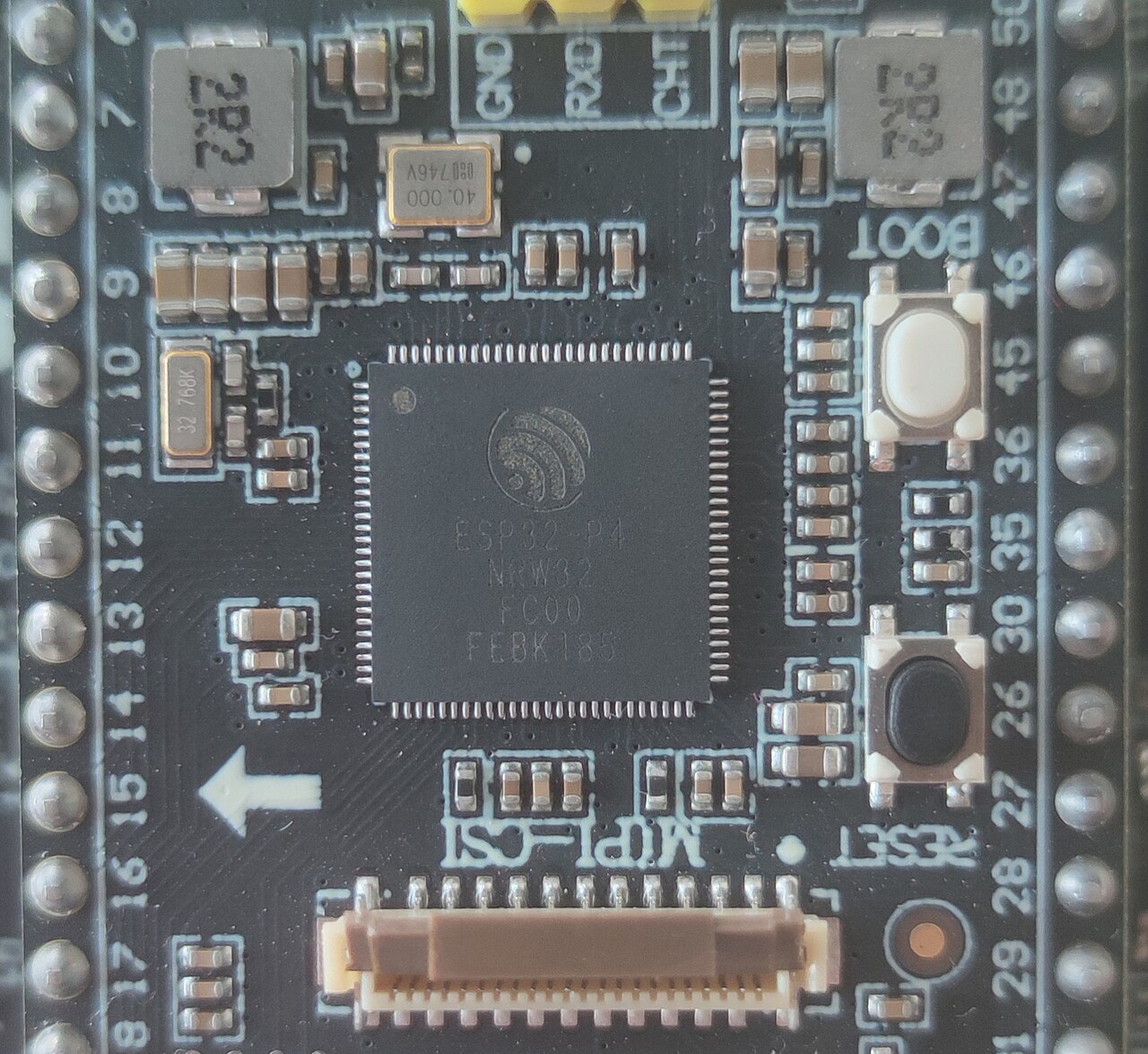
LILYGO has made a three-radio, two-processor development board in the shape of an M.2 2280 SSD. The T-Halow P4 measures 80 x 22 mm. It pairs Espressif's ESP32-P4 application processor with an ESP32-C6 companion for Wi-Fi 6 and Bluetooth 5, and adds a Taixin TX-AH module for 802.11ah Wi-Fi HaLow, the sub-GHz Wi-Fi variant built for long range at low data rates. CNX Software covered the board on October 23, 2026. It is already listed for sale on LILYGO's own Tindie store, with stock shown for all three frequency variants.
It is the follow-up to LILYGO's earlier T-HaLow, which CNX Software notes was based on the ESP32-S3. The new board moves to the much larger ESP32-P4 and gives Wi-Fi 6 and Bluetooth their own chip.
The processor: ESP32-P4NRW32X
CNX Software identifies the SoC as the ESP32-P4NRW32X. It has a dual-core RISC-V high-performance cluster at 400 MHz, plus a low-power core running at up to 40 MHz. On-chip memory is listed as 768 KB of HP L2MEM, 32 KB of LP SRAM and 8 KB of TCM. Program storage is 16 MB of QSPI NOR flash, a figure that LILYGO's GitHub README also gives ("QSPI interface connected to 16 MB Nor Flash").
PSRAM is where the sources disagree, and buyers should check it before ordering. LILYGO's GitHub README says the ESP32-P4 has 32 MB of PSRAM in the package, which matches the "32" in the NRW32X part number CNX reports. CNX Software lists 32 MB "according to GitHub and wiki" and says LILYGO's product page says 8 MB; we could not find an 8 MB figure in the Tindie page text we read. Until LILYGO clears this up, treat the PSRAM capacity as unconfirmed. If your application needs the larger buffer, for example frame storage for camera or display work, check with the seller first.
Display, camera and multimedia
The ESP32-P4 is aimed at human-machine interface work, and the T-Halow P4 brings out those interfaces. According to CNX Software, the board has a 2-lane MIPI DSI display interface with touch support and a 2-lane MIPI CSI camera interface, with OV2710 sensor support. CNX lists H.264 encoding at up to 1080p30.
LILYGO's README lists the multimedia blocks in more detail. The display side has MIPI-DSI, JPEG decode at 1080P 30fps, the PPA (pixel processing accelerator) and 2D DMA. The camera side has MIPI-CSI, 1080P pictures, an ISP, and H264 and JPEG encoding. The Tindie listing title mentions MIPI camera and AMOLED support. LILYGO has not named a specific bundled panel or camera module in the sources reviewed here.
Three radios, three buses
The ESP32-P4 has no radio of its own, so this board uses two separate wireless chips. Each connects to the P4 over a different bus.
- ESP32-C6-MINI (Wi-Fi 6, Bluetooth 5, 802.15.4). CNX Software identifies the module as the ESP32-C6-MINI-1U, connected over SDIO. The GitHub README says it is attached via SDIO and uses the
esp-hosted-mcuscheme, so the P4 handles the network stack while the C6 handles the radio. The C6 also supports 802.15.4 (the radio layer used by Thread and Zigbee), per CNX. - Taixin TX-AH (802.11ah Wi-Fi HaLow). The HaLow module connects to the ESP32-P4 over two links: SPI carries data through Taixin's non-OS driver, and UART carries AT commands for control, according to the README. CNX Software lists two RF ranges: 859-894 MHz with an 875M SAW filter, or 902-928 MHz with a 915M SAW filter. Channel widths are 1, 2, 4 and 8 MHz. Throughput runs from 150 Kbps to 32.5 Mbps. Range is up to 1.2 km line of sight.
The 1.2 km figure is a line-of-sight number from the source. Real-world range will depend on antenna placement, terrain, channel width and regional transmit power limits. A narrow 1 MHz channel at the low end of the rate table will reach much farther than an 8 MHz channel running near 32.5 Mbps.
Frequency variants
LILYGO's Tindie listing offers three SKUs:
- 915 MHz (902-928 MHz), H777
- 920 MHz (902-928 MHz), H777-01
- 868 MHz (859-894 MHz), H777-02
When we read the listing, each variant showed 30 units in stock. Sub-GHz spectrum rules differ by country, so buy the variant that matches the band permitted where the board will be used.
Why M.2?
The board has an M.2 B-key edge connector. CNX Software reports that it carries GPIO, I2C, UART, ADC and SD signals, among other ESP32-P4 interfaces, rather than PCIe or SATA. In practice, the board is meant to plug into a carrier board that supplies peripherals, a display connector or a custom I/O breakout, the way compute modules are used. We are not quoting a pin count for the edge connector. Check the repository's hardware files before designing a carrier.
One caution follows from the form factor. The card is the same shape as an M.2 2280 SSD, but it is not a storage device and its edge connector carries GPIO-style signals rather than PCIe or SATA. Do not plug it into a PC's M.2 slot.
For standalone use, there is a USB-C port for 5V power and programming, per CNX Software.
Software
CNX Software says LILYGO's examples target ESP-IDF 5.4.1 or later. The repository includes an examples/halow_spi_single demo for the HaLow link. There is also a browser-based "T-Halow Config" tool that talks to the module over Web Serial, which the README says works in desktop Chrome and Edge. GitHub's API shows the repository was created on May 8, 2025, and last pushed on August 5, 2026, so the repository predates this month's coverage by well over a year.
What It Means for Makers
The T-Halow P4 is for people who need a long-range, low-bandwidth link and enough local processing to do something with what they collect. Examples include a camera node at the far end of a field, a gateway that bridges HaLow sensors to a Wi-Fi 6 LAN, or a display terminal in an outbuilding beyond normal 2.4 GHz range. Compared with the earlier ESP32-S3 T-HaLow, it adds MIPI DSI/CSI, hardware H.264 and JPEG encoding, and a dedicated Wi-Fi 6/BLE 5/802.15.4 radio. The M.2 edge connector also makes it possible to design it into a carrier board instead of hand-wiring a dev board.
The trade-offs are complexity and documentation gaps. The board runs two firmware images (P4 plus the esp-hosted C6) and drives a third-party HaLow driver over SPI and UART. That is a heavier software stack than a single-chip ESP32 board. CNX Software also reports that the PSRAM figure is inconsistent between LILYGO's own pages: 32 MB on GitHub and the wiki, 8 MB on the product page.
Price and availability: The board is on sale now. On October 23, 2026, CNX Software reported prices of US$36.98 on AliExpress, US$26.57 from LILYGO's official store (China warehouse), and US$31.07 for the 915 MHz version (H777) from a US warehouse. LILYGO's Tindie store listed it at US$27.26 when we read it in October 2026, with 915 MHz, 920 MHz and 868 MHz variants each showing 30 units in stock.
