
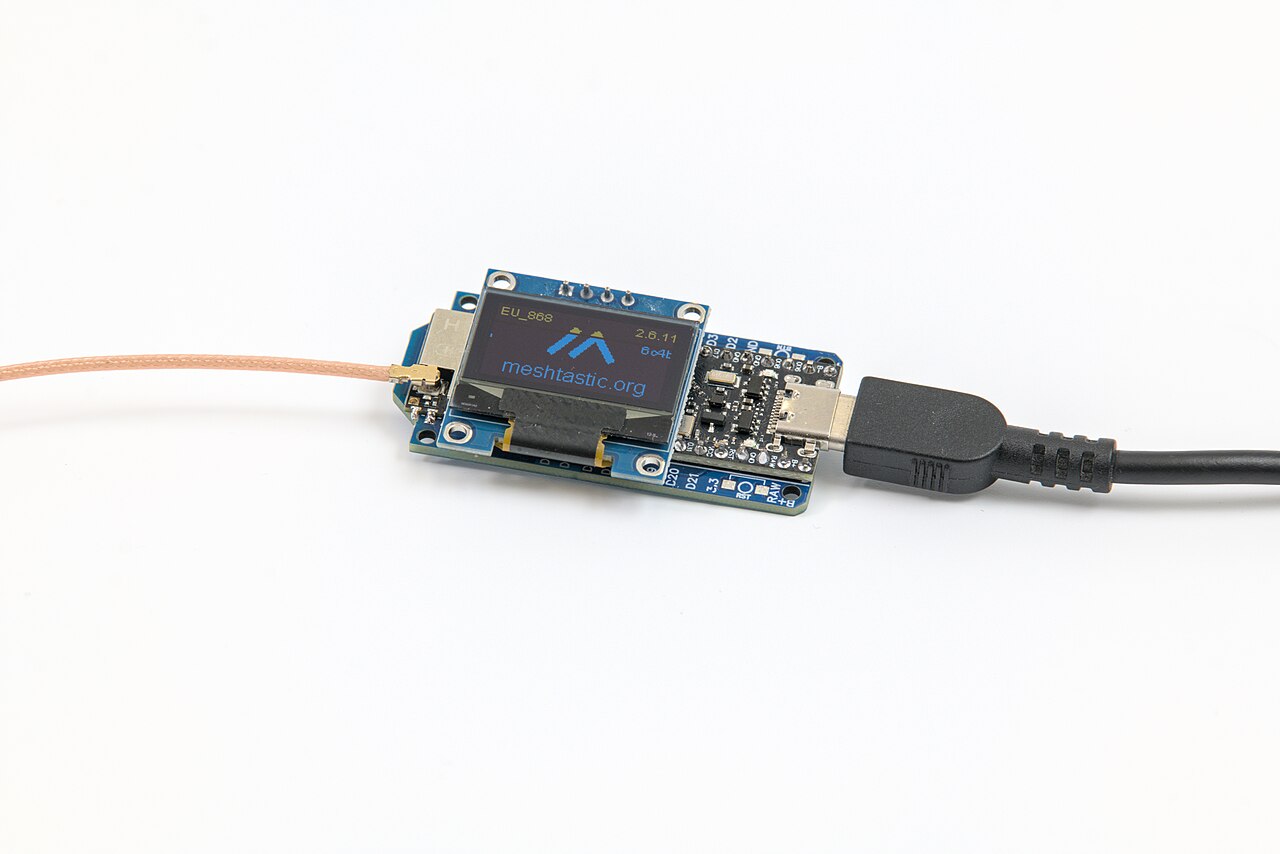
Most Meshtastic nodes are radios without a face. You flash the firmware, pair the node with a phone over Bluetooth, and the phone becomes the keyboard, the map and the message list. Seeed Studio's new Wio Tracker L2 Pro moves that interface onto the device. Seeed's store page calls it "an open-source Meshtastic device with a 3.2-inch touchscreen for standalone on-device communication and hands-on customization." The same page says it is "powered by the Wio-S3 module" and "combines LoRa (863-928 MHz), GNSS positioning, offline maps, Wi-Fi and BLE."
The store lists the L2 Pro at a special price of $59.42 (USD, as listed on 21 October 2026), carries a 15% discount marker, and shows it as "In stock". That makes it a retail product on sale now, not an announcement, a pre-order or a crowdfunding campaign.
The silicon
The Meshtastic project has a hardware page for the device, and it gives the most complete spec list of the three sources. The figures below are copied from that page.
- MCU: ESP32-S3, on Seeed's Wio-S3 module
- Memory: 16 MB flash, 8 MB PSRAM
- Wi-Fi: 2.4 GHz 802.11 b/g/n
- Bluetooth: Bluetooth 5.0 LE
- LoRa transceiver: Semtech SX1262, 863-928 MHz
- GNSS: L76K, supporting GPS, BeiDou, GLONASS and QZSS
- Display: 3.2-inch, 320 x 240 touchscreen
- Connectors: USB-C, Grove, SD card slot
Seeed's store page adds two figures the Meshtastic docs omit: a rechargeable Li-ion battery of 3000 mAh, and a maximum transmit power of 20 dBm. Neither page gives a CPU clock, core count, GPIO count or battery runtime figure for the L2 Pro, so this article doesn't give one either. Treat any such number you see elsewhere with caution until it shows up in a Seeed datasheet.
The pairing of an ESP32-S3 and an SX1262 is well established in Meshtastic hardware. What stands out here is the memory. With 8 MB of PSRAM, the ESP32-S3 has headroom for a touch UI alongside offline maps, which a bare radio node has no reason to run. The 863-928 MHz LoRa range is quoted identically by Seeed and the Meshtastic docs, so the hardware spans both the 868 MHz and 915 MHz sub-GHz bands. Which band and power limits you are allowed to use still depends on the Meshtastic region you set and your local regulations.
What the screen actually does
The Meshtastic docs say the release firmware runs Meshtastic UI (MUI) on the touchscreen, and that BaseUI is available from the settings menu. Offline maps load from the SD card, which is how the device shows positions without a phone or a data connection. The docs also mention an audio codec and amplifier that "play notification tones." That is a small detail, but it matters on a handheld you may not be looking at when a message comes in.
Seeed's getting-started wiki explains how to switch between the two interfaces: go to the Settings page, choose Reboot/Shutdown and long-press the Bluetooth icon. You can still connect a phone. The wiki says that under MUI the device must first be put into Bluetooth Pairing mode, after which you pair it with the standard Meshtastic app using the code shown on the screen.
Expansion: Grove, not a header farm
The only expansion connector on the spec list is a single Grove port. According to the Meshtastic docs it takes I2C sensors "such as the BME280 and SHT31." Anyone hoping for a breadboard-friendly row of ESP32-S3 GPIO should note that the sources list no pin header and no GPIO count. This looks like a finished handheld that also has a sensor port, not a dev board in a case.
Flashing and firmware
The release firmware is already on the device, but the Seeed wiki describes the reflash process in case you want a newer build or need to recover a bad flash:
- Open the Meshtastic Web Flasher and select the target "Seeed Wio Tracker L2".
- Put the device into DFU mode.
- Tick "Full Erase and Install" to overwrite the previous firmware.
The target name in the flasher is "Seeed Wio Tracker L2", not "L2 Pro." That is the label the wiki gives, and it is worth knowing before you scroll the device list looking for the "Pro" suffix. The wiki also warns not to reboot or power off the device while it is being configured or while a message is mid-transmission. Full erase overwrites the previous firmware, so note your channel settings and keys before you flash.
What It Means for Makers
The L2 Pro is aimed at people who want a mesh messenger that works without a phone. Hikers, event crews, search-and-rescue volunteers and off-grid hobbyists may not want to rely on a phone's battery and Bluetooth link. Households and clubs may want a few self-contained handsets for people who will never install an app. Because it has an on-device map, a touchscreen, GNSS and notification audio, you can read and send messages from the unit itself. That job usually takes a phone plus a radio.
For builders it also works as a ready-made ESP32-S3 LoRa platform. Wi-Fi and BLE are on board, and the Grove port gives a simple path for I2C sensors. Developers working on Meshtastic UI code get a target with a 320 x 240 touch panel and 8 MB of PSRAM, without building their own display hardware first.
The limits are clear from the spec list. There is no exposed GPIO header in the published specs, the radio is a single SX1262 rather than a multi-radio design, and the only power figure Seeed publishes is the 3000 mAh battery, with no runtime estimate. For a fixed router or repeater node, a cheaper headless board still makes more sense. The L2 Pro is for when the node is also the user interface.
On price and availability, Seeed's store lists the Wio Tracker L2 Pro for Meshtastic at a special price of $59.42 (USD, as listed on 21 October 2026) with a 15% discount marker, and shows it as in stock. The store page doesn't say how long the special price lasts, so check the listing before you budget for several units.
