
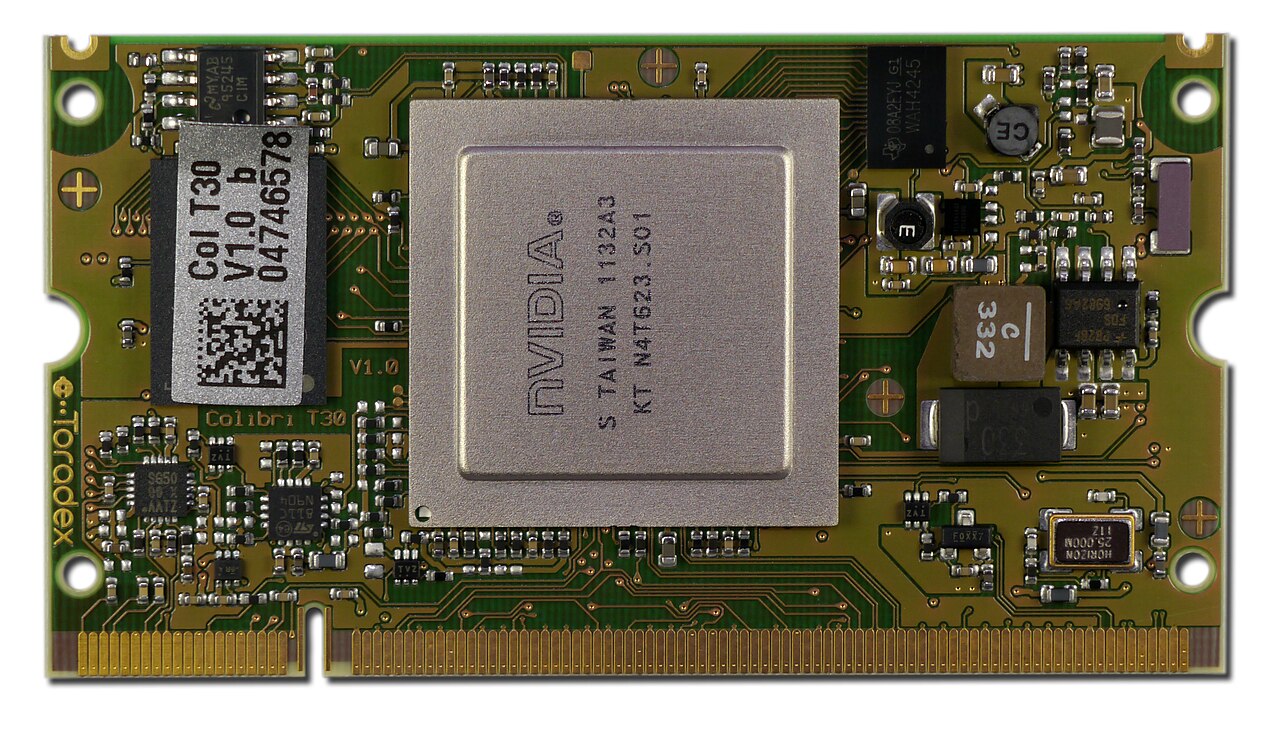
MYiR has put Rockchip's RK3576 on a standard carrier-board form factor. The MYC-JR3576 is a SMARC 2.2 system-on-module that plugs into a 314-pin MXM 3.0 edge connector. It comes in two versions: one with the commercial-grade RK3576 and one with the industrial RK3576J. MYiR also sells a matching carrier, the MYD-JR3576 development board. CNX Software reported on 27 October 2026 that the modules and kits are shipping now. Sample prices start at US$192 for the module and reach US$293 for the full development kit.
The SoC itself is familiar. What makes the product worth a closer look is the form factor, plus a few places where MYiR's own product page and CNX's write-up don't agree. Those differences are covered below, before the specs.
Why SMARC, and why the RK3576
SMARC modules plug into a carrier board instead of being soldered down or castellated. That makes a design easier to upgrade or second-source: in principle, a carrier built for one vendor's SMARC 2.2 module can take another vendor's, though pin-level differences between vendors still need checking. Rockchip's product page lists the RK3576 as a quad-core Cortex-A72 plus quad-core Cortex-A53 design with a maximum frequency of 2.2 GHz. Rockchip describes the NPU as a "6 TOPS self-developed high-efficiency AI NPU", and its spec table lists the NPU as "6TOPS* RKNN".
MYiR isn't the only vendor putting this chip on a SMARC card. Advantech's AOM-5841 is also a SMARC 2.2 module built on the RK3576. Advantech calls it an "AI-on-Module". It pairs the same quad A72 and quad A53 cores with 4 or 8 GB of LPDDR5 and 64 GB of eMMC. Advantech's developer page lists HDMI/eDP, DP and MIPI-DSI outputs, two MIPI CSI inputs, two Gigabit LAN ports, one PCIe 2.1 interface and four UARTs. It supports Debian 12 (kernel 6.6.23) and Android 15 (kernel 6.1.22). When two established embedded vendors put the same SoC on the same open module standard, carrier-board designers get a real chance at a second source.
Where the sources disagree
Before the spec list, here are the points where the two main sources for the MYC-JR3576 differ:
- Cortex-A53 clock. MYiR's product page lists the RK3576 at four Cortex-A72 cores at 2.2 GHz and four Cortex-A53 cores at 2.0 GHz. CNX Software gives 1.8 GHz for the A53 cluster. Rockchip's page gives only the 2.2 GHz maximum. MYiR also lists lower clocks for the industrial RK3576J: four A72 cores at 1.6 GHz and four A53 cores at 1.4 GHz. CNX's spec list does not give a separate figure for the J part.
- Wireless. MYiR's page describes an onboard Wi-Fi 6 and Bluetooth 5.4 module. CNX lists the wireless as optional Wi-Fi 6E plus Bluetooth 5.4, and names the AzureWave AW-XM729 module based on NXP's IW623. Until MYiR's datasheet settles the question, don't assume 6 GHz band support or wireless on every SKU.
Neither point changes the basic shape of the module. They do matter for anyone budgeting thermals around a particular CPU clock, or planning around 6 GHz Wi-Fi.
The module, spec by spec
Unless noted otherwise, the figures below are from CNX Software's spec list. Where MYiR's own page gives the same figure, it agrees.
- SoC: Rockchip RK3576 (commercial) or RK3576J (industrial), with four Cortex-A72 cores, four Cortex-A53 cores and a Cortex-M0 core. CNX gives the M0 a 400 MHz clock.
- GPU: Arm Mali-G52 MC3.
- NPU: 6 TOPS (CNX specifies INT8). MYiR's wording is "up to 6 TOPS".
- Video: decode up to 8K@30 or 4K@120; H.264/H.265 encode up to 4K@60.
- Memory and storage: 4 GB or 8 GB of LPDDR5, 32 GB or 64 GB of eMMC, and a 32 Kbit EEPROM.
- Networking: two Gigabit Ethernet ports using Motorcomm YT8531SH PHYs, plus the wireless option discussed above.
- Edge connector: 314-pin MXM 3.0, SMARC 2.2.
- Interfaces routed to the connector (per CNX): three MIPI CSI, two CAN FD, four UART, two SPI, four I2C and 14 GPIO. MYiR's page also lists HDMI, DP, LVDS and MIPI-DSI display outputs.
- Security: TPM 2.0.
- Power: 5 V/2 A input, with a Rockchip RK806S-5 PMIC (per CNX).
- Dimensions: 82 x 50 mm.
- Temperature: 0 to 70 °C for commercial parts and -40 to 85 °C for industrial parts.
- Software: a Linux 6.1 BSP with Debian and Yocto, plus Android 15, per CNX. CNX notes that MYiR provides these to customers only, not as a public download.
Fourteen GPIO is a modest count for a module with this much I/O. Three MIPI CSI inputs is one more than Advantech lists for the AOM-5841. That could matter for multi-camera vision builds, which are the kind of edge-AI work both vendors are targeting.
The MYD-JR3576 carrier
The development board is much larger than the module, at 206 x 126 mm, and runs from a 12 V/2 A supply. CNX lists these features:
- M.2 PCIe NVMe storage and SATA
- HDMI and DisplayPort outputs, plus MIPI-DSI/LVDS
- An M.2 socket for 4G/5G cellular modules
- Isolated RS232, RS485 and two isolated CAN FD ports
The isolated serial and CAN ports suggest who the board is for: industrial controllers and gateways rather than desktop SBC users. MYiR's page also notes that the board's wireless module is rated for -20 to 70 °C, narrower than the -40 to 85 °C industrial range of the module itself.
What It Means for Makers
This isn't a Raspberry Pi competitor, and MYiR doesn't pitch it as one. The MYC-JR3576 suits small product teams, test-fixture and automation engineers, and advanced makers who need a vision-capable Arm module that can sit in a field enclosure, rated to -40 to 85 °C on the industrial SKU, on a carrier they design themselves. It enables designs that need several cameras, CAN FD and a 6 TOPS NPU on a socketed card. If a module ever goes out of stock, the SMARC 2.2 standard at least suggests a path to alternatives such as Advantech's AOM-5841, subject to checking pinouts and supported features.
The software terms need attention. CNX says the Linux 6.1 and Android 15 BSPs go to customers only, so expect to buy hardware before you can inspect the board support package. Hobbyists used to public GitHub repositories should factor that in.
These are the sample prices at launch, as reported by CNX Software and listed by MYiR. Both say the sample price applies to the first two units; MYiR specifies two pieces per customer:
- MYC-JR3576-64E8D-220-C (8 GB LPDDR5 / 64 GB eMMC, 0 to +70 °C): US$209
- MYC-JR3576J-32E4D-160-I (4 GB LPDDR5 / 32 GB eMMC, -40 to +85 °C): US$192
- MYD-JR3576 development kit: US$293 with the commercial module or US$279 with the industrial module
The kit pricing looks backwards at first: the industrial kit is cheaper. That's because it ships with the industrial module that has less memory and storage. CNX reports the modules and kits as shipping now, not pre-order. Anyone whose design depends on CPU clock or Wi-Fi 6E should confirm the exact SKU configuration with MYiR before ordering, given the differences between the two sources.
