
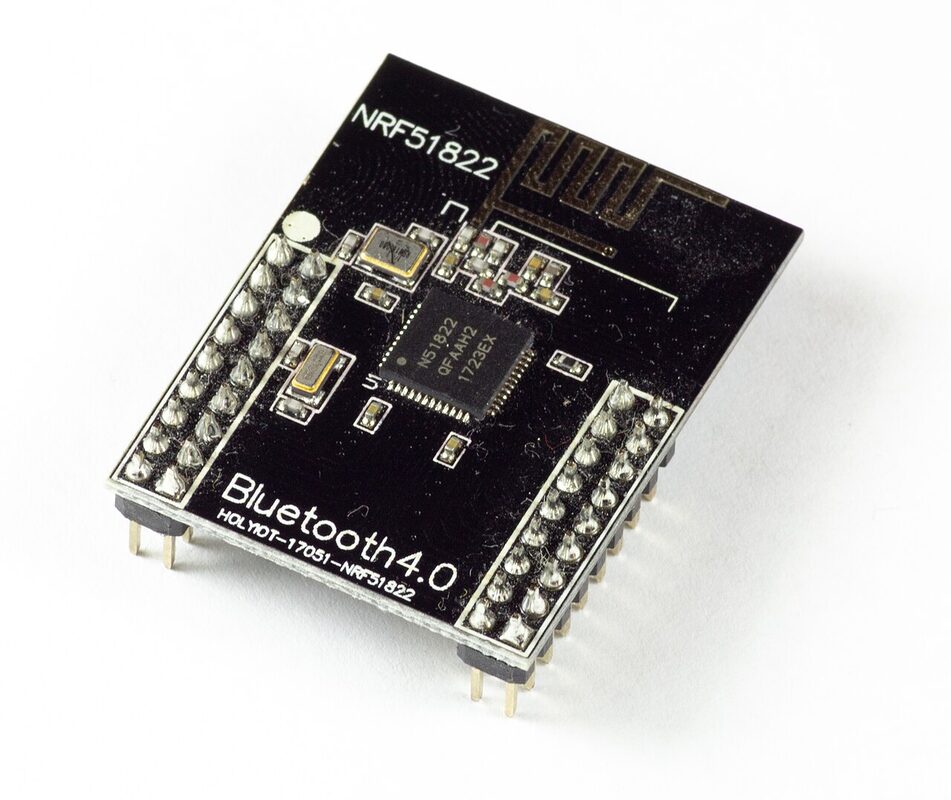
Nordic Semiconductor announced its nRF71 Series on 3 November 2026 in Oslo. The company describes the chips as ultra-low-power SoCs that combine Wi-Fi, Bluetooth LE, Thread and edge AI on one die. The main claim is power. According to Nordic's press release, the new parts draw up to 20 times less standby power than its current-generation nRF70 Series Wi-Fi products. Unlike a Wi-Fi-only part, the nRF71 integrates the application processor, Wi-Fi and the Bluetooth LE/Thread radio on one chip.
Status matters before anything else. Nordic says the parts are "now sampling with selected customers" and tells interested buyers to contact local Nordic sales. The release gives no general availability date and no list price. The 20x standby figure comes from Nordic and has not been independently measured.
Two parts, one key difference
The series launches with two devices:
- nRF7120: dual-band Wi-Fi 6.
- nRF7120E: tri-band Wi-Fi 6E, plus Nordic's Axon neural processing unit (NPU).
Nordic says both parts have 4 MB of on-chip non-volatile memory and 1 MB of user-accessible RAM. Only the nRF7120E has the NPU. The press release says the Axon NPU runs machine-learning models 10x to 17x faster than the 256 MHz Arm Cortex-M33 can on its own. The release gives a range rather than a single benchmark, and it does not say which models produced those numbers.
On the software side, Nordic offers its Neuton tooling for very small models, and models can be updated over the air through nRF Cloud. CNX Software reports that both parts are supported in the nRF Connect SDK.
Two radios that receive at the same time
The nRF71 is not a Wi-Fi chip with a Bluetooth block added as an afterthought. Nordic says it has two independent radios. One is a Wi-Fi radio. The other is the 2.4 GHz multiprotocol radio from Nordic's nRF54 Series, which handles Bluetooth LE and Thread. Nordic says both radios can receive simultaneously. Nordic's stated benefit is that a device can keep its Wi-Fi connection to the cloud while listening for Bluetooth LE or Thread traffic, without either protocol waiting for the other.
The spec sheet, as reported
The press release gives few electrical details. Most of the figures below come from the spec table CNX Software published on launch day. Treat them as CNX's reporting until Nordic publishes a public datasheet.
- CPU: Arm Cortex-M33 up to 256 MHz, plus a RISC-V coprocessor up to 256 MHz. CNX says the coprocessor supports SoftPeripherals such as CAN 2.0B and SDIO.
- Memory: 1 MB RAM, 4 MB NVM.
- Wi-Fi: Wi-Fi 6 (802.11ax), station and SoftAP modes, with Target Wake Time (TWT). Tx power +22 dBm.
- Bluetooth LE: Tx +10 dBm, Rx sensitivity −99 dBm.
- Other connectivity: NFC tag; high-speed USB with integrated PHY.
- I/O: up to 65 GPIOs; 2x MSPI and 2x SPI up to 64 MHz; UART up to 4 Mbps.
- Security: TrustZone, Nordic's CRACEN crypto engine, designed for PSA Certified Level 3.
- Supply: 2.8 to 5.5 V.
- Connected current: average of 14 µA at 2.4 GHz and 8 µA at 5 GHz, at DTIM 10.
- Package: WLCSP, 4.9 x 4.6 mm.
- Temperature range: −40 to +85 °C.
The DTIM 10 current figures are the ones battery designers will care about most. DTIM 10 means the station wakes for every tenth beacon from the access point. That is a common setting for low-duty-cycle sensors, but it adds latency for traffic coming down to the device, and the access point has to cooperate. Do not expect these averages for a device that is actively streaming data. They describe a device that stays associated with the network and mostly sleeps.
The 2.8 to 5.5 V supply range also stands out. If that figure holds in the datasheet, the chip can run directly from a USB 5 V rail or from a range of battery chemistries. The sources do not describe the internal regulation.
The GPIO count depends on the source
The pin count differs between sources. CNX lists "up to 65 GPIOs" for the SoC. u-blox, which has announced modules built on the chip, lists "GPIO x 63" on its ALMA-W1 product page. These numbers do not have to contradict each other. A module usually exposes fewer pins than the bare die, and "up to" may refer to the full WLCSP ball-out. Until Nordic publishes a datasheet, plan around 63 if you are using the u-blox module, and confirm the SoC figure before committing to a pin map.
The power figures also need context. CNX reports +22 dBm Wi-Fi Tx power for the chip. u-blox lists 20 dBm Wi-Fi output power and 10 dBm Bluetooth LE output power, both as EIRP. The sources do not say how CNX's chip-level figure was measured, so the two numbers should not be compared directly.
First modules: u-blox ALMA-W1
u-blox lists six ALMA-W1 variants, all described as stand-alone Wi-Fi 6/6E multiradio modules on the nRF7120 series:
- ALMA-W101 / W106: dual-band Wi-Fi 6, Bluetooth LE, Thread/Zigbee, with 4 MB or 12 MB NVM.
- ALMA-W111 / W116: tri-band Wi-Fi 6E with the NPU, with 4 MB or 20 MB NVM.
- ALMA-W161 / W166: dual-band, running u-blox's u-connectXpress firmware.
The u-blox page lists the same Cortex-M33 256 MHz plus RISC-V 256 MHz pairing, 1 MB RAM, 2.8 to 5.5 V supply and −40 to +85 °C range as CNX. It also lists WPA3, Bluetooth Channel Sounding, Matter, TrustZone-M, secure boot and FOTA. Every ALMA-W1 variant is marked "Under development".
CNX also reports that Nordic is working on its own nRF7120 module measuring 14 x 10 mm. No part number or date has been given.
What It Means for Makers
Nordic is aiming the nRF71 at battery-powered smart home, wearable and industrial IoT devices. The release names Matter-enabled smart locks, security panels, wearables, industrial sensors, and even battery-powered smart home hubs, Matter bridges and Thread border routers, running Wi-Fi, Thread and Bluetooth LE on one chip. Wi-Fi has traditionally demanded a power budget that battery devices could not afford, which is the gap Nordic says the nRF71 closes. Nordic says it cuts standby power by up to 20x compared with the nRF70, and that the series uses the software and tools developers already use for Bluetooth LE.
The NPU on the nRF7120E is aimed at running small classifiers on the device, such as the keyword spotting, anomaly detection and image classification Nordic names in the release. A designer could use that to wake the Wi-Fi radio only when a result is worth sending. Nordic's 10x to 17x speedup figure is a vendor claim with no published method. Benchmark your own model before relying on it.
Hobbyists cannot buy these parts yet. Nordic is sampling to selected customers only and has not announced general availability or SoC pricing. The only price in the sources is for the development kit: CNX Software reports that DigiKey lists the nRF7120-DK at US$72.38 as of 3 November 2026, with a minimum order quantity of 35 and stock estimated for April 2027. At an MOQ of 35, that is not a single-board purchase for most individuals. The u-blox ALMA-W1 modules are still under development. Nordic has shown the series at Electronica, Hall C6, booth 159. Firmware developers already using the nRF Connect SDK can start reading about it now, but realistically the chip is something to evaluate in 2027.
Kjetil Holstad, Nordic's EVP of Wi-Fi and Power Management, is quoted in the release. The release itself has fewer numbers than CNX's spec table, so check which source a figure came from before you cite it.
Sources
- Nordic Semiconductor: Nordic brings edge AI to battery-powered Wi-Fi devices, achieving twenty times lower standby power with new nRF71 Series, 3 Nov 2026 (via mirror)
- CNX Software: Nordic Semi nRF71 wireless chips to deliver 20 times lower standby power for battery-operated WiFi devices
- u-blox: ALMA-W1 series product page
