
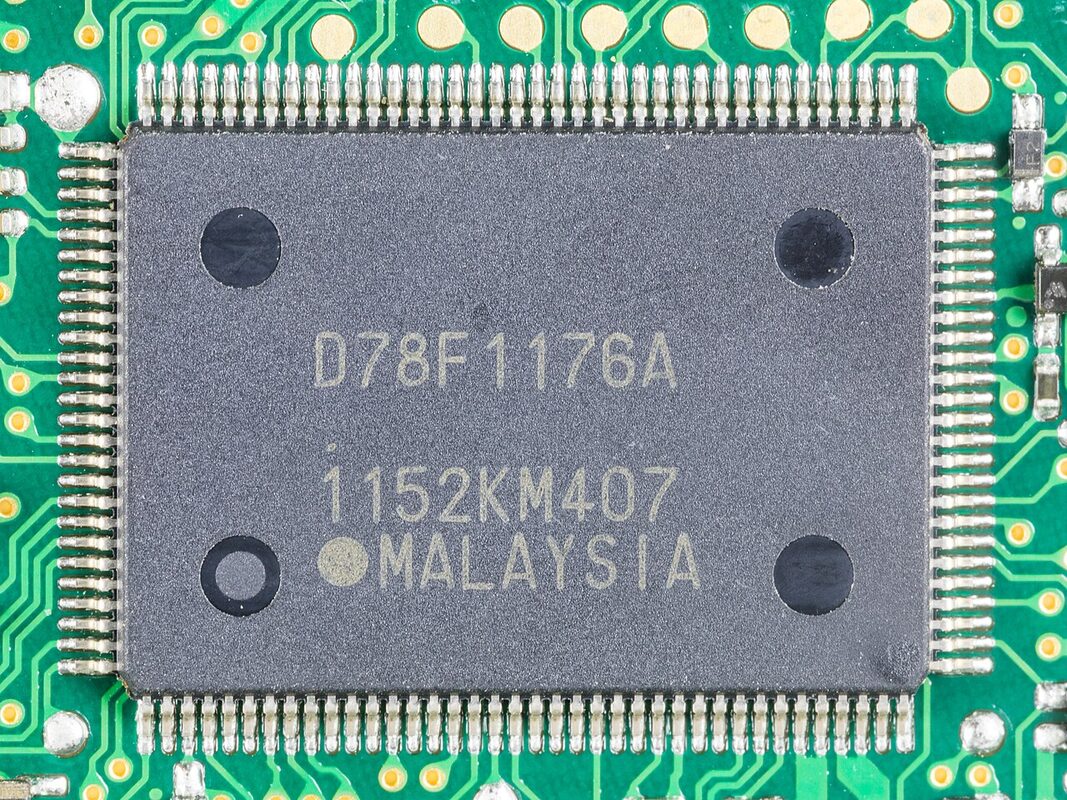
Renesas has added a new entry-level part to its RL78 16-bit microcontroller family. The RL78/G21 is built for system control in large appliances: air conditioners, refrigerators, washing machines and microwave ovens, according to IoT Now. Renesas' headline claim is an operating current of 34 µA/MHz, which the company says is "nearly half" that of its RL78/G13 products. The announcement also gives the existing RL78/G23 more capacitive-touch channels. The Renesas newsroom dates the press release October 28, 2026. Trade coverage in EE Journal and IoT Now is dated October 29. Renesas says both the G21 and the new G23 devices are available now.
This chip is not meant for hobby dev boards. It is a cost-optimized appliance controller, and it is worth knowing about as a price and spec reference point at the cheap end of the embedded market. What follows is what Renesas has published, with each figure attributed to its source.
The silicon, by the numbers
The figures below come from the RL78/G21 product page unless noted otherwise:
- CPU: RL78-S3 core at 32 MHz. Renesas' own comparison lists the RL78/G13 on the older RL78-S2 core.
- Memory: 128 KB or 256 KB code flash, 8 KB SRAM, 4 KB data flash.
- Supply: 1.6 V to 5.5 V.
- Operating temperature: Ta −40 °C to +105 °C.
- Packages: 20- to 64-pin, in LSSOP, LQFP and LFQFP.
- I/O ports: 17, 29, 41, 45 or 59, depending on package.
- Serial: 4 SCI/UART channels on the product page, which also lists UART, SPI and I²C interfaces. The press release adds a newly introduced UARTA communication interface, described as an upgrade over the RL78/G13.
- Analog: 10-bit A/D converter, 6 to 12 channels.
- Timers: eight 16-bit timers.
- Security/identity: Unique ID and a true random number generator (TRNG). The press release adds flash read protection, a flash shield window and a Customer ID.
- Product longevity: 2037, as listed on the product page.
The press release also claims ±1.0% accuracy for the on-chip high-speed oscillator (HOCO) and ±4 kV HBM ESD tolerance. Renesas notes that the ESD figure applies to the G21 only. It also says an IEC 60730-compliant self-test library is available, which matters for safety certification of appliance controls.
Where the 34 µA/MHz figure comes from, and what it means
Renesas gives 34 µA/MHz as the G21's operating current and describes it as nearly half that of "the leading RL78/G13 MCU products." The comparison is against Renesas' own older part, not a competitor. EE Journal's coverage repeats Renesas' headline, which says the G21 cuts power consumption by half and that the RL78 family has achieved top ULPMark-PeripheralProfile scores. Neither the press release nor the trade coverage quoted here gives an actual ULPMark score, so we don't print one. Readers who need a specific number should go to the EEMBC listing or the Renesas datasheet rather than the marketing copy.
For a rough sense of scale, a µA/MHz rating is a linear active-current estimate. Applied to the full 32 MHz, it gives roughly 1.1 mA of core operating current (34 × 32 = 1,088 µA). That figure is our arithmetic, not a Renesas specification. Real current depends on which peripherals are running, the supply voltage, and the conditions Renesas used for its measurement, and none of the sources here spell those out.
Fewer parts on the board
Renesas' design pitch, beyond power, is a smaller bill of materials. According to the press release, the ±1.0% HOCO and the 4 KB of data flash together "eliminate" the need for an external oscillator and an external EEPROM. In an appliance controller that ships in very large volumes, dropping a crystal and a serial EEPROM saves cost, board area and assembly steps. For an engineer weighing the G21 against a cheap 32-bit part, those savings belong in the comparison along with the chip price.
Renesas also says the ±4 kV HBM ESD tolerance contributes to higher reliability throughout manufacturing and assembly, as well as during operation of the end product, and its business division manager calls it a key differentiator.
Drop-in path from RL78/G13 and G23
Both Renesas and IoT Now describe the G21 as pin and function compatible with the RL78/G13 and RL78/G23. Renesas says customers can transition designs to the new devices with minimal redesign effort. For a design already on the G13, that points to a newer core, lower operating current and the UARTA interface without a new board layout, though you should confirm package and peripheral details against the datasheet. The product page also cites hardware and software compatibility with both siblings as a way to reuse existing design assets. EE Journal reports that Renesas cites the No. 1 global market share in 16-bit MCUs, which is the company's claim and not one we have checked independently.
RL78/G23 gets more touch channels
The second half of the announcement is an expansion of the existing RL78/G23 lineup. According to the press release, the R7F104G variant of RL78/G23 offers 24 capacitive-touch channels in the 44-pin version and 25 in the 48-pin version. The existing R7F100G offers 14 and 16 in the same versions. For appliance front panels with many touch keys and sliders, that is a substantial increase in channel count. Renesas also says it provides common touch peripheral functionality and its QE for Capacitive Touch tool across the RL78, RX and RA families.
What It Means for Makers
Who it is for: Embedded engineers designing cost-sensitive consumer and appliance products, and existing RL78/G13 users looking for a pin-compatible upgrade. Renesas' named targets are air conditioners, refrigerators, washing machines and microwave ovens. Hobbyists are not the audience. The G21 is a 16-bit proprietary architecture with no wireless (the product page lists wireless as "No"), and it competes on price and power against a large field of low-cost 32-bit parts.
What it replaces or enables: It is a pin- and function-compatible step up from the RL78/G13. Per Renesas, it may let a design drop the external oscillator and EEPROM, and it brings a TRNG and Unique ID to the low end of the range. Its 1.6 to 5.5 V supply range means it can run directly from a 5 V rail, which many older 8- and 16-bit designs rely on.
Development support: Renesas lists support in its Smart Configurator tool and on a Fast Prototyping Board (FPB). The sources quoted here give no part number or price for a G21-specific FPB, so check Renesas' tools listing before assuming one exists for your package.
Price and availability: Renesas says the RL78/G21 is available now, as of the October 28, 2026 announcement. Suggested resale pricing, which Renesas says is for reference only and based on a 10,000-unit purchase quantity in U.S. dollars, starts at US$0.56 for the 128 KB flash, 44-pin LQFP version and US$0.77 for the 256 KB flash, 44-pin LQFP version. Those are launch prices for volume orders. Single-unit distributor prices will be higher, and Renesas has not published them in these sources. The new RL78/G23 R7F104G touch variants are also described as available.
Even if you never put a G21 on a board, the launch is a useful reference point: Renesas is selling a 32 MHz, 256 KB MCU with a TRNG, a 1.6 to 5.5 V supply range and a 2037 product longevity listing for under a dollar at volume.
Sources
- Renesas Expands RL78 Family with Ultra-Low-Power 16-Bit RL78/G21 MCU (Renesas press release)
- RL78/G21 product page (Renesas)
- Renesas expands RL78 family with ultra-low-power 16-bit RL78/G21 MCU (IoT Now, Oct 29 2026)
- Renesas Expands RL78 Family with Ultra-Low-Power 16-Bit RL78/G21 MCU (EE Journal, Oct 29 2026)
