
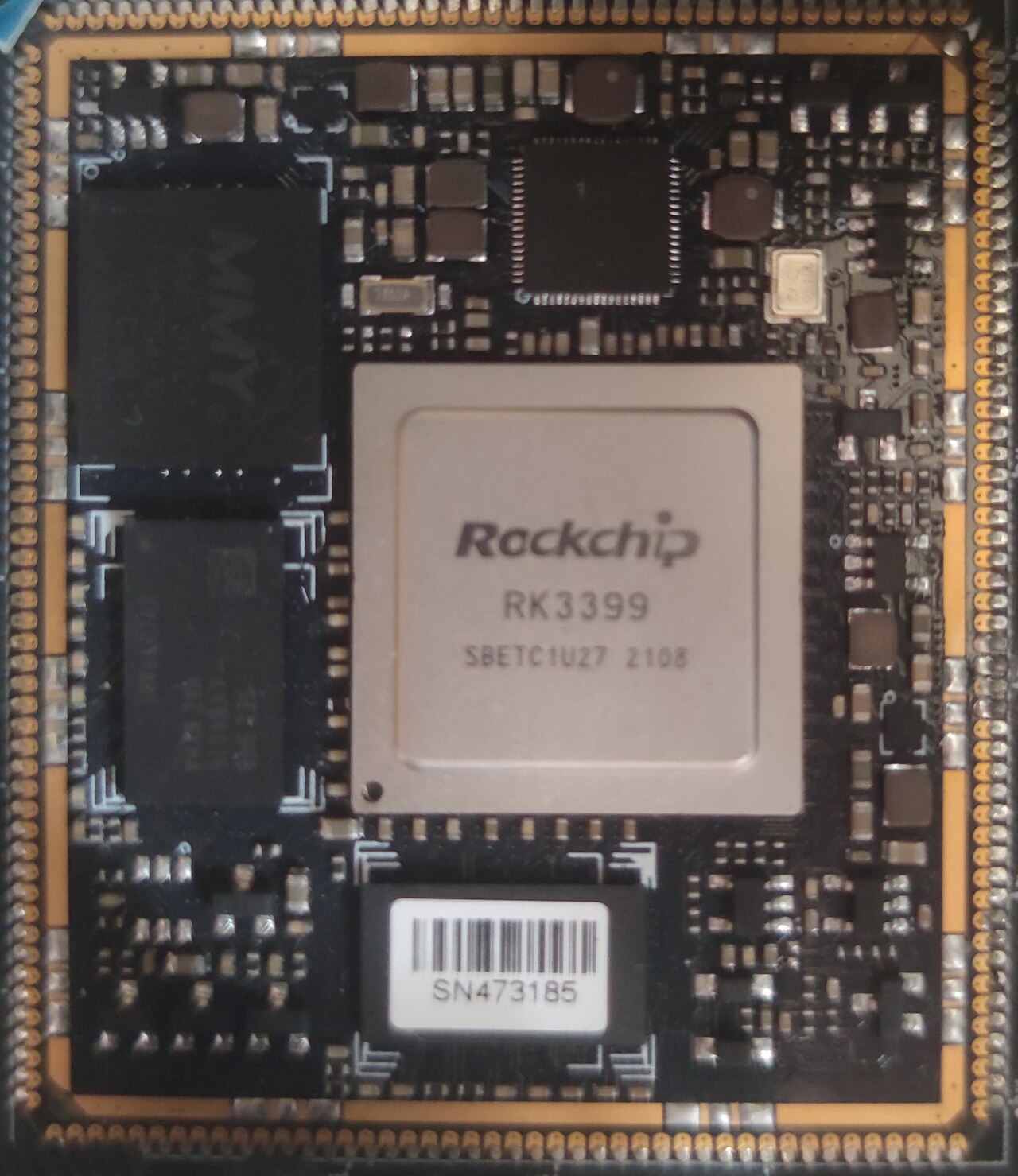
The RK3668 that Rockchip first showed in July 2025 had ten cores: four Cortex-A730 and six Cortex-A530. That chip will not be built. A nine-page Rockchip application deck, labelled REL02 and dated 2026-10-09, describes a different RK3668. It is a 6nm octa-core part with six Cortex-A725 cores and two Cortex-A520 cores, a Mali G2-series GPU and a neural processing unit rated at 44 TOPS sparse. According to CNX Software, the redesign happened mostly because the Cortex-A730 and Cortex-A530 cores were never launched.
The deck carries Rockchip's confidential marking. Radxa hosts the PDF, and ArmSoM has republished it with an English translation. ArmSoM says plainly that its translation is editorial, not an official Rockchip English edition. Some of the slide text is in Chinese. The figures below come from the deck and the coverage that cites it. Rockchip itself describes many of them as "expected", and CNX calls the specs preliminary.
The CPU: Armv9.2, 64-bit only
The CPU page of the deck lists an ARMv9.2 cluster:
- 6x Cortex-A725, up to 2.5GHz (expected)
- 2x Cortex-A520, up to 2.2GHz (expected)
- 4MB L3 cache, 4MB system-level cache (SLC), 4MB SRAM
- 64-bit only, with no direct support for 32-bit APK or ELF binaries
ArmSoM's write-up adds the architecture features the deck lists: SVE2, RME, MTE, PAC and BTI. LinuxGizmos, which reported on 2026-10-24 from an application brief shared by Radxa, also lists SVE2, MTE and PAC. CNX notes that the clock speeds are Rockchip's own estimates.
The 64-bit-only line affects anyone moving an existing userland over. Older RK3588 images that still ship armhf binaries, or Android builds that rely on 32-bit APKs, will not run those binaries directly on this core complex. Plan to rebuild them.
GPU and NPU
The spec page lists a Mali G2Pro MC4 with virtualization, rated at 1.23 TFLOPS. The GPU page gives an expected maximum GPU clock of 1.1GHz and support for up to 16 virtual machines. LinuxGizmos specifies the 1.23 TFLOPS figure as FP32. The roadmap slide calls the GPU simply "Mali G2".
The NPU is rated at 44 TOPS (sparse), and the asterisk on the roadmap slide refers to that sparse qualifier. LinuxGizmos describes it as sparse INT8. CNX reads the slide as apparently five NPU cores of up to 8.8 TOPS each, which multiplies out to 44. CNX also warns that the NPU slide is marketing material with no benchmark data. A sparse TOPS figure assumes the model can exploit sparsity, and dense throughput is usually lower. None of the sources gives a dense number.
Memory and storage
The deck lists two memory options: 64-bit LPDDR5x-8533 or 96-bit LPDDR6-10667. CNX and the deck's memory page give up to 64GB of addressing. The deck works out usable LPDDR6 bandwidth in two steps: 128 GB/s × 0.88 = 112 GB/s, then 112 GB/s × 0.8 = 90 GB/s (rounded). ArmSoM notes the coefficients are not fully explained. CNX reports the same thing as 128 GB/s theoretical and 90 GB/s usable.
Storage options in the deck are eMMC 5.1 HS400, SDIO 3.0, NVMe, SFC (serial flash) and UFS 4.0 2-lane Gear5B. CNX puts the UFS 4.0 interface at up to 11.7 GB/s.
I/O: where the RK3668 departs from hobby SoCs
The interface list on the spec page is long, and it reads more like an industrial or edge-server part than a set-top-box chip:
- PCIe 5.0: listed as 4 controllers, with a breakdown of 1x 4-lane, 2x 2-lane and 2x 1-lane (ArmSoM notes the total and breakdown are ambiguous)
- PCIe 3.0: 5 controllers
- Storage/networking combo: quad SATA 3.1, dual USB 3.0 DRD, dual XGMII, triple 10-G PHY combo, dual RGMII
- USB: USB 3.2-10G DRD with Type-C and DP, one USB 2.0 OTG, dual USB 2.0 host
- Display: up to 2x 8K60 or 6x 4K60. Two HDMI 2.1/eDP 1.4/DP combo outputs with DSC, one 4-lane MIPI-DSI TX with DSC, and Type-C with USB 3.2 Gen2x1 and DP
- Camera: dual 24M plus one 16M ISP, 4x MIPI CSI-2 and DVP
- Video: H.265/H.264/VP9/AV1/AVS2 decode up to 8K@120, and H.264/H.265 encode at 8K@60 10-bit/YUV444
- Audio: 20-lane SAI, 2x 8-channel PDM
- Low-speed: I2C, I3C, SPI, UART, GPIO, 6x CAN, DSMC
- Safety and security: a safety domain with dual M52 cores in DCLS (dual-core lockstep), plus TrustZone, secure boot and HDCP
The six CAN controllers and the lockstep safety island stand out. Together they point at automotive, robotics and industrial control as target markets. The deck does not give per-interface lane-sharing rules or pin multiplexing tables, and the package is listed as "TBD" with a 0.65 pitch. Exact GPIO counts and how these interfaces map onto pins are therefore unknown.
How it compares with the RK3588
The roadmap slide places the RK3668 next to the RK3588 (8nm, 4x A76 + 4x A55, 6.0T NPU) and shows the RK3688 flagship separately. CNX reports these Rockchip benchmark claims for the RK3668 against the RK3588:
- About 2x the multi-core DMIPS
- +49% in Geekbench 6 single-core
- 2.4x raw GPU throughput (1228 GFLOPS)
- GFXBench Manhattan 3.0: 287 FPS vs 144.4 FPS
These are vendor numbers for silicon that is not yet sampling, so treat them as targets. ArmSoM also warns that RK3668 specs should not be relabelled as RK3688 specs. The RK3688 is still the separate future flagship, which CNX expects in late 2027 or 2028.
What It Means for Makers
Who it is for: mainly SBC and system-on-module vendors, and through them developers building edge-AI boxes, NVR and multi-camera vision systems, multi-display signage, and CAN-connected robotics or vehicle controllers. LinuxGizmos describes the chip as positioned above the RK3588, which makes it the step up for anyone who has outgrown that chip's 6 TOPS NPU.
What it enables: on paper, PCIe 5.0 NVMe, multiple 10GbE links, quad SATA, UFS 4.0 and LPDDR6 bandwidth on a single Rockchip part. If the 44 TOPS sparse figure holds up for real workloads, it also means much larger on-device models than current RK3588 boards can run. Whether that happens depends on Rockchip's NPU toolchain and on how much sparsity real models can use. None of the sources gives benchmark data for the NPU.
What to watch out for: the 64-bit-only CPU, a package that has not been finalised, and clocks and GPU frequency that Rockchip itself labels "expected". Mainline Linux support was not addressed in any of the sources.
Price and availability: none of the sources gives a price for the chip or any board; LinuxGizmos says pricing has not been announced. The RK3668 is at the announced/roadmap stage. The deck gives availability as "ES in 2027Q1". ArmSoM stresses that this is an engineering-sample planning milestone, not mass production or an ArmSoM product launch. CNX expects early RK3668 SBC prototypes in the first half of 2027. None of the sources mentions pre-orders or shipping.
Sources
- RK3668 Application, Rockchip slide deck REL02 (2026-10-09), hosted by Radxa
- CNX Software: Rockchip RK3668 switches to Cortex-A725 and Cortex-A520 cores, engineering samples planned for Q1 2027 (2026-11-17)
- ArmSoM: RK3668 application guide: technical slides, 44 TOPS NPU and PDF download (2026-11-06)
- LinuxGizmos: Rockchip RK3668 Targets Edge AI with 44 TOPS NPU and PCIe 5.0 (2026-10-24)
