
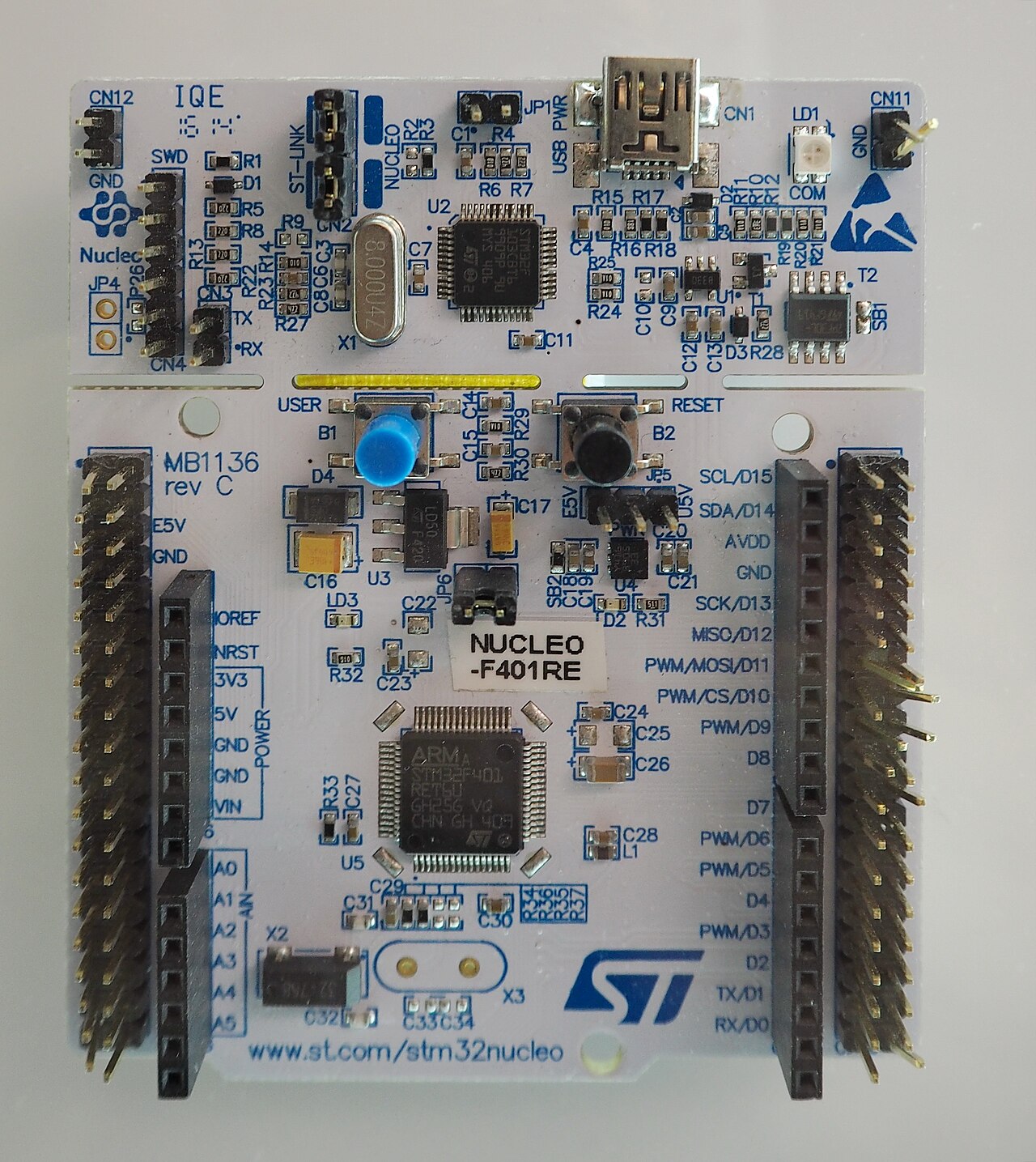
STMicroelectronics announced the STM32G5 on November 4, 2026. It is a mixed-signal microcontroller series and the successor to the STM32G4, which has been a common choice for digital power and motor control for years. In its press release, dated Geneva, ST aims the part at two markets: real-time power conversion in AI datacenter power supplies, and motor control in robotics, including humanoid robot hands. ST says the series is in production now. The press release lists a Nucleo board and two discovery kits as part of the ecosystem.
The headline numbers are a faster core, a finer-grained timer, and a block of programmable logic. ST's own blog post gives the full breakdown, and it reads like a list of complaints from the G4 era that ST decided to fix.
The core: Cortex-M33 replaces Cortex-M4
The STM32G4 used an Arm Cortex-M4 at 170 MHz. The STM32G5 moves to a Cortex-M33 at 280 MHz with TrustZone. ST's blog gives the benchmark comparison: 1136 CoreMark for the STM32G5 against 569 for the STM32G4. The press release quotes the same CoreMark figure plus 420 DMIPS, and describes the result as twice the compute of the STM32G4. Two FMAC (filter math accelerator) units handle filter math so the CPU doesn't have to, which matters in control loops where every cycle in the interrupt counts.
On memory, the blog lists up to 512 KB of flash, with an optional dual-bank layout of 2x256 KB. It also lists 96 KB of data flash and SRAM with ECC. The press release gives the full range of on-chip flash across the series as 64 KB to 512 KB, and the blog says a 256 KB flash version is coming. ST has not published an SRAM capacity in either source we read, so we are not quoting one.
The timer: 111 ps across 12 channels
This peripheral is the main reason most power-electronics engineers will look at the part. ST says the STM32G5 is the first MCU to carry its enhanced 12-channel high-resolution timer. According to the blog, resolution improves to 111 ps from the STM32G4's 184 ps. In a switched-mode converter, finer PWM edge placement means finer control of duty cycle at high switching frequencies. That makes it easier to regulate tightly without dropping switching frequency or living with limit-cycle oscillation. Twelve channels also leave room for multiphase and interleaved topologies on one chip.
Around the timer, ST lists a 12-bit ADC at 5 Msps (up from 4 Msps on the G4) and an ultra-fast comparator with 20 ns response. For motor control, there is a hardware position encoder interface that the press release calls POSENC.
PLAy: a small programmable logic array
The STM32G5 includes a programmable logic array that ST brands "PLAy". The blog describes it as having 16 logic elements. That is far too small to be an FPGA. Its job is glue logic: combining comparator outputs, building custom fault or blanking conditions, or gating timer signals in hardware without a round trip through the CPU. Designers have traditionally done that with discrete logic or by stretching the timer's built-in event routing. Sixteen elements is modest, but in power stages, a fault path that never waits on firmware is worth having.
Connectivity and security
ST's blog lists USB Full Speed and I3C among the interfaces. For security, the press release names STiRoT secure boot and post-quantum cryptography (PQC) libraries. Together with TrustZone on the M33, that puts the G5 in a different security class from the G4. ST's press release says the security features, including provisioning, support current and upcoming compliance requirements in datacenters.
Five dies, many packages, and a dual-core follow-up
The blog says the STM32G5 family is built from five dies, compared with three for the STM32G4. The press release gives package options from QFN32 to LQFP128. ST did not give per-package GPIO counts in the material we reviewed, so check the datasheet for any specific part number before laying out a board.
A dual-core variant, which the blog calls the STM32G5D, is due next year. The press release says the dual-core products arrive in 2027. ST also announced the STM32H7P on the same day, according to its blog, but that is a separate high-performance line.
On the software side, the press release says the series is supported by STM32CubeMX2 and HAL2, ST's newer generation of configuration tool and hardware abstraction layer. Teams porting G4 code should expect some API migration work in addition to the core change.
What It Means for Makers
Most hobbyists will never need 111 ps PWM edges. The STM32G5 is built for people designing power stages and motor drives: hobby builders of BLDC/FOC controllers, students in power-electronics labs, and engineers prototyping converters. For that group, it is a direct upgrade from the STM32G4. You get roughly twice the CoreMark score, a finer and wider high-resolution timer, a faster ADC, hardware logic for fault handling, and ECC on SRAM. A part with this feature set is a reasonable choice for control loops where a corrupted variable can destroy hardware.
For anyone else, the useful takeaway is that a Cortex-M33 with TrustZone, USB Full Speed and I3C now sits in ST's mixed-signal line, with a Nucleo board listed in ST's launch material. Circuit.rocks, which covered the launch on November 5, points readers to any STM32 dev board with a built-in USB debug probe and the free STM32CubeIDE as a low-cost way to start with the family. Note that the STM32G5 itself is priced and sold for volume buyers.
Boards: the press release lists the NUCLEO-G564RE development board, the B-G564E-MC1S motor-control discovery kit and the B-G564E-DPOW1 digital-power discovery kit. ST's announcement did not include prices for the boards.
Price and availability: ST says the STM32G5 is in production now, with prices from $1.0340 (USD) for orders of 10,000 units at launch (November 4, 2026). Circuit.rocks also reports the parts as orderable at $1.034 each in 10,000-unit quantities. Single-unit distributor pricing will be higher and was not stated in the sources. The dual-core STM32G5D is expected in 2027.
A practical caution: the discovery kits are made for power and motor work. If you take one beyond logic-level experiments, use proper current-limited bench supplies and follow ST's kit documentation. This article covers the silicon. It is not a wiring guide.
Sources
- STM32G5: 2x the performance, unprecedented peripherals (The ST Blog)
- STMicroelectronics reveals advanced microcontrollers for real-time power control in AI datacenters and robotics (ST press release via GlobeNewswire, read via mirror)
- STM32 Gets One Platform: What ST's Cortex-M Shift Means (Circuit.rocks)
