
The Raspberry Pi has been sold as a "PLC" many times. Usually that means a carrier board, a plastic DIN-rail case and a hopeful datasheet. Synergy Logic's new SLM-RP4 is a fuller attempt. It is a stock Raspberry Pi 4 Model B in a fanless aluminum enclosure that runs from 24V DC. It is listed to UL 61010 and CE marked to EN 61131-2, and an SPI backplane lets it stack up to eight of the company's own I/O modules. CNX Software reported the controller on 27 October 2026. On the same date, the maker's store lists it as in stock at $249.00.
This piece goes through what the hardware is, what the backplane changes compared with the earlier SL-RP4, how the software side works, and what an actual build costs.
The compute side: an unmodified Pi 4
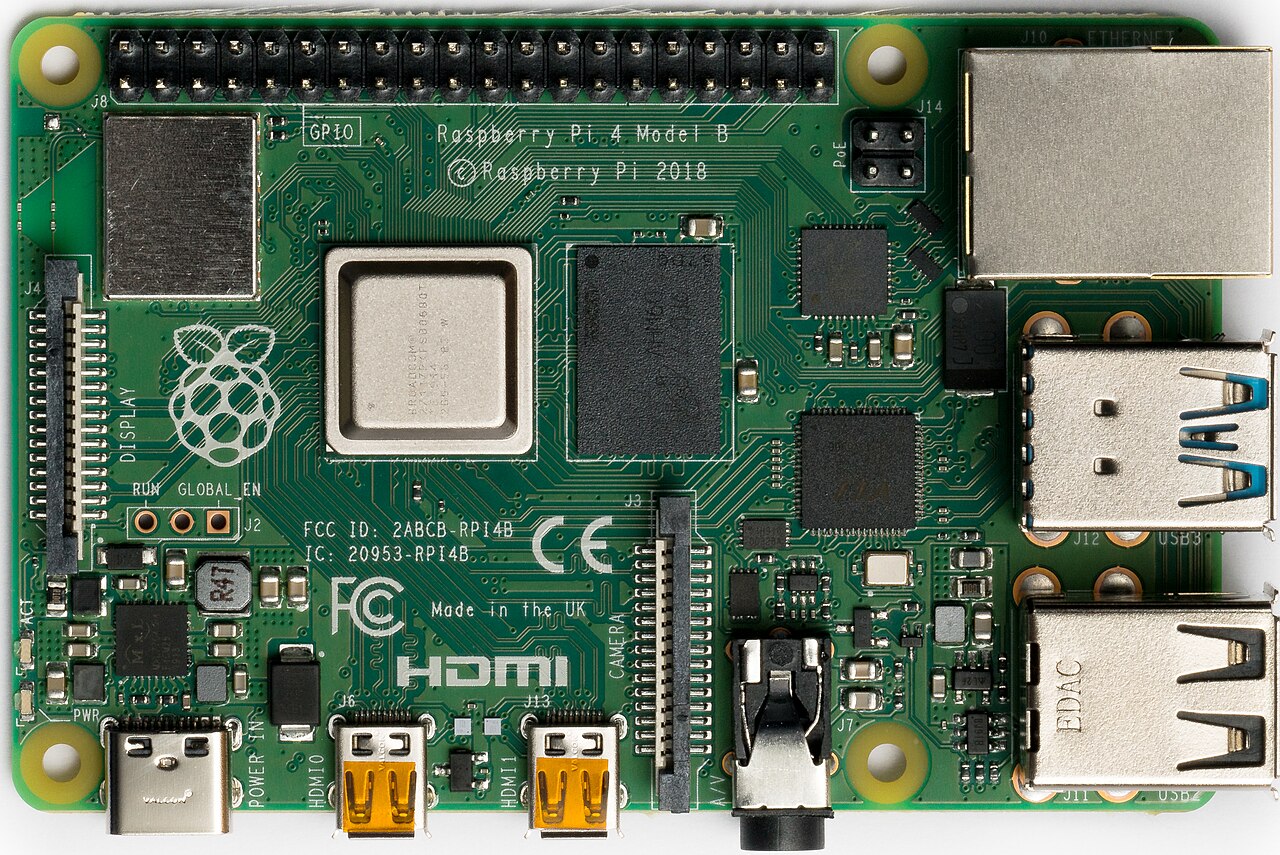
Synergy Logic did not design a custom compute module. According to CNX Software, the controller is a Raspberry Pi 4 Model B with 2GB of RAM and boots from a 16GB microSD card. All the usual Pi 4 ports are exposed:
- 2x micro-HDMI
- Gigabit Ethernet
- Dual-band WiFi 5
- Bluetooth 5.0 / BLE
- 2x USB 3.0 Type-A and 2x USB 2.0 Type-A
- 1x USB-C, used here for auxiliary power
The maker's documentation calls it "an industrial controller built around a Raspberry Pi 4 compute platform". That choice matters for long-term maintenance. Storage is a microSD card rather than soldered eMMC, so replacing it means swapping a card.
The industrial side: power, enclosure, certifications
CNX Software gives the power input as 24V DC Class 2 (+/-25%) via a terminal block. A separate 5V/3A input over USB-C powers the controller only. CNX Software states that this USB-C input does not power the I/O backplane, so field I/O needs the 24V DC supply.
Mechanical and environmental figures, per CNX Software:
- Weight: 289 g
- Operating temperature: 0 to 50 C
- Enclosure: fanless aluminum, open equipment, 35mm DIN rail mounting
- Certifications: UL 61010 and UL 61010-2-201 listed; CE marked to EN 61131-2 and EN 61010
The certifications are the main point here. EN 61131-2 is the equipment requirements and tests part of the IEC 61131 PLC standard. UL 61010-2-201 covers control equipment. For anyone who has to get past an inspector or a customer's compliance checklist, listed equipment is very different from a hobby board on a DIN-rail clip. The sources give the standards but no certificate numbers, so integrators should get the listing documents from the vendor.
What the backplane adds
The "M" in SLM-RP4 is the modular backplane. CNX Software describes it as an SPI backplane supporting up to eight stackable SLM modules. There are 18 compatible module models and a ceiling of up to 128 I/O points. The earlier, non-modular SL-RP4 remains in the catalog at $149.00, so the extra $100 pays for the expansion bus.
The maker's documentation lists the module families as discrete I/O, relays, analog current and voltage, and thermocouples. CNX Software gives these examples:
- 8-channel analog inputs, 0-10V or 0-20mA, at 13-bit resolution
- 8-channel analog outputs at 12-bit resolution
- 4-channel thermocouple input supporting J, E, K, R, S, T, B, N and C types
One limitation is stated plainly: CNX Software lists the modules as not hot-swappable. Anyone used to hot-swap I/O on larger PLC racks should plan maintenance windows around this.
Software: OpenPLC, or skip it entirely
The unit runs Raspberry Pi OS with OpenPLC Runtime preinstalled. CNX Software says it supports OpenPLC Editor 4.3.1 or newer, the IEC 61131-3 languages LD, ST, FBD and IL, and Python and C++ blocks inside those programs. Other details from the same report:
- I/O scan interval adjustable from 1 ms to 1000 ms, default 10 ms
- A hardware watchdog
- FUXA HMI/SCADA integration over Modbus TCP
The more interesting option for PinoutFeed readers is the second route in the maker's manual. Synergy Logic ships its Python and C++ libraries preinstalled and documents "stand-alone" Python or C++ programs that use those libraries directly, with OpenPLC left out. CNX Software notes the two methods cannot be used at the same time. That gives two ways to program the same hardware. A controls engineer can write ladder logic in a familiar IEC environment. A developer who would rather write a Python service with an HTTP API, a database client or a vision pipeline can drive the same I/O without going through a PLC runtime. The sources do not say how the libraries' timing compares with the OpenPLC scan loop, so determinism figures for the stand-alone route are unknown.
The OS image is real, published software. Synergy Logic's GitHub organization has one public repository, Synergy-Logic/SLM-RP4, described as "Images for SLM-RP4". Its release 1.0.4, published 13 October 2026, contains a single asset, slm-rp4-1.0.4.img.xz, at 1,855,742,192 bytes (about 1.86 GB compressed). The release notes are empty and the repository has one commit. It holds an OS image, not an open development history.
What a build actually costs
The Synergy Logic store listed 21 products on 27 October 2026. Prices below are as listed, in US dollars:
- SLM-RP4 (stock code 9300-00001): $249.00, In Stock
- SL-RP4 (9300-00002): $149.00, In Stock
- SLM-MX (9300-00003): $99.00
- SLM-DCI-16NP: $92.40
- SLM-RLY-16: $126.00
- SLM-AI-8-mA: $153.60
- SLM-AI-8-V: $151.20
- SLM-THM-4: $206.40
- SLM-SIM-8: $52.00
- SLM-AO-8-V: $182.40
The modules cost a lot relative to the base. A controller with one SLM-RLY-16 and one SLM-AI-8-V comes to $526.20 from those listings, before power supply, rail and shipping. Filling all eight slots with the cheapest listed analog module, the SLM-AI-8-V, would add $1,209.60 for a $1,458.60 system, again before power supply, rail and shipping. That is far from Pi-hobby money.
Where it sits in the Pi-PLC field
CNX Software compares the SLM-RP4 with three existing products: Industrial Shield's Pi PLC, the EDATEC ED-PLC2010, and Sfera Labs' Strato Pi Max. The ED-PLC2010 differs the most. It is built on a Compute Module 4 rather than a full Pi 4, it supports up to 32 expansion modules against the SLM-RP4's eight, and it targets CODESYS rather than OpenPLC. The SLM-RP4's selling points are a stock Pi 4 board, an open-source runtime, and the option to skip the runtime entirely.
What It Means for Makers
The SLM-RP4 is aimed at small integrators, plant engineers on a budget, educators teaching IEC 61131-3, and makers whose automation projects have outgrown a breadboard and now need a listed enclosure and 24V field wiring. It can replace a homemade "Pi in a box with a relay HAT" in places where certification matters. It can also stand in for an entry-level commercial PLC where the team would rather work in Python or C++ than a vendor IDE.
It does not suit applications that need hot-swap I/O, more than eight modules or 128 points, or operation outside 0 to 50 C. The 2GB Pi 4 is also a fixed choice. The sources mention no RAM or compute variants.
On status and price: Synergy Logic's store listed the SLM-RP4 as In Stock at $249.00 on 27 October 2026, with I/O modules sold separately at $52.00 to $206.40 each among the listings above. The non-modular SL-RP4 is also in stock at $149.00. The product is shipping, not a pre-order or a crowdfunding campaign.
