
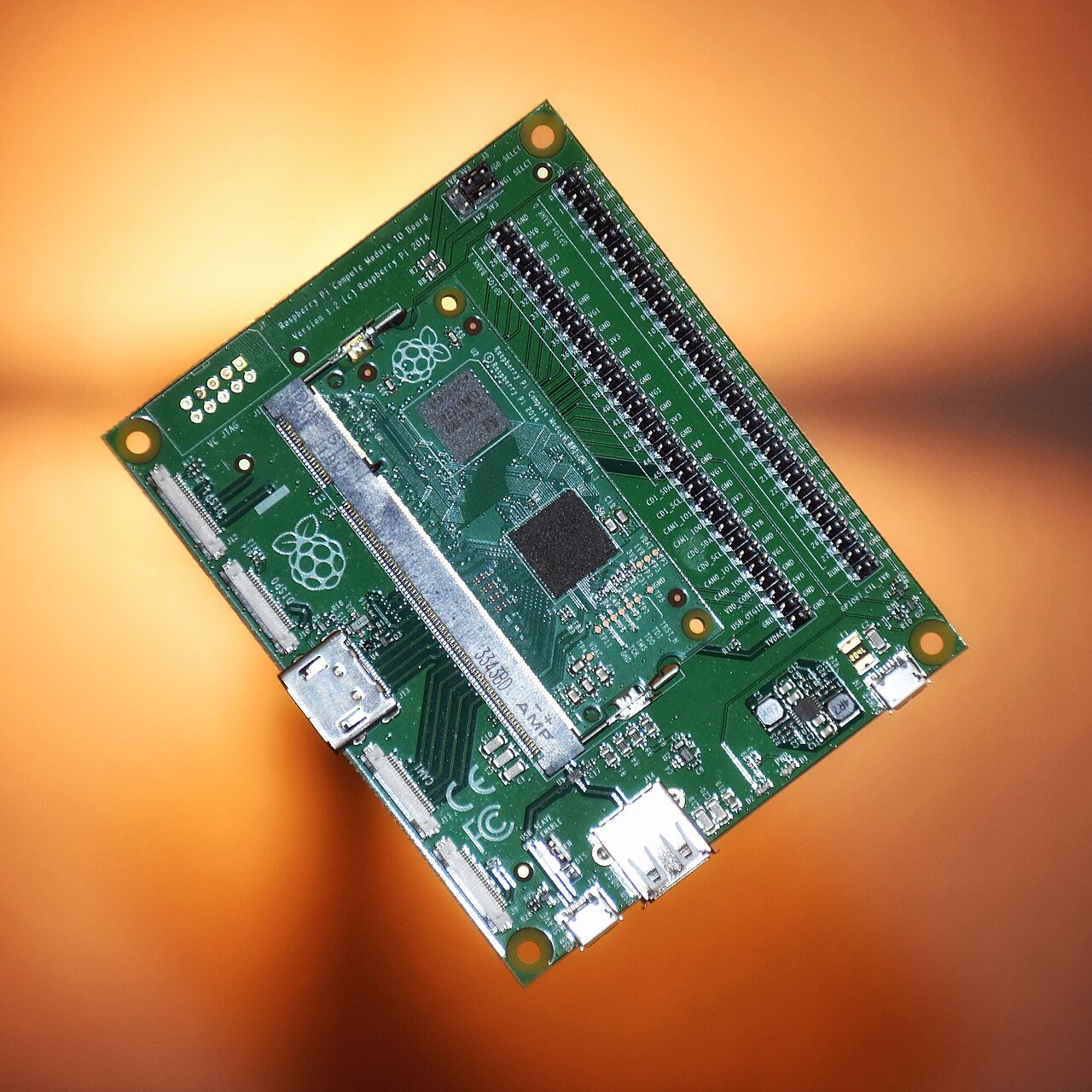
The Raspberry Pi Compute Module footprint has become a standard of its own. Many carrier boards, enclosures and industrial baseboards are built around the pair of high-density connectors on the underside of a CM4 or CM5. Italian company RELOC is now aiming a microcontroller at that ecosystem. Its SCINTIX P4 puts Espressif's ESP32-P4 application MCU and an ESP32-C6 wireless companion on a module with the CM4/CM5 form factor. A pre-launch page is up on Crowd Supply, and a community write-up appeared on the Espressif Developer Portal on October 28.
On its Crowd Supply page, RELOC calls the SCINTIX P4 the first MCU-based compute module in the CM4/CM5 form factor. The GitHub README hedges it as "to our knowledge", and we have not independently checked it. Either way, the idea is unusual: the module gives up Linux, and in return it gets a microcontroller's boot time, determinism and power profile while still plugging into Pi carrier hardware that people already own.
The silicon
The manufacturer's GitHub README lists the SoC as the ESP32-P4NRW32X. Crowd Supply describes the ESP32-P4 as a dual-core RISC-V processor at 400 MHz with AI instruction extensions and a single-precision FPU, plus a low-power core. The README gives the LP RISC-V core's clock as up to 40 MHz. It lists the on-chip memory as 768 KB of HP L2MEM, 32 KB of LP SRAM and 8 KB of TCM.
External memory is the same on both pages: 32 MB of PSRAM and 32 MB of NOR flash. For an MCU board that is a lot of memory. That headroom suits the MIPI display and camera interfaces the module exposes.
RELOC pairs the ESP32-P4 with an ESP32-C6 as a wireless companion. Crowd Supply says the C6 provides Wi-Fi 6, Bluetooth 5 and IEEE 802.15.4, which covers Zigbee, Thread and Matter. The README says the C6 connects to the P4 over a 4-lane SDIO interface plus UART.
Interfaces and mechanicals
Per the README, the module provides:
- Display and camera: 2-lane MIPI DSI and 2-lane MIPI CSI.
- Ethernet: an on-board 10/100 PHY, the Microchip KSZ8091RNACA. The module routes Ethernet to the carrier, so a CM4/CM5 IO board's RJ45 jack can be used.
- USB: a USB Type-C port on the module for power and programming, and USB 2.0 OTG host routed through the CMx connectors.
- GPIO: 23 ESP32-P4 GPIOs brought out to the carrier's 40-pin header.
- Power: 5 V DC input, either through the CMx connectors or through USB-C.
- Connectors: 2x Hirose DF40C-100DP-0.4V(51), the board-to-board parts used in the CM4/CM5 footprint.
- Dimensions and environment: 55.0 x 40.0 x 5.0 mm, 8.2 g, rated for -20 to 70 °C.
Crowd Supply also says the module can be powered and programmed over USB Type-C on its own, with no carrier attached. That makes it usable as a small development board on the bench before it goes into a baseboard.
A footprint match does not make it a drop-in replacement for a Pi. A CM4 or CM5 carrier is built for a Broadcom application processor, and some of its features have nothing to connect to on an ESP32-P4. The HDMI ports and PCIe slots on those carriers do not carry over. Anyone choosing a carrier should treat the 40-pin header, Ethernet, USB, microSD and the MIPI connectors as the working interfaces and check each one against RELOC's compatibility data.
Carrier compatibility
That data is the most useful part of the Espressif Developer Portal post, written by Leonardo Pedretti of RELOC. The post has support tables for the official Raspberry Pi CM4 IO Board and CM5 IO Board. Each table covers power, USB device, USB host, Ethernet, microSD, display, camera and GPIO, and marks any item that needs changes to work. The post says RELOC tested display output with the Raspberry Pi Touch Display 2 and camera input with an AS-AG638A32 module. The tables also cover some third-party CM4-format carriers.
The post's getting-started section uses ESP-IDF v6.0.1: idf.py set-target esp32p4, with the console on the chip's USB Serial/JTAG interface. It also includes an Ethernet iperf example on the CM4 IO Board, a 30-second UDP test. The post says the example README reports about 73 Mbit/s uplink and 79 Mbit/s downlink on that setup; we have not reproduced those numbers.
Beyond ESP-IDF, the README lists Arduino and PlatformIO support. Crowd Supply says the module runs bare-metal or RTOS firmware. Unlike Linux-based compute modules, it does not run Linux.
What It Means for Makers
The SCINTIX P4 is for people who already have CM4 or CM5 carrier hardware, or who design their own baseboards for that footprint, and who need a microcontroller rather than a Linux computer. Typical uses would be HMI panels on a MIPI-DSI display, camera-equipped sensor nodes, Matter or Thread devices that need wired Ethernet, and control boxes that need instant boot and keep running without an SD card that could get corrupted. A team that started on a Pi CM in a product that turned out not to need Linux could use the same baseboard with the SCINTIX P4 instead of respinning it. Educators with a cupboard full of CM4 IO Boards also get a way to teach embedded RISC-V on hardware they already have.
The limits are just as clear. This is an MCU platform. Code written for Raspberry Pi OS will not run on it, and the carrier's HDMI and PCIe go unused. Applications that need those, or that need a full Linux userland, should stay on a Pi Compute Module.
On status, RELOC's Crowd Supply page says the project is "launching soon". It is marked Coming Soon, has no updates posted, and shows no price and no launch date. This is a pre-launch listing, not an open crowdfunding campaign or pre-order, and nothing is shipping to the public. The GitHub README says board samples are available; contact RELOC for details. We will report pricing and campaign dates once RELOC publishes them on Crowd Supply.
