
Most deepfake countermeasures work on the file: detectors look for synthesis artifacts, and provenance schemes sign the video. The Protector puts the proof in the scene instead. It is a wearable LED pin that, in the words of hardware researcher David Kramer quoted by Tom's Hardware, "flashes a light pattern every second that's generated from a secret key and the time, so nobody without the pin can fake it." The idea is that anyone filmed wearing it can later show the lights in a clip match what their pin should have shown at that moment.
The pin is on pre-order at iamnotfake.com for $120. The site credits The Information Syndicate, and Tom's Hardware attributes the project to Kramer. Tom's Hardware also says plainly that it is not easy to tell whether this is a real product or a piece of commentary. Below is what the sources actually establish, and what they don't.
What is it, physically?
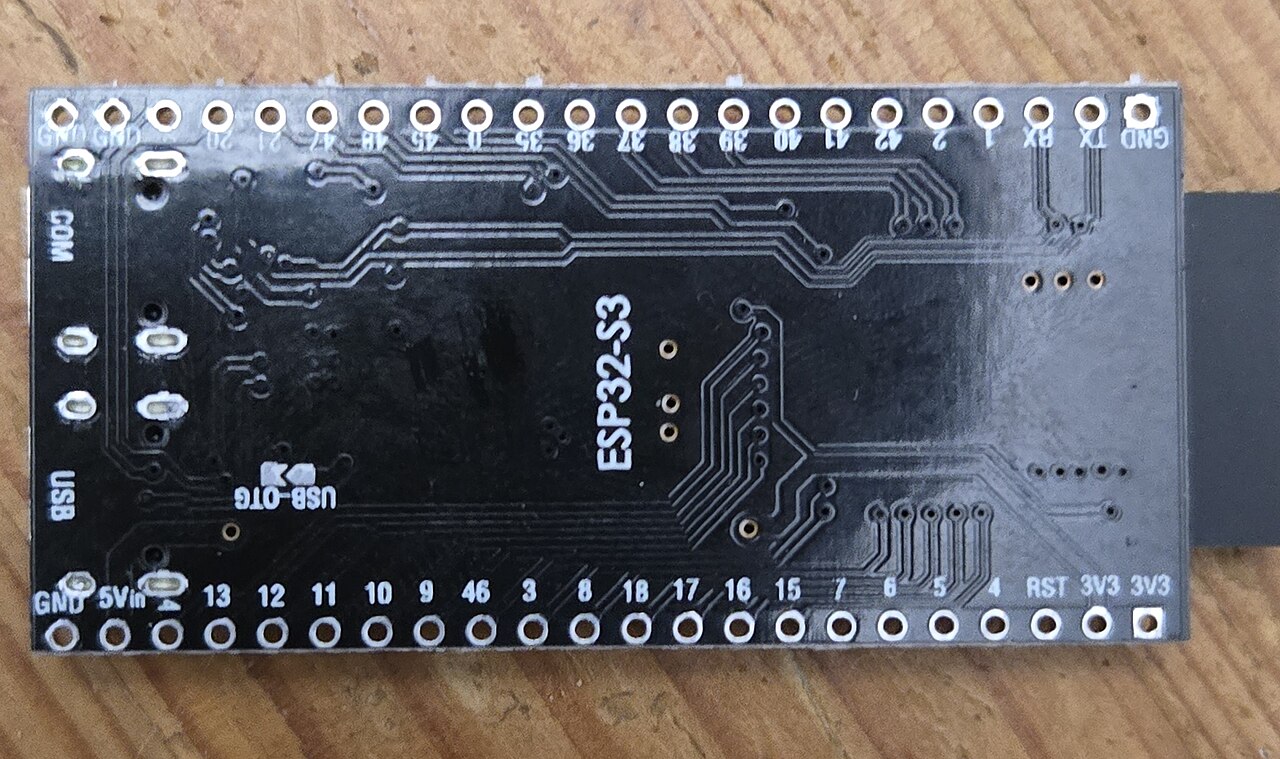
Tom's Hardware describes The Protector as a wearable ESP32-S3-powered pin with an LED matrix. It says the device holds a secret private key and a precise clock, and that it is not connected to the internet except briefly while charging, to keep its clock accurate.
The Circuit.Rocks blog (November 26, 2026) gives more detail. It describes a clip-on badge with a grid of 20 RGB LEDs that shows a new pattern every second. Each LED is red, green, blue or off, which gives 420 combinations, or about 1.1 trillion. According to Circuit.Rocks, early prototypes were LED-strip collars, and the board holds a small compute module, a real-time clock, a touch pad and the LED matrix, on a custom PCB.
Treat that hardware list with some care. Circuit.Rocks says an ESP32 development board appears in build photos taken during development, which does not confirm the final part. Its description is partly inferred from those photos. The only named controller in our sources is Tom's Hardware's "ESP32-S3". The maker's own pages, as we read them, list no chip, LED count, battery or clock specifications. So we can't give you a core count, memory size, radio configuration, battery capacity or runtime, because nobody has published one.
How does verification work?
The scheme works like a time-based one-time password, but you read it with a camera. Because the pattern comes from a secret key plus the current time, anyone holding the key, or a service that can check against it, can work out what the pin should have shown at a given second. A forger without the key can't produce the right sequence.
The maker's verification page describes the checking process. The video is read in your browser and never uploaded. You place the pin's corners and mark the colour of each light in the frame (or enter the lights by hand), then search by pin ID and the time the video was filmed. The page offers time windows from give or take 10 minutes up to a week. Circuit.Rocks describes the same steps: mark four pin corners, confirm the LED states, enter the pin ID and a rough filming time, all without the video leaving your machine. Tom's Hardware's summary says you verify by uploading a video to the site. The maker's own page is the better source on that point, and it says the file stays local.
There is also a way to handle a lost pin. A card in the box carries an owner code that lets you report the pin lost. After that, video of anyone new wearing it won't verify. Earlier matches stay valid but are marked "pin reported lost", and the same code can undo the report if you find the pin. That is basically key revocation without making old footage invalid, which is a sensible choice if the pin's past footage is the whole point.
What does a match actually prove?
Less than the "watermark for humans" pitch suggests, and the sources say so in some form.
- It proves the pin was in the footage, not that every frame is untouched. A correct light sequence shows a genuine pin was filmed at roughly the stated time. It says nothing about the audio, the lip movements, or parts of the frame away from the badge. The verification page itself warns that a match only proves something if those lights were really on the pin in the video.
- Editing the pin out. Tom's Hardware notes that suggestions on the project's YouTube video page include simply removing the pin from the footage. That doesn't fake a match. It just leaves a clip that can't be checked, and that is only a defense if audiences come to expect the pin.
- Keeping the real footage and faking the rest. Tom's Hardware points out that someone could keep the genuine video, with the pin flashing correctly, and deepfake or lip-sync new content over it. Circuit.Rocks makes the same point from the other side: real footage of the pin could be pasted into a fake video.
There are practical limits too, though the sources don't measure any of them. Twenty small LEDs have to be resolved clearly enough in the frame to tell red, green, blue and off apart, through compression, motion blur, exposure and white balance. The verification flow, where you mark the pin's corners and lights yourself, shows the reading is at least partly manual. No source gives figures for capture distance, frame rate, or how much the clock can drift between charges.
Is it serious?
This is the question Tom's Hardware raises and doesn't answer. It notes that the same inventor made a humorous physical NFT-minting device earlier in the year, and says that history makes it hard to be sure whether The Protector is a genuine product or commentary on the escalating arms race between content creators and AI impersonators. The pre-order page does take orders and set terms, which a pure art piece wouldn't need. But the lack of published specs, the dramatic copy ("The Protector is here.") and the creator's track record mean nobody should read this as a mature security product.
For comparison, Tom's Hardware mentions Nvidia's Synthetic Video Detector NIM microservice, revealed at SIGGRAPH in July, as an alternative approach. That is a detection service rather than hardware worn in the shot.
What It Means for Makers
Who it is for: The intended buyer seems to be someone who expects to be filmed and impersonated, such as a public speaker, streamer or executive, and wants a visible, checkable token in their footage. For the PinoutFeed audience, its main value is as a design case study. It applies a well-understood idea, deriving an unforgeable code from a shared secret and the time, to a physical channel, with revocation built into the service.
What it replaces or enables: Nothing yet replaces signed-media provenance or detection tools, and The Protector doesn't claim to. It adds a check that is independent of the camera and works on footage you didn't record yourself, as long as the pin is clearly visible. As the sources note, it does not prove the content is authentic.
Can you build your own? Circuit.Rocks sketches a DIY version: an ESP32, a DS3231 real-time clock, WS2812B addressable LEDs and HMAC-SHA256. That is the blog's own suggestion, not The Protector's design. Nothing in the sources confirms which RTC, LED type or cryptographic primitive the commercial pin uses. A homebrew build would also have no access to the iamnotfake.com verifier, so you would have to write your own, and reading the pattern back from video is the harder software side.
Price and availability: Status is pre-order, not shipping. The maker's site lists the pin at $120 (USD, pre-order price as of November 2026), with "Shipping included · US only · Up to 5 per order" and "Cancel for a full refund any time before it ships." Tom's Hardware reports delivery is promised to U.S. residents by December 18. That is the creator's promise as reported, not a confirmed ship date. This is not open hardware. No schematics, firmware or key-management details have been published. It is a consumer gadget whose security claims have not been independently tested.
