
Plenty of companies sell carrier boards and cases for the Raspberry Pi Compute Module 5. Few of them are PC brands with an industrial line. ZOTAC is now one of those few. The ZBOX PRO CM5-PICO, covered by CNX Software on 24 October 2026, is a passively cooled aluminium box measuring 114.8 x 76.0 x 31.3 mm (0.27 L) and weighing about 250 g. Inside is a CM5 on a carrier that exposes two HDMI outputs, Gigabit Ethernet, an M.2 2280 slot and, unusually for a sealed mini PC, the 40-pin GPIO header.
The product isn't brand new. CNX Software says it was shown at ISE 2026, and Japanese distributor ASK Corporation announced on 11 March 2026 that it had begun handling it. ASK describes it as its first Raspberry Pi-based product. Neither source gives a public price.
A note on sourcing: ZOTAC's own product page wouldn't load for our tools (it returned 403 and Cloudflare challenges, including through archive services), so we haven't read a ZOTAC datasheet. The system-level specs below come from CNX Software's report and ASK's Japanese announcement. Module-level specs are checked against Raspberry Pi's CM5 product page (read via an Internet Archive snapshot of 15 October 2026, because the live page sits behind a Cloudflare challenge). Where the two disagree, we say so.
The module inside
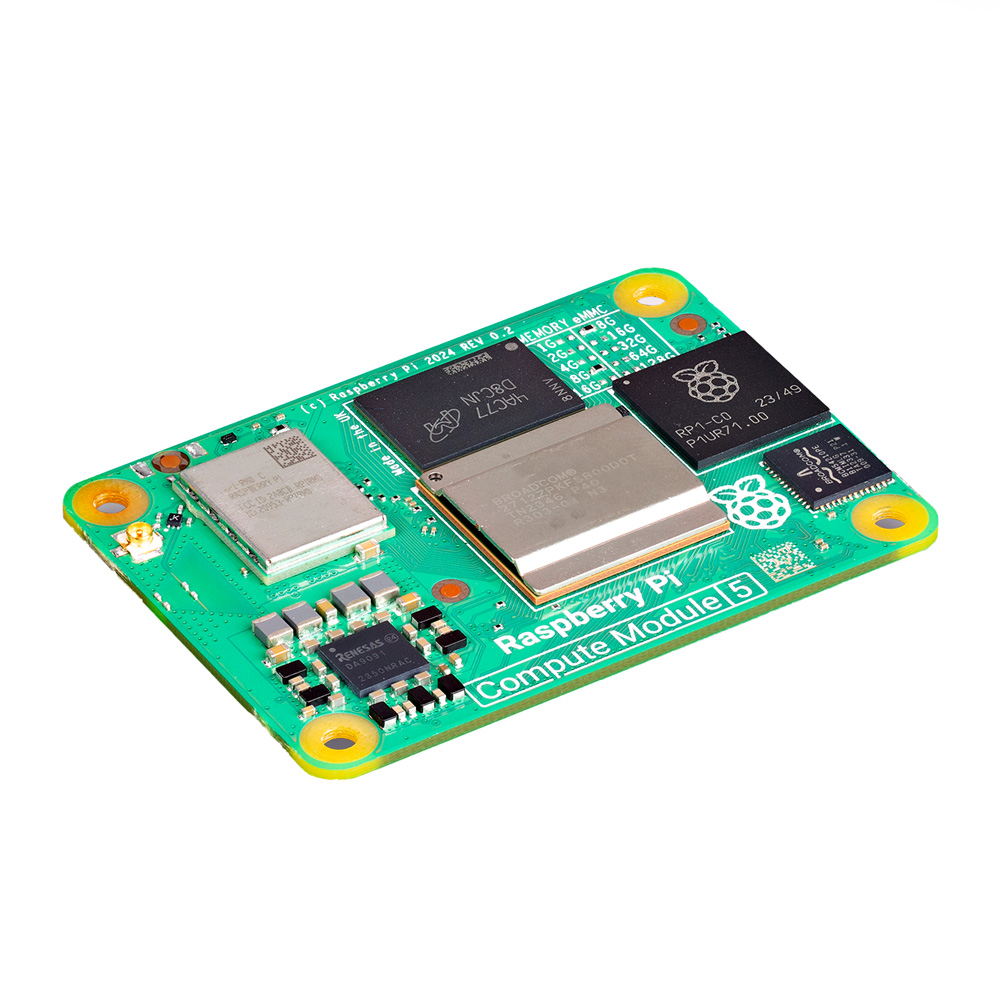
The CM5-PICO is a CM5 carrier in an enclosure, so the compute specs are the module's. Raspberry Pi lists the Compute Module 5 with a Broadcom BCM2712, a quad-core 64-bit Arm Cortex-A76 at 2.4 GHz, and 2, 4, 8 or 16 GB of LPDDR4-4267 SDRAM with ECC. eMMC options are 0 (Lite), 16, 32 or 64 GB. The module also offers optional 2.4/5 GHz 802.11ac Wi-Fi with Bluetooth 5.0/BLE, Gigabit Ethernet with IEEE 1588 support, one PCIe x1 Gen 2 lane, one USB 2.0 and two USB 3.0 interfaces, up to 30 GPIO, two HDMI 2.0 4Kp60 outputs, and two 4-lane MIPI DSI/CSI-2 interfaces, all on a 55 x 40 x 4.7 mm board.
CNX Software adds the VideoCore VII GPU at 800 MHz and lists the same RAM sizes (as LPDDR4x) and the same eMMC options. For Lite SKUs without eMMC, CNX says the box has a microSD slot for boot media.
ASK's announcement confirms the SKU matrix: with or without Wi-Fi 5/Bluetooth 5; 2, 4, 8 or 16 GB of LPDDR4x; and 0, 16, 32 or 64 GB of eMMC.
What the carrier exposes
According to CNX Software, the I/O breaks down like this:
- Display: 2x HDMI, each up to 4K60. CNX lists them as HDMI 2.1, but Raspberry Pi's CM5 page rates the module's outputs as HDMI 2.0 4Kp60. Read "HDMI 2.1" as the connector or marketing label, not as access to HDMI 2.1-only features. The 4K60 per-output figure is the same in both sources.
- Networking: Gigabit Ethernet with PTP, which matches the CM5's IEEE 1588 support. Wi-Fi 5 and Bluetooth 5.0 are optional, depending on the module SKU.
- USB: 2x USB 3.2 Type-A (Raspberry Pi lists the module's interfaces as USB 3.0) plus a USB-C port that CNX says is for firmware updates.
- Storage and expansion: one M.2 2280 M-Key socket on PCIe Gen2 x1, for an NVMe SSD or an AI accelerator. There's also an M.2 3024 B-Key socket for an optional Quectel EG916Q-GL LTE Cat 1 bis modem. ASK's announcement mentions 4G/5G modem and AI NPU expansion through the Key-M 2280 and Key-B 3024 slots.
- Camera/display ribbons: 2x internal 22-pin, 0.5 mm-pitch MIPI CSI-2/DSI combo connectors.
- Headers: an internal 40-pin HAT/GPIO header, an RS-232 header and a UART0 debug header.
- Housekeeping: an RTC with a CR2032 coin-cell holder.
- Power: 5-20 V DC input.
- Environment: -20 to +55 °C operating, passive aluminium enclosure.
Two of these matter more than the rest. The first is the single PCIe lane. The CM5 has only one PCIe x1 Gen 2 lane, and CNX lists only the M.2 2280 slot as PCIe-attached. An NVMe drive and an M.2 AI accelerator would therefore share that one socket, so in practice you would fit one or the other, not both. The B-Key 3024 socket is described as the cellular modem slot. Neither source says which bus it uses, so don't assume it carries a second PCIe lane.
The second is the wide 5-20 V input. Accepting 5-20 V on a DC input lets the box run from the 12 V rails common in kiosks, vehicles and control cabinets. CNX describes it as a "DC IN jack" and does not give the connector size or polarity, and without a readable ZOTAC datasheet we won't guess.
Software and lifecycle
CNX Software reports that the unit ships with Raspberry Pi OS based on Debian 13. Listed alternatives are Ubuntu, Twister OS, Emteria Android, LibreELEC and Home Assistant OS. Because the board uses a standard CM5, any OS that already supports the module should run on it with little or no carrier-specific work. The open question is whether ZOTAC's RS-232, RTC and modem paths need device-tree overlays. CNX's report doesn't cover this.
CNX says ZOTAC specifies a supply lifecycle through January 2036. That matches Raspberry Pi's own statement that the CM5 stays in production until at least January 2036. For an industrial buyer, a module vendor and a box vendor quoting the same end date matters more than most of the spec sheet.
Where it sits
The CM5-PICO isn't a hobbyist dev board, and it doesn't try to be one. The 40-pin header and the CSI/DSI connectors are internal, so using them means opening the case and routing cables or a HAT inside a sealed aluminium shell. The enclosure is a heatsink first and a dev platform second. CNX and ASK point to digital signage, HMI, kiosk and IoT-gateway use. It suits a fixed install: signage driving two 4K panels, a Home Assistant or LibreELEC box that stays quiet in a living room, a PTP-timed edge node, or a gateway with an LTE modem and a serial line to legacy equipment.
CNX notes the CM5-PICO has plenty of competition, naming the Waveshare IPCBOX-CM5 and the EDATEC ED-IPC3100 series. CNX says ZOTAC's differences are dual 4K HDMI, a single-sided external I/O layout and a palm-sized enclosure. ASK distributes it in Japan, and ZOTAC specifies a supply lifecycle through January 2036.
What It Means for Makers
Who it's for: people deploying a Pi rather than prototyping on one. That includes signage integrators, home-automation installers, small-batch kiosk builders and anyone who has made a CM5 or Pi 5 work on the bench and now needs something that looks like a product, takes 12 V, and runs without a fan. Educators and hobbyists who swap HATs every week will find the internal header fiddly. A bare Pi 5 or a CM5 IO board is the better tool for that work.
What it replaces: the usual DIY stack of a CM5, a third-party carrier, an M.2 HAT, a 3D-printed or generic aluminium case, and a separate buck converter to get 5 V from a 12 V supply. It puts all of that in one 0.27 L enclosure with an RTC, an RS-232 header and an optional LTE slot already on board.
What to watch: the M.2 2280 slot is a single PCIe Gen2 x1 link, so NVMe throughput is limited by that one lane, and with only one PCIe-attached socket you would fit either storage or an accelerator, not both. The "HDMI 2.1" label from CNX should be read against Raspberry Pi's HDMI 2.0 rating for the module. Expect 4K60 per output and nothing beyond what the BCM2712 supports.
Price and availability: no public price has been published. ASK Corporation began handling the product in Japan on 11 March 2026, and CNX Software says ASK has to be contacted for pricing and availability; ASK directs quote requests and product inquiries to its sales department. For scale only: Raspberry Pi lists the bare Compute Module 5 as "available now from $67.50" (USD, as shown on its product page in an Internet Archive snapshot of 15 October 2026). That's the module alone, not the ZOTAC system, and it says nothing about what the finished box will cost.
