
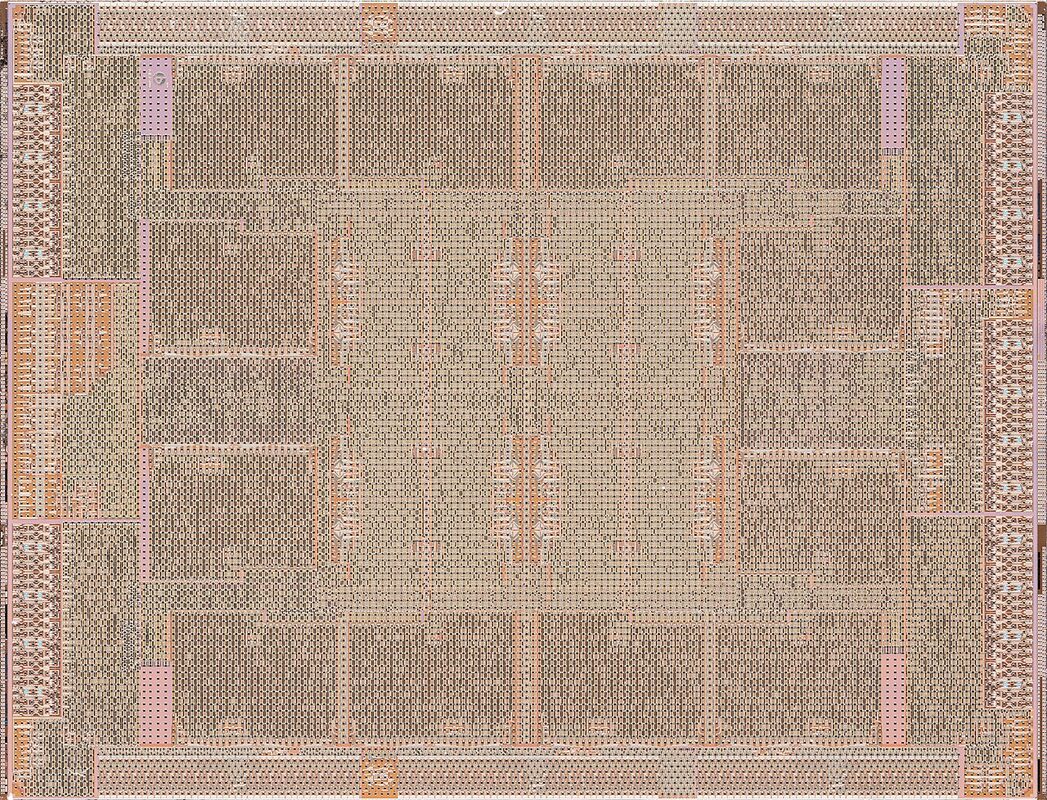
Andrew "bunnie" Huang has published a long write-up on the Baochip-1x, a security-oriented system-on-chip fabricated in TSMC 22nm using a dedicated mask set. His blog post calls it "mostly-open." Hackaday covered it on November 12, 2026. Alongside the post there is a public GitHub repository holding parts of the chip's RTL and an official "Coder's guide." The guide is unfinished, but it already gives enough detail to place the part. It is a microcontroller-class device with a feature that microcontrollers almost never have: a memory management unit.
Below is what the chip contains, what "mostly open" means in practice, and what the sources say about getting one.
The Core: VexRiscv With Virtual Memory
According to the Coder's guide, the Baochip-1x is fabricated in TSMC22ULL. Its CPU is a 350MHz VexRiscv RV32-IMAC with Sv39 (virtual memory) support. Hackaday calls it a single-core 350 MHz VexRiscv and notes that the design is based heavily on the FPGA-based CPU in Precursor, the device from bunnie's earlier work. Since the MMU is there, Hackaday says, you can run any software on it that supports the RV32IMAC instruction set, instead of being limited to bare-metal firmware.
The MMU is the main design choice. In his blog post, Huang says that, to the best of his knowledge, no other microcontroller in this performance and integration class has one. The point is the software it allows. The chip is designed to run Xous, the pure-Rust OS that Huang and Sean "xobs" Cross wrote, which uses the MMU but is aimed at small-memory devices. The MMU puts every application in its own virtual memory space, which Huang contrasts with the flat memory spaces and proprietary MPU protection of Cortex-M parts. He also says it lets enthusiasts try running Linux.
Memory
Both the creator's post and the official docs give the on-chip memory as:
- 2 MiB SRAM
- 4 MiB nonvolatile RRAM
Hackaday writes these as "4 MB RRAM, 2 MB SRAM." The project's own documents use MiB. The docs describe RRAM as non-volatile memory analogous to flash, so the program store is resistive RAM rather than conventional embedded flash. Huang's post also says the RAM is ECC-protected.
BIO: Four 700 MHz PicoRV32 Cores for I/O
Next to the main CPU is an I/O processor Huang calls BIO. His post describes it as quad 700MHz PicoRV32s. That is four small RISC-V cores, each clocked at twice the speed of the main CPU, dedicated to handling I/O.
As an editorial comparison, this is in the same spirit as the RP2040/RP2350's PIO state machines: offload precisely timed protocols from the main CPU. The difference is that BIO uses general-purpose RISC-V cores rather than a custom state-machine instruction set. The sources we reviewed do not give per-core memory, the BIO programming model in detail, or how many GPIO pins BIO can drive. We will not guess at those figures. The Coder's guide is the place to watch as it fills in.
Security Hardware
Huang's post title says the chip is for "high assurance applications," and the feature list matches. According to the post, the Baochip-1x includes:
- A true random number generator (TRNG)
- A variety of cryptographic accelerators
- A secure mesh
- Glitch sensors
- ECC-protected RAM
- Hardware-protected key slots
- One-way counters
The post does not give specifics such as which algorithms the crypto accelerators support or how many key slots there are. We have not filled those in.
Production Silicon, Not a Shuttle Run
Open-hardware silicon projects usually go through multi-project wafer (MPW) shuttles, where many designs share one reticle and the result is a small batch of samples. Huang's post says the Baochip-1x is instead fabricated in a fully production-qualified TSMC process using a dedicated mask set, and that "this isn't a limited-run MPW curiosity." He says the supply chain could produce millions of chips if demand appeared.
The post also explains how that was funded. Huang says he "hitchhiked" on a 22nm chip designed primarily by Crossbar, Inc., adding a CPU of his choice in unused floorplan space. Because peripherals are memory mapped, switching which CPU is active gives the same silicon two different personalities.
Hackaday commenters say the Baochip-1x was the DEF CON badge chip this year. That claim comes from readers, not from the project's documentation, and we have not verified it.
What "Mostly Open" Means
The qualifier in the title is deliberate. The baochip/baochip-1x repository describes its contents as the open source elements of the chip. Its listed components include:
- The open-sourced elements of the taped-out RTL
- The VexRiscv CPU configuration
- A Verilator simulation of a subsetted RTL analog
- Arty-A7 FPGA SoC stubs
- Documentation, including the book source
In the blog post, Huang says everything that can "compute" on data is available for simulation and inspection. The closed parts include the AXI bus framework, USB PHY, and analog components such as the PLL, voltage regulators and I/O pads. He argues these are effectively "wires" that do not transform data, while acknowledging this is dissatisfying from an absolute-trust perspective.
The repository also explains how the published RTL relates to physical silicon. Each die revision gets a tag such as tapeout-a0 with a matching branch, marking the point where the rtl directory exactly matches what went into the tapeout. The repo describes the silicon as a fixed and unpatchable artifact. For anyone auditing the chip, that is a useful property: the tagged source is pinned to a specific die revision.
The Coder's guide also identifies a sister chip, Daric. The docs describe it as the exact same silicon with the ARM cores activated instead of the RISC-V ones. The full part number given in the guide is BAO1X2S4F-WA.
Software
The project offers two software paths:
- Rust: The repository says the official Rust SDK lives in the Xous repo. This is the main route, matching the chip's purpose as a Xous host.
- C: A bare-metal C SDK for the Dabao evaluation board, which the repo says provides headers, libraries, a build system, peripheral drivers and examples, and is still under development.
The Coder's guide states that it is a work in progress. Expect gaps if you start now.
What It Means for Makers
Where it fits. Huang describes the Baochip-1x as a general-purpose microcontroller that fills a gap between the Raspberry Pi RP2350 (found on the Pi Pico 2) and the NXP i.MX RT1062 (found on the Teensy 4.1). The two things that set it apart from both neighbours are the MMU and the secure-element-style security block.
Who it is for. The clearest audience is people building devices where trust in the hardware matters, in the lineage of Precursor and Betrusted, the initiative Huang says this chip continues. Developers who want per-application memory isolation on a microcontroller-class part will also be interested. The partial RTL, Verilator simulation and Arty-A7 stubs let educators and silicon hobbyists study and simulate parts of a real production SoC design on an FPGA before touching the chip. Those are rare materials.
What it is not. The sources make no claims about radios or wireless connectivity. The Coder's guide lists peripheral topics such as UDMA, UART, SPIM, I2C, SDIO and camera interfaces, but the sources we reviewed give no GPIO count, package or power figures. If you need any of those, wait for the documentation to fill in.
Hardware to start with. The docs, the repository and Hackaday all mention the Dabao evaluation board. Hackaday says it has a very Raspberry Pi Pico-shaped form factor, and it is the target of the bare-metal C SDK.
Price and availability. None of the sources we reviewed give a price for the Baochip-1x or the Dabao board. Huang's post, which is dated March 10, 2026, said hundreds of engineering samples had been handed out through an early sampling program, that two wafers were earmarked to become production-qualified silicon yielding "a few thousand" chips to sell, and that further inventory would come late in 2026. It also said a limited number of Dabao boards were available for pre-order at that time. We did not read the pre-order page, so check the project for current status and pricing before planning around it.
