
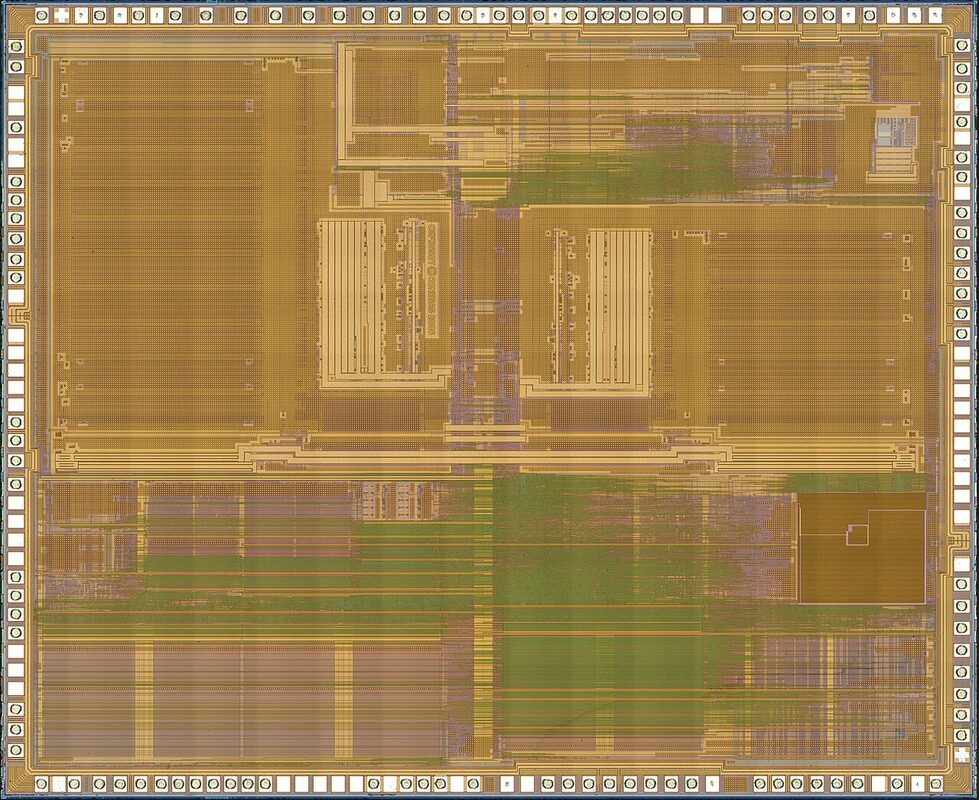
Most industrial motion designs run on two or three chips. An application processor handles Linux, the HMI and networking. A real-time MCU or DSP closes the current and position loops. Often an FPGA or a dedicated ASIC handles the fieldbus. Renesas' new RZ/T2N puts all three jobs on one die. Renesas lists the part as "NEW" and "Active" on its product page, and the Japanese trade paper Dempa Shimbun Digital reported on 5 November 2026 that the company has started sales and mass production.
Here is what the part contains, according to Renesas' own specifications, and what is known so far about getting hold of one.
Two clusters, two jobs
The RZ/T2N is a heterogeneous MPU. According to the Renesas product page, it combines a dual Arm Cortex-A55 cluster running at up to 1200MHz with a dual Arm Cortex-R52 cluster running at up to 800MHz. Dempa Digital and Hackster.io both report the same clock figures. Hackster calls it a "quad-core" chip, which is fair as a core count but hides the split: two of the four cores are application-class and two are real-time.
The A55 side is where Linux runs, and Renesas says the part supports application-rich operating systems such as Linux. The R52 cores are Arm's real-time profile cores for deterministic, safety-oriented control. Each R52 gets 576KB of tightly coupled memory (TCM) with ECC, which Dempa Digital says reduces execution-time variation for high-precision motor control. The chip also has 2MB of on-chip SRAM with ECC, and Renesas lists a trigonometric function accelerator, a block that suits the sine/cosine-heavy math of field-oriented motor control.
External memory uses an LPDDR4 interface, which Renesas says supports on-the-fly encryption and decryption. Renesas also lists an xSPI interface and an SD/eMMC/NAND controller. For expansion there is PCIe Gen2.
Motor control and encoders
Renesas specifies the RZ/T2N for up to 4-axis motor control. That puts it in multi-axis drives and small robot joints, not single-motor inverters. The sensing side is fairly complete. The product page lists:
- 8-channel encoder interface supporting A-format, EnDat2.2, EnDat3, BiSS-C, BiSS-Line, HIPERFACE DSL and FA-CODER
- Three 12-bit ADC units
- 15-channel delta-sigma interface
Native support for these absolute-encoder protocols matters in practice. They are serial protocols used by industrial servo motors, and supporting them in silicon can remove FPGA logic or protocol-converter ICs from a servo board.
Industrial Ethernet on-die
The networking block is the other headline. Renesas lists a 3-port Gigabit Ethernet switch with Time-Sensitive Networking (TSN) plus three Ethernet GMACs. Protocol support covers EtherCAT, PROFINET RT/IRT, EtherNet/IP and the redundancy schemes HSR/PRP/FRER. Hackster specifies that the EtherCAT support is an EtherCAT sub-device controller, the role formerly called slave. So the chip is built to sit in a drive or I/O node on an EtherCAT network. Dempa Digital also cites EtherCAT, PROFINET RT/IRT and TSN support.
Hackster lists the lower-speed serial peripherals as four SPI, three I2C, 14 SCI and two CAN-FD interfaces.
Security, packaging and power
On security, Renesas lists secure boot, Arm TrustZone and a true random number generator (TRNG), along with the LPDDR4 encryption mentioned above. The part comes in 537-pin and 489-pin FBGA packages, with a 1.1V core supply and 3.3V GPIO. Renesas' stated targets are industrial robots, motion controllers, PLCs and servo drives.
Hackster's coverage quotes Renesas' Hari Pendurty on the launch. The vendor's positioning, which Dempa Digital echoes, is that the RZ/T2N combines real-time motor control, industrial Ethernet and application processing in a single chip.
Shipping or not?
The sources disagree on availability, and readers planning a design should note the gap:
- Dempa Shimbun Digital (5 November 2026) reports that Renesas has started sales and mass production of the RZ/T2N.
- Hackster.io (published in the days after, by 10 November 2026) reports that an evaluation board is available to order at $549, but that the chips themselves had not yet appeared in the sales channel at the time of writing. Hackster gives no currency; the dollar sign suggests USD.
- The Renesas product page marks the part as NEW and Active.
One plausible reading is that mass production has started at Renesas while distributor stock has not caught up yet. Neither source says that directly, though. Until distributors list stock, treat bare silicon as announced and in production rather than readily orderable. None of the three sources gives a unit price for the chip.
What It Means for Makers
The RZ/T2N is not a hobbyist part, and Renesas does not pitch it as one. Its 537-pin and 489-pin FBGA packages mean a multilayer board and BGA assembly, and the LPDDR4 interface brings DRAM routing on top of that. Nobody is going to drop this on a two-layer board for a weekend CNC retrofit.
The chip is relevant to three groups in the PinoutFeed audience.
Embedded and motion-control engineers who build drives, robot joints or multi-axis controllers. The pitch is consolidation: one device instead of a Linux SoC, a real-time MCU and an EtherCAT or PROFINET ASIC or FPGA. It also handles four axes, eight encoder channels and TSN switching. Whether that beats a discrete design will depend on unit pricing, which none of the sources has published.
Educators and labs teaching industrial networking or servo control. A single evaluation board that runs Linux, closes motor loops on R52 cores and joins an EtherCAT network as a sub-device would cover a lot of curriculum. According to Hackster, that board costs $549 (currency not stated, presumably USD; price at the time of Hackster's article) and was available to order at the time of writing.
Advanced makers and open-hardware robotics projects that already use EtherCAT servos or industrial absolute encoders such as BiSS-C, EnDat and HIPERFACE DSL. Native protocol support on one chip is something the hobby world usually gets only through an FPGA soft core or a pile of interface boards.
On status: the evaluation board can be ordered at $549, according to Hackster. Dempa Digital reports that sales and mass production of the chip have begun. As of Hackster's writing, the chips themselves had not yet appeared in the sales channel.
