
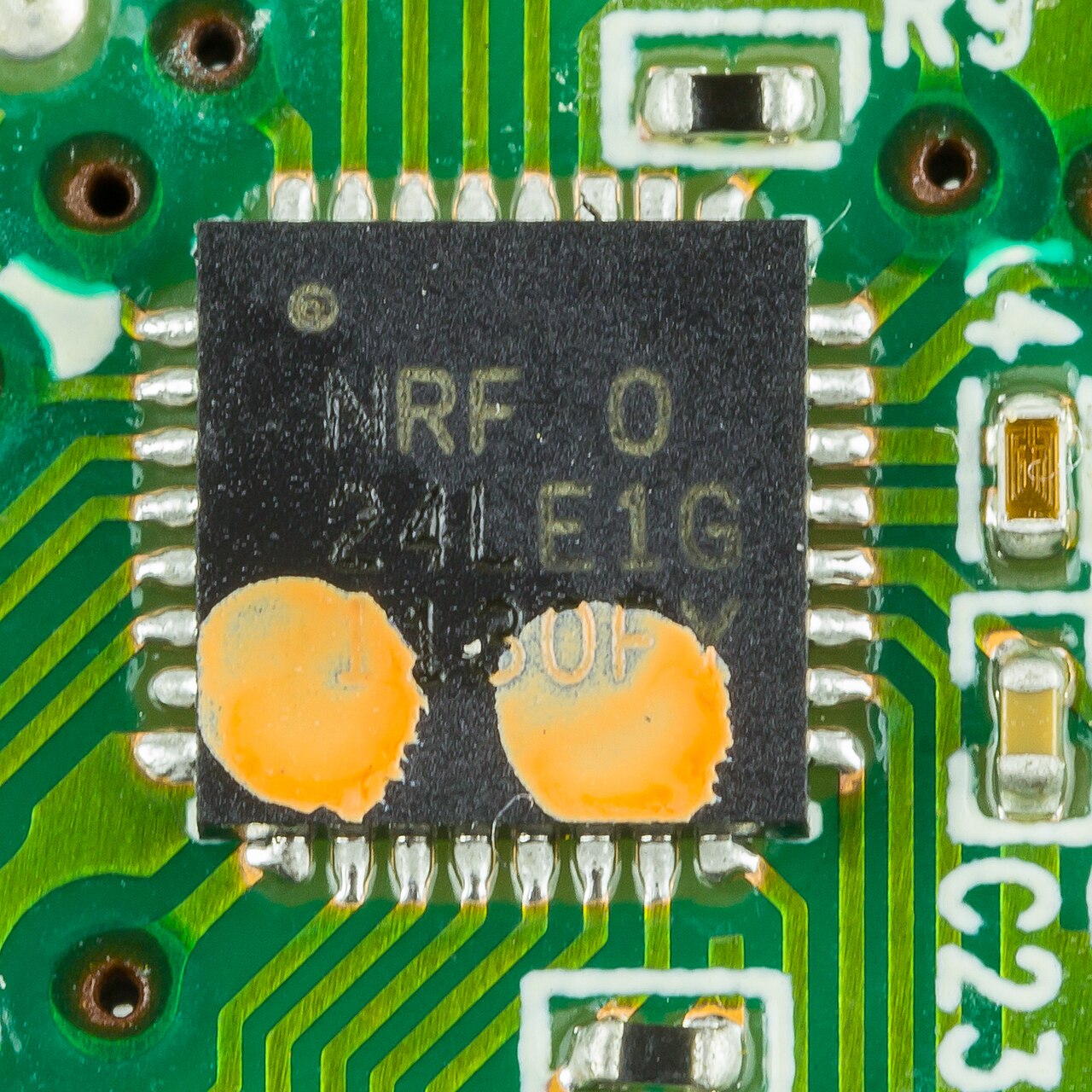
On November 10, 2026, Montreal-based SPARK Microsystems announced a wireless gaming-peripherals platform built on two chips and two radios. Nordic Semiconductor's nRF54LM20 handles Bluetooth LE and application processing. SPARK's SR1120 transceiver runs the company's own Low Energy Ultra-Wideband (LE-UWB) link. The platform initially targets high-performance gaming mice. SPARK says complete hardware and software reference design files are available as part of the gaming mice platform, and that it will continue to work with Nordic to launch additional gaming peripherals on the platform later.
To be clear about status: this is an announced reference platform, not a shipping product. According to SPARK's release, the platform "is being evaluated" by leading gaming peripheral manufacturers, with customer development programs underway. SPARK named none of them, and no retail mouse based on this exact pairing has been announced. A reference mouse was shown at electronica 2026 in Munich, Hall C3, Booth #178, according to Hackster.io.
Why put two radios in a mouse?
Gaming mice that offer both Bluetooth and a dedicated low-latency 2.4 GHz link are already common. Bluetooth LE covers laptops, tablets and low-power everyday use. The proprietary link, usually through a USB dongle, covers competitive play, where polling rate and latency matter. SPARK's pitch is that its LE-UWB radio is the better choice for that second link. Its release frames the targets as responsiveness, high polling rates, power efficiency and reliability in crowded RF environments.
LE-UWB already has a foothold in this market. Hackster.io notes that SPARK's LE-UWB is used in SteelSeries' Sensei Pro and Rival Pro mice at 8,000 Hz polling. What is new here is the partner silicon. SPARK's earlier mouse reference design uses an NXP MCU. This platform pairs the SR1120 with a Nordic Bluetooth LE SoC that, per SPARK's release, provides both application processing and Bluetooth LE connectivity, so one chip on the board handles both jobs.
The SR1120: SPARK's second-generation LE-UWB transceiver
SPARK's SR1120 product page describes the part as its second-generation LE-UWB transceiver, designed for higher data rates, extended range and multi-antenna support. The page lists the following figures:
- Frequency band: 6.2-9.5 GHz; TX power up to 3 dBm; RX sensitivity -81 dBm
- Host interface: standard SPI and Quad-SPI; supply voltage 1.8-3.3 V
- Active current: 0.34 mA per Mbit/s receive and 0.10 mA per Mbit/s transmit; deep sleep 920 nA
- Package: 4 mm x 4 mm QFN32; a WLCSP package is also available by contacting SPARK sales
- Ordering: SR1120AA-4Q32-CT (single piece, cut tape) with a Digi-Key link, and SR1120AA-4Q32-TR (5,000-piece tape and reel) listed as "Contact Sales"
The same page lists reference designs built around the SR1120. The gaming ones are Dual-Radio Mouse, Mouse, Keyboard, a 3-in-1 system demo and a Headset demo. The page gives no price for the part, and PinoutFeed is not quoting one.
The nRF54LM20: one Cortex-M33 plus a RISC-V coprocessor
SPARK's release names the Nordic part as the "nRF54LM20," a member of the nRF54 Series. Nordic's product page covers the nRF54LM20A variant. The figures below come from that page and describe the A variant. Treat them as indicative of the part SPARK uses, not as a confirmed bill of materials for the reference mouse.
- CPU: 128 MHz Arm Cortex-M33
- Coprocessor: 128 MHz RISC-V coprocessor with support for SoftPeripherals
- Memory: 2 MB NVM and 512 KB RAM
- I/O: up to 66 GPIOs; high-speed USB
- Packages: CSP98, CSP61 and QFN52
- Protocols: Bluetooth LE, Matter, Thread, Zigbee, and 2.4 GHz proprietary protocols with data rates up to 4 Mbps
- Radio current: RX 3.3 mA and TX 5.0 mA at 0 dBm (3 V)
- Max TX power: +8 dBm (CSP), +7 dBm (QFN)
- Sensitivity: -96 dBm (Bluetooth LE 1M), -101 dBm (802.15.4)
Hackster.io's coverage adds that the chip supports IEEE 802.15.4 and proprietary 2.4 GHz modes alongside Bluetooth LE, and it gives the same 128 MHz Cortex-M33, 512 kB SRAM and 128 MHz RISC-V coprocessor. Hackster quotes the non-volatile memory as 2,036 kB, while Nordic's own page says "2 MB NVM." We use Nordic's figure.
On-chip high-speed USB matters for this application. A gaming mouse's USB receiver dongle has to move reports to the host at the polling rate. The release does not say whether the reference design uses the nRF54LM20 at the dongle end as well as in the mouse.
Don't mix up the two mouse reference designs
SPARK's gaming applications page lists two separate mouse reference designs, and their specs should not be merged.
- Dual-Radio Mouse Reference Design (the subject of this announcement): SPARK LE-UWB plus Nordic Bluetooth LE, with application processing on the nRF54LM20. Silicon is the SR1120 plus the nRF54LM20. The page does not publish latency or polling figures for this design.
- Mouse Reference Design (a separate design): SPARK claims ≤150 µs end-to-end latency in 8 kHz mode and "true 8 kHz sustained polling." That design uses an NXP LPC55S28 MCU, not the Nordic SoC.
The 150 µs and 8 kHz numbers are SPARK's claims for the LPC55S28-based design. The sources we read do not give them for the new dual-radio platform. Wait for measured figures before assuming the Nordic-based design matches them. Hackster's subtitle does say the reference design "targets an 8,000Hz polling rate," but SPARK's own pages do not state that for this design.
The same gaming page also describes a headset demo that streams uncompressed stereo audio at up to 96 kHz/24-bit with 5 ms latency on the stereo main channel. That is a separate SR1120 demo, and it sits alongside SPARK's stated plan to launch more gaming peripherals on this platform.
What the companies say
The press release includes quotes from SPARK CEO Fares Mubarak and from Øyvind Strøm, Executive Vice President, Short Range BU at Nordic Semiconductor. Both present the partnership as combining Nordic's application expertise and Bluetooth LE ecosystem with SPARK's LE-UWB link. Neither quote adds technical specifications beyond those summarized above.
What It Means for Makers
This is mainly an OEM play. The intended customers are gaming peripheral companies that want a reference design combining Bluetooth LE for everyday compatibility with a dedicated LE-UWB link for latency-sensitive gaming, with hardware and software integration, APIs and reference designs provided to shorten development. In this design the Nordic SoC handles application processing and Bluetooth LE, and the SR1120 handles the low-latency link.
For hobbyists and embedded engineers, the picture is mixed:
- Chip availability: SPARK's SR1120 page links a single-piece cut-tape part (SR1120AA-4Q32-CT) to Digi-Key, while the 5,000-piece tape-and-reel part (SR1120AA-4Q32-TR) is listed as "Contact Sales." None of the sources give a unit price, and SPARK's pages point to an SR1120 evaluation kit without giving a price.
- Reference design files: SPARK says the hardware and software reference design files for the gaming mouse platform are available. The release does not say whether they are public downloads or provided under NDA, or what licence they carry. The product page offers a "Request Design" route for the reference designs.
- Pricing: No price is given in any source for the platform, the reference mouse or either chip.
- The Nordic side is easier to start with: the nRF54LM20A's 128 MHz Cortex-M33, RISC-V coprocessor, high-speed USB and up to 66 GPIOs (per Nordic) make it a capable HID and USB part on its own, whatever happens with LE-UWB.
Status as of November 2026: the platform is announced and under evaluation by peripheral makers, reference design files are available, and a reference mouse was shown at electronica 2026. No consumer product built on the SR1120 plus nRF54LM20 combination has been announced in the sources we read, and no shipping date has been given.
Sources
- SPARK Microsystems: Dual-Radio Platform to advance wireless gaming based on Nordic Bluetooth LE SoCs (press release, Nov 10, 2026)
- SPARK Microsystems: SR1120 LE-UWB Wireless Transceiver IC product page
- SPARK Microsystems: Gaming and esports applications page
- Hackster.io: SPARK Microsystems Partners with Nordic Semiconductor for a High-Performance Gaming Mouse Platform
- Nordic Semiconductor: nRF54LM20A product page (via mirror, Wayback Machine snapshot Nov 8, 2026)
