
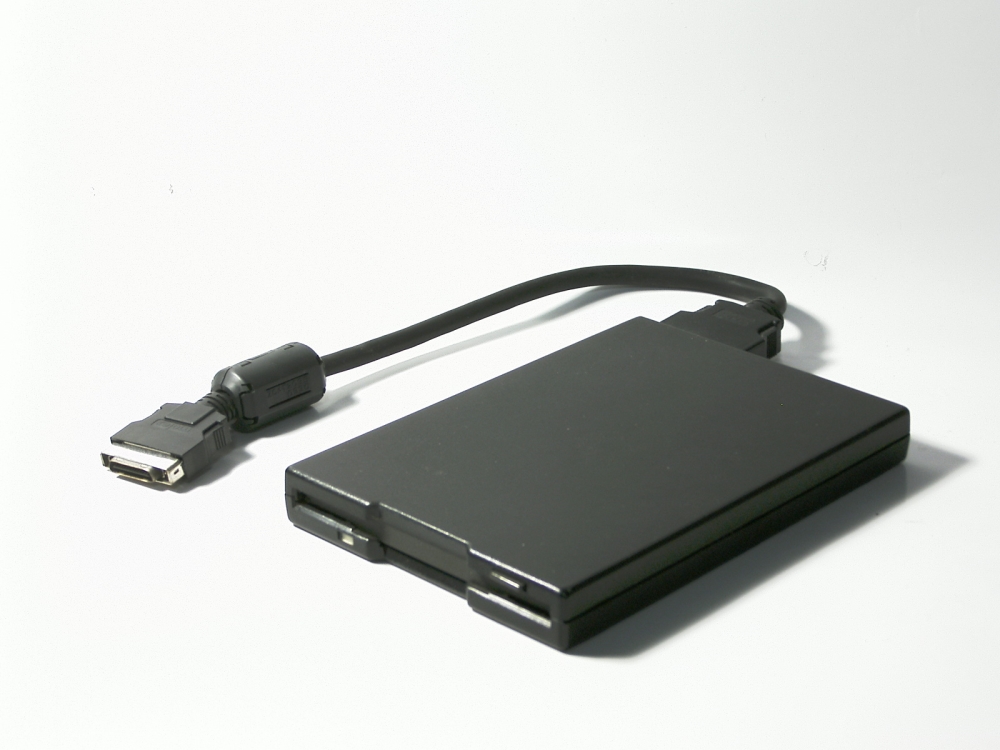
Sony's Mavica cameras, as Hackaday notes, stored their images on ordinary 3.5-inch floppy disks. That made them easy to use in their day and awkward to live with now, when few computers have a floppy drive. A builder who goes by bigcrimping has published a fix called floppy3.5. The project page calls it "A Portable 3.5" Disk WiFi NAS": a battery-powered box built around a slimline floppy drive. It reads a disk, copies the files to microSD and serves them to any device on the Wi-Fi network.
The design files are public. The creator's demo video says the firmware, PCB and mechanical files are free to download from the GitHub repository. The sources describe an open-hardware project and mention no kit, assembled unit or price.
What it does
The YouTube description lays out the intended workflow. You fill a disk in the camera, insert it into floppy3.5 and press READ, and everything on the disk is copied to the SD card. The photos can then be reached over Wi-Fi, which the creator says makes the device double as "a pocket floppy NAS."
According to the repository, floppy3.5 reads any FAT12-formatted 1.44 MB HD disk. It is not limited to Mavica media, though Mavica owners are the audience it was designed for. Files in the disk's root folder appear on a web page at floppy.local, and copies are written to the microSD card under numbered directories in the form /DISKnnnn/. The README describes the scope as the root folder only. Readers with disks that use subdirectories should check the repository for current behavior rather than assume full-tree support.
Two processors, split by job
The interesting engineering choice is the split between two processors. The repository describes the signal path as a slimline 3.5-inch drive connected over a 26-pin interface to an RP2354A controller. The RP2354A talks over SPI to an ESP32-S3 bridge, which handles Wi-Fi and the microSD card.
RP2354A: the flux engine. The low-level work of reading the drive runs on the RP2354A. The repository says it implements the Greaseweazle host protocol, using the chip's PIO and DMA for flux capture. Because it speaks that protocol, the standard gw host tool works with it over the board's secondary USB port. Hackaday puts it this way: the RP2354 "runs a Greaseweazle port" and can act as a standalone Greaseweazle over USB. In practice the board can serve as a general flux-level disk-imaging adapter for a PC, separate from its role as a Mavica offloader.
ESP32-S3: filesystem, storage and network. The ESP32-S3 takes the raw data from the RP2354A over what the project describes as a custom SPI link. It decodes the disk, copies the files to SD and serves the web page. The parts list specifies an ESP32-S3-WROOM-1-N16R8 module, which the repository lists with 16 MB of flash and 8 MB of PSRAM. The repository says both processors can be updated over the air (OTA), so the device does not have to be opened or tethered for firmware revisions.
The split is a sensible one. Timing-critical flux sampling stays on the microcontroller whose PIO blocks are built for that kind of deterministic bit-level I/O. The FAT12 decoding, file handling and network stack run on the part with the radio and the larger memory.
Parts list highlights
The repository's parts list names the following key parts. They are reproduced as listed:
- Wi-Fi/application processor: ESP32-S3-WROOM-1-N16R8 (16 MB flash, 8 MB PSRAM)
- Floppy controller: RP2354A
- Drive: Sony MPF920-type slimline 3.5-inch drive (the repository notes it is 5 V only)
- Display: 1.9-inch ST7789 SPI LCD, 170×320
- Charger: BQ25180
- Fuel gauge: MAX17048
- Regulators: TPS63020 for the 3.3 V rail and TPS61022 to generate 5 V for the drive
The power section follows from the drive choice. The slimline mechanism needs 5 V and the logic runs at 3.3 V, so the board carries a dedicated boost stage for the drive alongside the system regulator, plus a charger and fuel gauge for battery operation. PinoutFeed is not reproducing the battery connection or wiring details. Anyone building a unit should follow the creator's published schematic and observe the usual precautions for lithium cells.
What is in the repository
According to the README, the repository includes:
- Gerber files, the schematic and an assembly drawing for the PCB
- A 3D-printable housing in STL and 3MF formats
- RP2354 firmware built on the pico-sdk
- ESP32 firmware built on ESP-IDF
- A bring-up self-test for checking a newly assembled board
The repository also records the project's history. The first prototype used an ESP32 development kit, a Greaseweazle-type adapter and a desktop floppy drive. The current design puts the two processors, charger and power supplies on one PCB aimed at a slimline drive. Builders who want to try the concept before ordering boards could reasonably start the same way.
What It Means for Makers
Who it is for. The obvious audience is anyone still shooting with a floppy-based Mavica. floppy3.5 lets them offload a disk in the field and grab images on a phone over Wi-Fi without carrying a laptop and USB floppy drive. Hackaday points to a second audience: because the RP2354A side works as a Greaseweazle over USB, the board is also a portable Greaseweazle peripheral for people who archive and image old disks.
What it replaces or enables. For Mavica users it replaces a computer, a USB floppy drive and a card reader with one pocketable, battery-powered unit. For archivists it adds a self-contained flux-capable reader that speaks the Greaseweazle protocol the existing gw tool already uses. Because the RP2354A and ESP32-S3 firmware are separate projects on the pico-sdk and ESP-IDF, the design is also a readable reference for anyone who wants a PIO/DMA flux front end feeding a networked application processor.
Price and availability. None of the sources gives a price, and none of them mentions a kit, assembled unit, pre-order or crowdfunding. As of the creator's video description, the firmware, PCB and mechanical files are free to download from the GitHub repository. Builders source the parts, have the boards fabricated and print the housing themselves. The README says the project is released under the Unlicense (public domain), but check the repository's LICENSE file and the separate licenses of bundled libraries before building derivatives.
