
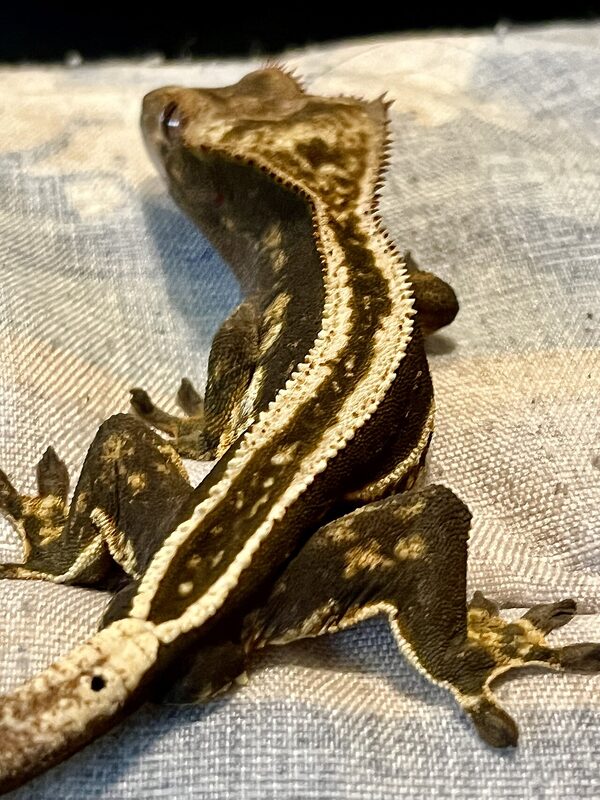
Most terrarium controllers run on a fixed schedule: lights on at a set hour, heater held at a setpoint, a misting timer. Andreas Frisch, who publishes as fraxinas, built one that works from weather records instead. His Geckocontroller is an ESP32 board running ESPHome. It drives the lights, a heater, a misting pump and fans so that a crested gecko's enclosure in Germany follows the real climate of New Caledonia, the gecko's native range.
Hackaday covered the project on November 26, 2026. The coverage came shortly after Frisch updated his long-form build write-up on November 24. That update documents a new hardware revision, which the project's GitHub repository lists as v2.0, dated September 2026.
Weather from the other side of the planet
The project's most unusual feature is how it picks its setpoints. According to the GitHub repository, the weather simulation uses real records from Nouvelle-Calédonie. Frisch's write-up puts the target climate at about 22 degrees South, where the seasons and day length still shift through the year, though far less than in Germany. The write-up says the weather data now comes from Open-Meteo, using the milder climate of the Île des Pins.
The terrarium is in Germany, in the Northern Hemisphere, so a direct replay would put New Caledonian summer in the middle of a German winter. Hackaday reports that Frisch gets around this by running the data six months behind, and the write-up specifies a replay of the weather from 182 days ago. The enclosure reproduces the conditions recorded about half a year earlier, which lines the gecko's seasons up with Germany's. The GitHub repository says the simulation uses temperature, humidity, rain and sky cover values, and adds a simulated sunrise, sunset and lightning storm.
The weather feature was not part of the original design. Frisch's write-up says he added a fogger in January 2022, and that addition is what led him to build the New Caledonia simulation.
Architecture: ESPHome on the board, Home Assistant on top
Frisch describes the Geckocontroller as his first ESP32 project, his first ESPHome project and the largest PCB he had designed. The firmware is an ESPHome YAML configuration in the repository, which describes itself as "Terrarium Automation Hardware+Software based on ESP32." The ESP32 connects to the network as a Wi-Fi client. The repository says Home Assistant is the web interface for data logging and visualization, manual control of the outputs and changing setpoints.
The work is split across two layers. ESPHome on the device reads the sensors and runs the outputs. Home Assistant stores history and gives the keeper a place to adjust targets. Because ESPHome handles the device side, sensor drivers and output components are set in YAML rather than written as custom firmware. This is a common way to build a home-automation node, applied here to a living animal's enclosure.
The I/O, as the repository lists it
The GitHub repository lists the following hardware features. They are reproduced here as published:
- Lighting: PWM outputs for RGB LEDs (12V) and for white LEDs.
- Airflow: PC-fan control with PWM and tachometer feedback, plus a cut-off.
- Temperature probes: two DS18B20 inputs.
- Climate sensing on I²C: a BME280 at the ceiling and an SHT-3xD at ground level.
- Weight sensing on I²C: a NAU7802 load-cell ADC (on Rev 2.0).
- USB: a USB-C port with a CH343G USB-to-serial bridge (on Rev 2.0).
- Expansion: an SPI add-on connector.
The repository places the two climate sensors at different heights, the BME280 at the ceiling and the SHT-3xD at ground level, so the controller reads conditions at both ends of the enclosure.
The load cell has a less obvious job. Frisch's write-up says it sits under the gecko's coconut nest and is used to tell whether the gecko is at home. The write-up lists a camera only as a possible future feature, so the current controller detects the animal by its weight.
The repository also documents the board's mains-switching hardware for the heater and other loads. PinoutFeed is not reproducing those details. Anyone interested in that part of the design should read the maker's own documentation and follow local electrical codes.
Revisions since 2021
Frisch's write-up says the terrarium and its crested gecko arrived in January 2020, and the first PCB revision was made at Aisler in February 2021. The repository's revision table gives this history:
| Revision | Date | Notes (per repository / write-up) |
|---|---|---|
| v1.0 | 2021-02 | First board, produced at Aisler |
| v1.1 | 2021-03 | — |
| v1.2 | 2021-04 | In service from 2021-05 until replaced in fall 2026 |
| v2.0 | 2026-09 | Mains section rebuilt, white channel added (per repository milestone); HX711 replaced by NAU7802; ESP32-WROOM-32E-N4; CP2102 replaced by CH343G; board 126.0 x 110.5 mm (vs 114.3 x 96.5 mm) |
Revision 1.2 ran for more than five years. The v2.0 changes concern the board's parts rather than what it does. The load-cell front end moves from an HX711 to a NAU7802, which the repository lists as an I²C device, so it joins the BME280 and SHT-3xD on the same bus. The USB-serial bridge moves from a CP2102 to a CH343G. The repository names the module as an ESP32-WROOM-32E-N4. The board is also larger than before, at 126.0 x 110.5 mm against 114.3 x 96.5 mm.
Frisch's write-up includes sections on the new board revision, on a canopy with a built-in console, and on robustness. The robustness section describes a failover to a simulated day cycle if the Home Assistant connection or the climate data is lost, plus alarms for out-of-range readings and failing sensors. The repository shows 348 commits and 10 stars at the time of writing.
The project has also changed in another way. Hackaday reports that the original gecko has died. A new gecko arrived after several months, and Frisch used the gap to upgrade the lighting for the plants and to switch to materials that are safer for geckos.
What It Means for Makers
The Geckocontroller is mainly a reference design for keepers of tropical reptiles, amphibians or plants who already use Home Assistant and want an enclosure to follow a real climate rather than a timer. Some of its ideas carry over to other projects:
- Climate replay with a phase offset. Driving setpoints from historical records for a target location, shifted six months to match the opposite hemisphere, works for any enclosure, greenhouse or grow tent where seasonal cues matter.
- Presence detection by weight. A load cell under a nest or hide is a cheap and passive way to know where an animal is, and it does not need a camera.
- Two-height climate sensing. A ceiling sensor and a floor sensor on one I²C bus show the gradient that a single probe misses.
- ESPHome plus Home Assistant as the stack. Device logic stays in YAML, while logging and setpoint changes run through Home Assistant.
Price and availability: none of the sources lists a price, a kit or a product for sale. The Geckocontroller is a personal project published openly. The hardware and the ESPHome configuration are in the fraxinas/Geckocontroller repository, and Rev 2.0 has been documented since September 2026. Anyone who wants one would need to build it from the published files. The write-up lists a license of CC BY-SA-NC 4.0, so check the terms before reusing the design. The write-up warns that the board switches 230 V AC loads and should only be rebuilt by qualified persons with electrical engineering training.
For anyone thinking of building a climate controller for animals, Frisch's write-up shows a single board kept in service for years and revised as the enclosure and its occupant changed. That track record says more about the design than the feature list does.
