
The Lindby Velua is a CCT ceiling lamp, meaning it has adjustable colour temperature. Its only control is an 8-button 2.4 GHz remote. It has no Wi-Fi, no Zigbee and no app. Henrikbiscuit (HenrikBiscuit on GitHub) wanted it in Home Assistant, so he cloned the remote. He has published the result as lindby-velua-rf-bridge, an open-source ESP32 and CC2500 transmitter that stands in for the handset. He did the reverse engineering without a software-defined radio. Hackaday covered the project on 24 November 2026.
The bridge itself is not the interesting part. The route to it is. He found the protocol with a cheap nRF24L01+ and then rebuilt it on a TI CC2500. Along the way he hit a fault that looked like a rolling code and turned out to be a missing preamble.
The hardware: four parts
The README lists four components for the finished bridge, plus a few wires and a USB power supply:
- An ESP32. The author used an ESP32-S3-DevKitC-1 (N16R8 variant), and says any ESP32 with Wi-Fi and SPI should do.
- A CC2500 module. The author used a VT-CC2500PA-S2, which pairs the TI CC2500 transceiver with a CC2591 PA/LNA front end and a 26 MHz crystal. The README says a plain CC2500 module without the amplifier should work but is untested.
- An IPEX/U.FL to SMA pigtail.
- A 2.4 GHz SMA antenna.
The ESP32 drives the radio over SPI. That is the CC2500's native control interface: TI's product page describes it as a low-cost 2.4 GHz transceiver for the 2400-2483.5 MHz ISM/SRD band with an SPI interface. It has a configurable baseband modem with a data rate up to 500 kBaud, on-chip packet support (sync word detection, address check, automatic CRC handling), clear channel assessment and wake-on-radio. TI's listed applications include RF-enabled remote controls. The part is marked ACTIVE, and TI notes that a newer version of the product is available. The repository also includes an ESPHome version under firmware/esphome that puts the buttons into Home Assistant, alongside a plain transmitter firmware in firmware/velua-transmitter for use with a serial monitor.
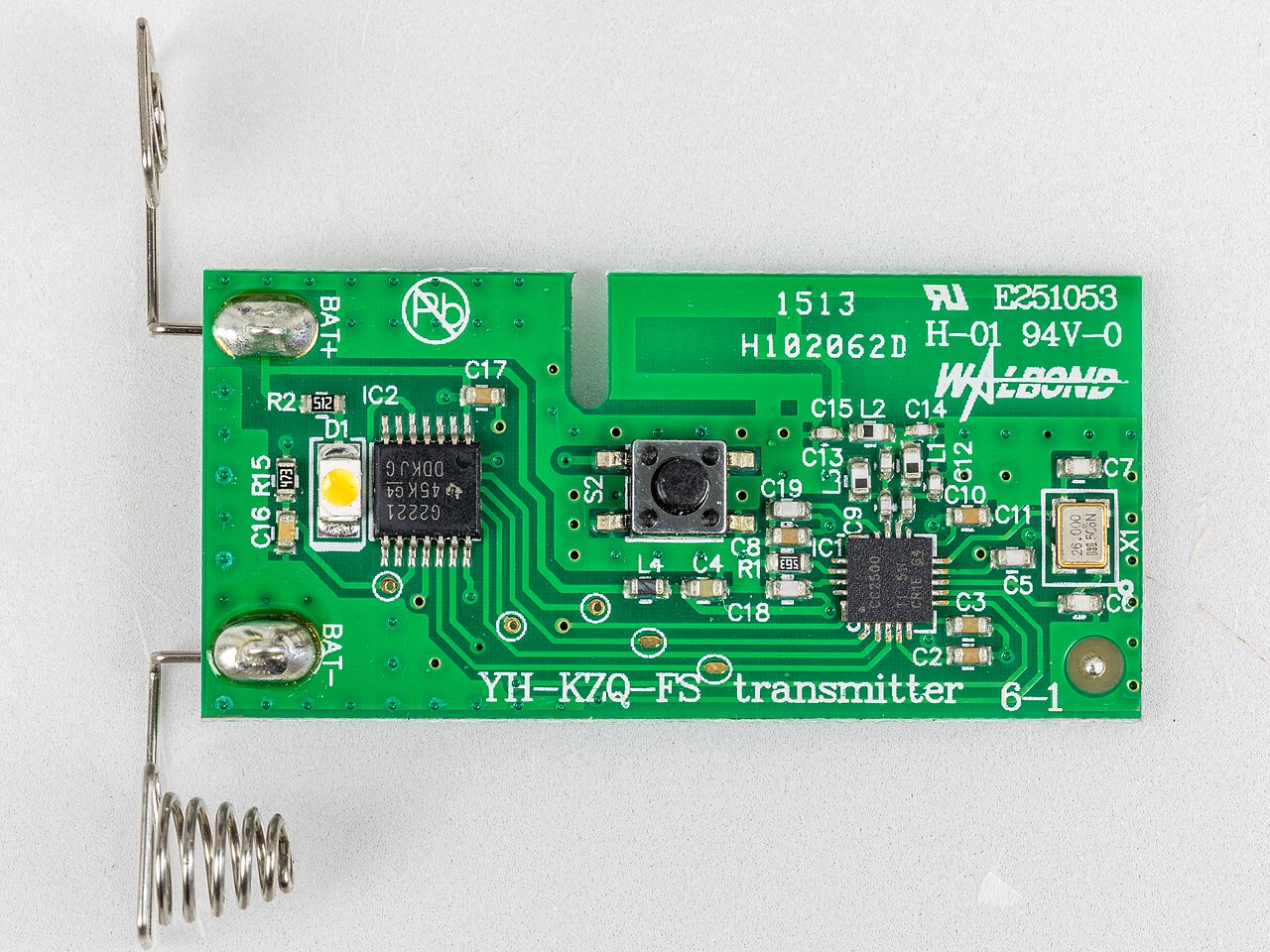
The repository's docs/hardware.md records several board-level findings. A PATABLE setting of 0x60 was enough to reach the lamp from the next room. On the author's VT-CC2500PA-S2 the PA and LNA pins are swapped compared to the module's guide. That is worth checking on any such module before blaming the firmware. The original remote's PCB is marked YM-2.4G-B and carries one unmarked SOP16 chip and a 16 MHz crystal, so the transmitter silicon could not be identified from its markings.
Sniffing it with an nRF24L01+
Without an SDR, the author used a well-known trick: he put an nRF24L01+ into promiscuous mode and narrowed the signal down from there. That showed the sync word B9 A1 99, according to both the repository and Hackaday. Once he set it as the nRF24's receive address, he got clean 17-byte frames instead of noise. The hardware notes add that the nRF24 clone he used needed bit 0 of the RF_SETUP register kept set.
He also tried an AMICCOM A7105 receiver (marked XL7105-SY-B). It picked up the remote's signal in an RSSI scan but never decoded a packet. He suspects the remote's wide deviation is too much for it.
The protocol, as documented in docs/protocol.md:
| Parameter | Value (per docs/protocol.md) |
|---|---|
| Modulation | 2-FSK, wide deviation, around ±250 kHz |
| Data rate | 250 kbps (4 µs/bit) |
| Channels | 2402.00, 2448.00 and 2478.95 MHz |
| Packets per channel | 3 |
| Packet spacing | about 1245 µs |
| Full hop round | about 11.69 ms |
| Sync word | B9 A1 99 |
| Frame length | 17 bytes |
| CRC / whitening | None at the radio level |
| Preamble | AA, required |
The remote sends three packets on each channel and then hops to the next. A tap sends the press frame for about 100 ms, followed by a release frame for about 1.6 s. A hold repeats the press frame for as long as the button is down. The 2478.95 MHz channel corresponds to nRF24 channel 79, and the other two to channels 2 and 48.
The "rolling code" that wasn't
The first replays from the CC2500 worked only some of the time, around 30% of presses. Combined with a field in the frame that changed on every press, that looked like a rolling code. Hackaday reports that fixing an issue in the CC2500 transmission settings improved things, but not by much.
The real cause was the preamble. The original remote sends an AA byte before the sync word. The nRF24 and the CC2500 in packet mode both strip the preamble on receive, so it never appeared in the sniffed data. The clone was therefore sending a malformed lead-in instead of the AA the lamp's receiver expected. The protocol notes say that without it the lamp reacted to about 30% of presses. After the author added the preamble, all 8 buttons worked, both taps and holds, including from the next room.
The changing field was also a dead end. The docs describe it as a counter with only 8 states, and the author found the lamp does not check it at all: sending the same counter value three times toggled the lamp three times. The frame's check bytes are linear over GF(2), meaning they are XOR combinations of other bits rather than a keyed or cryptographic value. Hackaday's summary matches: the author found no intentional cryptographic security. One practical consequence from the docs is that repeating a command "to be safe" is a bad idea, because every repeat is another toggle.
The preamble lesson applies well beyond this lamp. A receiver that hides the preamble cannot show you whether the original transmitter sent one, or how long it was. If a replay only partly works, a missing or short preamble is cheaper to rule out than a rolling-code theory.
What It Means for Makers
The direct audience is narrow: owners of a Lindby Velua who run Home Assistant. Hackaday notes that the author made his work available for anyone with the same light. For them, the bridge replaces the handheld remote, or more accurately runs alongside it, with an ESP32 that Home Assistant can control. ESPHome users get a ready-made option in firmware/esphome. The lamp itself is not opened or modified. The only hardware built is the low-voltage ESP32 and radio module. One limitation from the protocol notes: the lamp never transmits, so Home Assistant cannot know whether it is on or off.
The wider audience is anyone with a proprietary 2.4 GHz remote and no SDR. The project shows that an nRF24L01+ in promiscuous mode and a CC2500 can recover and replay a simple 2-FSK protocol. It also lists, with useful honesty, where things went wrong: a clone nRF24 that needed a register bit set, swapped PA/LNA pins, an A7105 that could see the signal but not decode it, and a preamble the receivers stripped. Treat the specific numbers here as describing this lamp only. The protocol notes say other remotes might use a different ID, and the sync word and frame layout may differ too.
Availability and price: the project is published now as open-source code and documentation on GitHub. It is not a product, so there is nothing to pre-order or buy as a kit. Neither the repository nor Hackaday lists prices for the four parts. The author's tested build uses the VT-CC2500PA-S2 with the CC2591 amplifier, and the README states that a bare CC2500 module has not been tested, so anyone substituting cheaper modules is going beyond the documented build.
