
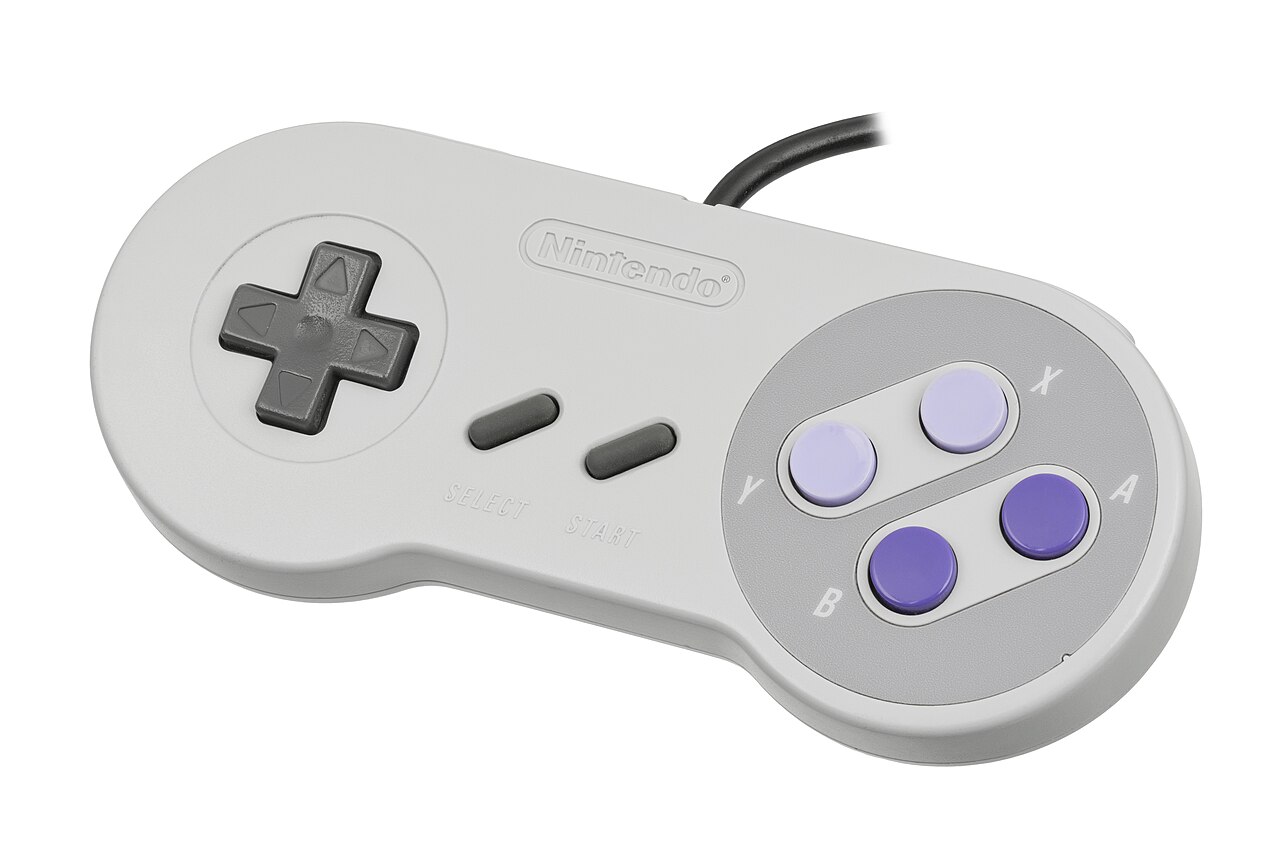
The Super Nintendo never had a network port. Danny Boland's Super Network Adapter, or SNET, connects the console to Wi-Fi anyway, through the one external interface every SNES has: the controller port. In a build write-up published in November 2026, Boland describes a board that plugs into controller port 2. It pairs a Raspberry Pi RP2350A, which handles the console's 5V lines and the serial link, with an Espressif ESP32-C3 that acts as the Wi-Fi coprocessor. The firmware, the 65816 code and the tooling are in a public GitHub repository. Hackaday covered the project on 23 November 2026.
The headline feature is save synchronisation. SNET copies a cartridge's battery-backed SRAM to and from a WebDAV server, using the same layout RetroArch uses. A game saved on real hardware and the same game saved in an emulator can then stay in step. Boland also built a less practical demo in which a large language model writes NPC dialogue for The Legend of Zelda: A Link to the Past.
A network link made from a joypad protocol
The SNES controller port is a small synchronous serial bus with a clock line, a latch line and a data line. SNET reuses those lines. According to Boland's write-up, the link is bit-banged from the console side: the SNES writes to Latch and reads D0 from the adapter, one bit at a time. He puts the maximum throughput at about 30 KB/s after some optimisation. That is plenty for save files and short strings of text. It is nowhere near enough to stream anything substantial.
On the adapter side, the RP2350's PIO block watches the console's signals. The write-up says a PIO state machine watches clock and latch and filters out glitches shorter than 100 ns. That matters on a cable driven by a console from 1990. The repository README splits the work across the RP2350's two cores. Core 1 runs the controller link with PIO. Core 0 handles save sync, Wi-Fi setup and communication with the coprocessor.
From Pico 2 W to custom PCB
The first prototype was a Raspberry Pi Pico 2 W with two 4k7 pull-up resistors, wired to a cut controller extension cable. Boland says the RP2350A can handle the console's 5V logic on its pins directly. The repository's breadboard notes give the pin assignments: Clock on GP9, Latch on GP10, D0 on GP11 and a status LED on GP12. The README also carries two warnings. Do not connect SNES pin 1 (the console's 5V) to the Pico's VBUS or VSYS. Do not put series resistors on the signal lines.
The custom PCB replaces the Pico's onboard wireless with a separate coprocessor and splits the work between two chips:
- RP2350A: runs at 150 MHz according to Boland's diagram. It handles the 5V controller-port lines and the serial link to the console.
- ESP32-C3: runs at 160 MHz per the write-up. It is the Wi-Fi coprocessor and talks to the RP2350A over UART. The repository's
src/coprocdirectory holds its firmware for the "rev A" board. - Power: an LM66200 dual ideal diode lets the board take 5V from either the console or USB-C. A 3.3V LDO supplies the logic.
Boland also describes a problem on the Pico 2 W prototype: series resistors on the link lines caused issues. He says this may be related to erratum RP2350-E9 in the A2 stepping of the RP2350A on his Pico 2 W. For the assembled PCB order he used 0 Ω links in those positions, and the boards turned out to carry the fixed A4 stepping, so real resistors can go in next time.
The enclosure was generated in code with build123d, using the PCB's STEP files from KiCad. Boland describes the render as about the size of a Zippo lighter.
How save sync works
The game has to take part in the sync, so SNET patches the game. A tool in the repository, tools/savehook.py, patches a ROM by injecting code at the reset vector, and Boland says the sync runs at power-on and whenever the console is reset. Hackaday notes that the patched ROMs have to be loaded from a flash cartridge. Boland says he already owned a programmable flash cart.
The patched game syncs its SRAM through the adapter to a WebDAV server at saves/<core>/<name>.srm. That path follows RetroArch's convention, so an emulator instance pointed at the same share sees the same save files. RetroArch keeps a manifest with a hash of every save, and the adapter updates it, comparing hashes to decide whether the cartridge or the server has the newest save. To save time on the slow link, each save is split into chunks with their own checksums, so only changed chunks are sent. Boland says the 1–2 second load screen happens only when the SNES pulls an existing save for the first time. If both sides have changed, nothing is overwritten and the cartridge's save goes to a conflicts folder.
The adapter gets onto Wi-Fi in one of two ways. A setup ROM lets you pick a network and type its password with the D-pad, or the adapter creates a temporary network and shows a QR code on the TV, leading to a captive portal for entering the network and WebDAV details from a phone. The repository lists Rust 1.78 or later as an optional build dependency, used only for the setup ROM's music.
The LLM dialogue demo
The stunt demo hooks the game's dialogue text renderer in A Link to the Past so that NPC dialogue comes from a large language model instead of the cartridge's fixed text. The game is patched to push context, such as which character you are talking to and recent events, out over the controller port to the adapter and on to the model through a proxy on a local machine that holds the API key. A model's response time matters even more than usual over a 30 KB/s pipe. Boland reports a time to first token of about 0.8 s with Haiku and an average of 2.2 s with Opus. His answer is speculative generation: the dialogue is produced when Link approaches an NPC and cached, then invalidated as the context changes. He calls it "a great way to burn tokens", and Hackaday likewise notes you will burn through tokens. That is a fair warning for anyone who expects to run it for free.
What is in the repository
At the time of fetching, the dannyboland/snet repository had a single commit and a GPL-3.0 licence. It contains:
src/pico: RP2350 firmware, covering the PIO controller link, save sync, Wi-Fi setup and the coprocessor interfacesrc/coproc: ESP32-C3 firmware for the rev A boardsrc/snes: 65816 code that runs on the consoletools/savehook.py: the ROM patcher for save sync
The build needs a wide toolchain: cc65 for the 65816 side, Python 3, Lua, a C compiler, CMake, Ninja, arm-none-eabi-gcc and, optionally, Rust 1.78 or later.
Timeline
Boland's build log gives these dates. The breadboard link to port 2 was working on 2 November 2026. The PCB was designed and ordered from JLCPCB on 13 November. The boards arrived on 19 November, and he says they "work perfectly". He ordered 3D-printed enclosures on 21 November and was awaiting delivery.
What It Means for Makers
SNET is an open-source hobby project, not a product. Boland lists no price, no pre-order and no crowdfunding campaign in his write-up or the repository. What exists now is a working rev A PCB, a breadboard version anyone can build from a Pico 2 W, and the firmware to run both.
It will interest retro-hardware tinkerers who play on both original hardware and RetroArch and want one set of saves. It will also interest anyone curious about pushing data through a 1990 joypad protocol. The breadboard route needs only a Pico 2 W, two 4k7 resistors and a cut controller extension cable, according to the repository. Builders should follow the README's warnings about the 5V pin and series resistors. Save sync also requires patched ROMs loaded from a flash cartridge, which limits it to people who already have one.
The design itself is worth studying. It uses PIO to watch and filter a legacy 5V bus, offloads Wi-Fi to a separate ESP32-C3 over UART, takes power from either of two sources through a dual ideal diode, and patches a ROM at its reset vector. Each of these techniques could carry over to other retro consoles and to embedded projects outside gaming. The roughly 30 KB/s ceiling is the main limit: this is a link for saves, messages and text, not for media.
