
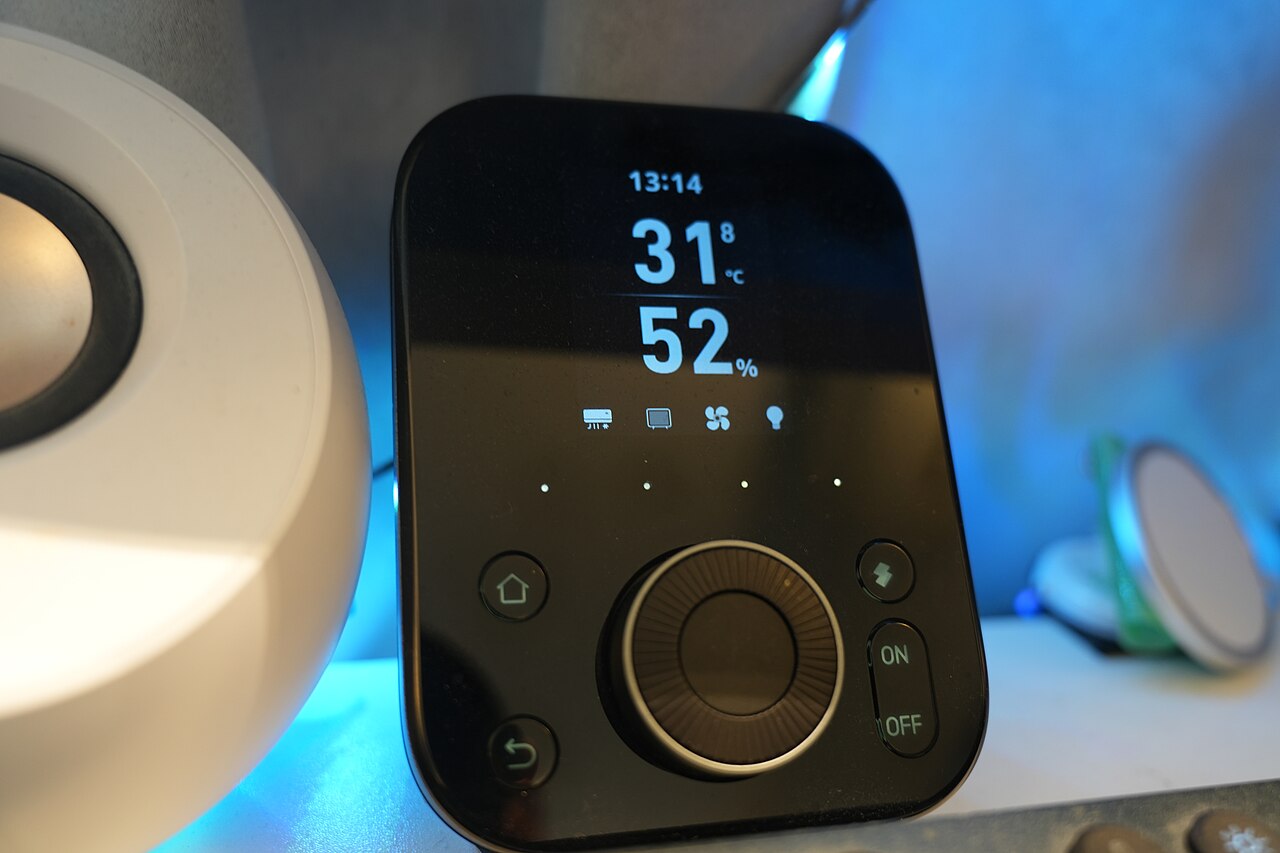
SwitchBot has opened pre-orders for the Hub 4, a desk- or wall-mounted controller that combines the company's Bluetooth bridge, an infrared blaster and a Matter bridge with something the earlier hubs lacked: a 2.8-inch screen, four hardware shortcut buttons, a rotary dial and an on-device wake word. CNX Software covered the device on 19 November 2026 and published the fullest spec list so far. SwitchBot's own US product page confirms the headline features, the price and the shipping window.
PinoutFeed treats this as a hardware note, not a maker board. The Hub 4 is a closed consumer appliance configured through a phone app. Its radio and bridge limits still matter to anyone building a mixed Matter, Bluetooth and IR setup, and so does a gap in third-party platform support.
The hardware, line by line
SwitchBot's US page does not include a spec table we could extract, so the figures below come from CNX Software's listing. CNX gives the model number as W108021000.
- Processor: not specified. CNX suggests it could be an ESP32-S3. That is CNX's guess, and SwitchBot has not named the chip. PinoutFeed treats the SoC as unknown.
- Display: 2.8-inch IPS, 240 x 320.
- Controls: physical buttons and a rotary knob. SwitchBot's page describes four customizable shortcuts and a dial that adjusts temperature, brightness or volume.
- Audio: 2 W speaker and two omnidirectional microphones. The wake word is "Hello Kata", with a quoted range of 3 m.
- Wi-Fi: 2.4 GHz only. CNX lists 120 m range in open space.
- Bluetooth: 4.2 or later, up to 120 BLE sub-devices, about 200 m range in open space.
- Matter: Matter Bridge 1.3 with 30 Matter sub-devices. The hub's own built-in sensors take three sub-devices by default.
- Infrared: four IR emitters and one IR receiver. The database covers more than 101,000 IR appliances, and the hub can learn codes that are missing.
- Enclosure: PC, metal and ABS. 126 x 94 x 38 mm.
- Power: 5 V / 2 A over USB-C. A 5 V / 2 A adapter is in the box.
- Environment: operating range -20 to 65 °C, 0 to 90% RH.
- Certifications: TELEC, FCC, CE, RoHS.
- In the box: the power adapter and a temperature/humidity cable.
The Matter figures need a closer look. According to CNX, the three default sub-devices are the hub's own motion, temperature and humidity sensors. Read that way, the 30-device Matter allowance is shared with the hub's own sensors. The BLE limit is four times larger at 120 sub-devices. In practice, a large SwitchBot Bluetooth installation can sit behind the hub in SwitchBot's app, but only a smaller subset can be exposed to a Matter controller such as Apple Home, Google Home or Home Assistant's Matter integration. SwitchBot's published material does not say how it chooses which devices get those slots.
The temperature/humidity cable explains how the hub senses climate. The probe sits on a lead away from the enclosure, which presumably keeps the readings clear of heat from the display and the power circuitry. That is our inference, not a SwitchBot claim.
Why the missing SoC matters
On a consumer hub, an unnamed processor would normally be a footnote. For this audience it decides whether the device is worth opening up. If the hub did use an ESP32-S3, people would naturally ask about UART headers, flash dumps and alternative firmware. Nothing in the sources supports any of that. SwitchBot has not named the chip, nobody has published a teardown, and the device has not been sold yet. Until a unit ships and someone takes it apart, any claim about reflashing it is speculation. CNX framed its own ESP32-S3 remark as a guess, and we do the same.
Home Assistant: two paths, and a gap
CNX notes that Home Assistant has both a SwitchBot Bluetooth integration and a SwitchBot Cloud integration. When we read the Home Assistant SwitchBot integration documentation, its Hubs section listed the Hub 2 (WoHub2), the Hub Mini Matter Enabled and the Hub 3 (WoHub3). The Hub 4 was not on that list. The documentation also says some hubs can act as a bridge while sensor data is read over Bluetooth, and it points readers to SwitchBot's list of Matter-certified devices.
There are three possible routes into Home Assistant:
- Matter bridge: the hub reports Matter Bridge 1.3 support, so a Matter controller should be able to pair with it, subject to the 30-sub-device limit. We have not confirmed whether the Hub 4 is already on SwitchBot's Matter-certified list.
- Bluetooth integration: the Hub 4 is not listed yet, so treat native local support for its sensors and display as unconfirmed.
- Cloud integration: this depends on SwitchBot's cloud API and gives up the local control that many Home Assistant users want.
As of 19 November 2026, the Hub 4 is not on Home Assistant's documented hub list, and we cannot say when or whether that will change.
The app dependency
According to CNX, setup requires the SwitchBot app for Android or iOS, and CNX says the app has mixed reviews. Voice control is also limited by SwitchBot's own description: "Hello Kata" controls supported SwitchBot devices and compatible IR appliances, and CNX adds alarm creation and calendar queries. The product page also says IR control requires 2.4 GHz Wi-Fi and that compatibility and available controls vary by appliance model.
What It Means for Makers
Who it is for: people who already own SwitchBot Bluetooth devices, such as Bots, curtain motors and sensors, and want a single always-on controller with a screen and physical controls. It also suits households that still have IR-only air conditioners, TVs, projectors and fans that they want visible to a Matter controller.
What it replaces: for an existing SwitchBot setup, it combines the jobs of a separate IR blaster, a Matter bridge and a room thermometer in one unit, and adds local buttons and a dial so you don't need a phone for everyday control. For someone building their own setup, it does what a DIY IR transceiver and a bridge running ESPHome or something similar would do. The difference is that the Hub 4 uses a closed firmware stack and a vendor app.
What it does not enable: based on public information, it offers no documented hardware hacking. The SoC is not specified, firmware access has not been described, and nobody has published a teardown. If you need local control under your own firmware, a board you build yourself is still the more predictable choice.
Price and availability: on 19 November 2026, SwitchBot's US store listed the Hub 4 at US$119.98 at launch as a single variant with no compare-at price. (CNX reports Amazon pricing of $119.99 US.) The device is in pre-order. SwitchBot's page says "Preorders are expected to ship in early December." It has not shipped yet, so none of the figures above have been independently tested.
What to wait for: a teardown that confirms or rules out the ESP32-S3 guess, Hub 4 support in Home Assistant's SwitchBot integration, and confirmation of the Hub 4's place on SwitchBot's Matter-certified list.
