
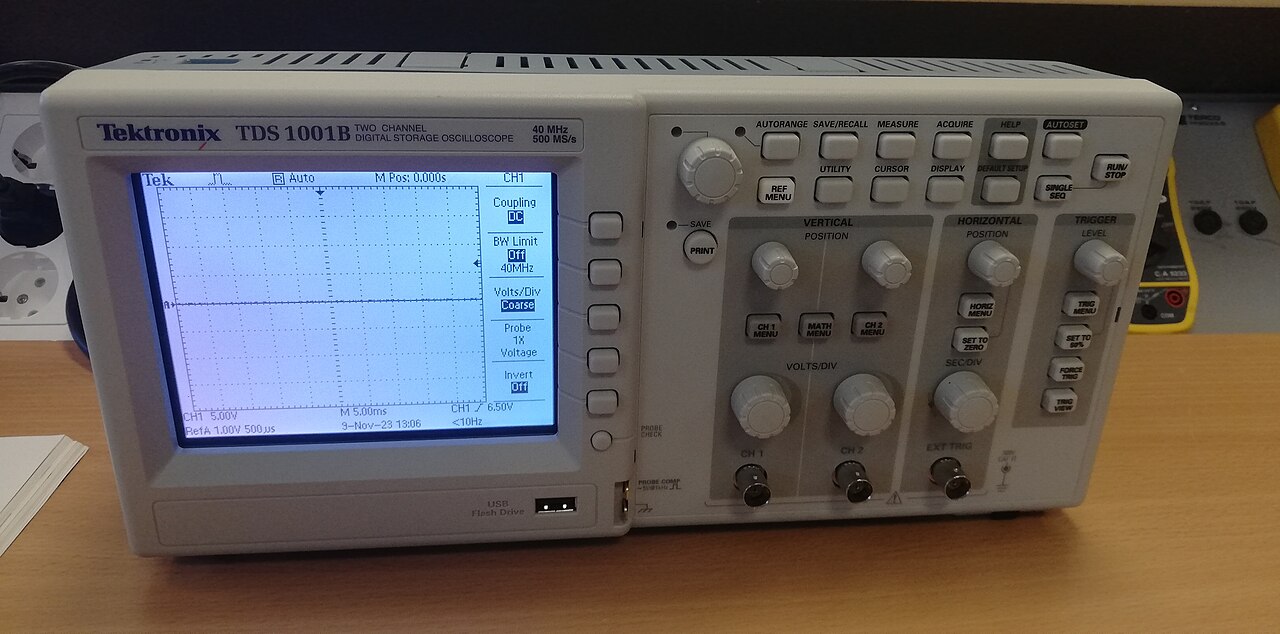
Tektronix has announced the 1 Series DPO, a range of compact oscilloscopes. The range is aimed at hobbyists, students and educators, and Electronic Design says Tektronix is showing it at electronica 2026 in Munich (10 to 13 November). It covers two- and four-channel models from 50 to 200 MHz, all with 12-bit vertical resolution. Launch pricing starts at $450 for the base DPO1052 and goes up to $1,650 for the four-channel, 200 MHz DPO1204S, according to Hackster.io.
A note on sourcing. We could not reach Tektronix's own product pages for this story. Every spec below comes from two independent trade outlets, Hackster.io and Electronic Design, plus a distributor listing. Until a datasheet is available to check against, treat any figure that only Tektronix could confirm as provisional.
The line-up
Hackster.io describes the 1 Series as two- to four-channel instruments in bandwidths from 50 to 200 MHz. The DPO1052 is at the bottom and the DPO1204 at the top, with 70 and 100 MHz models in between. Neither outlet lists the part number of every intermediate model, so we won't guess them. Models with an "S" suffix add a built-in arbitrary function generator (AFG).
The most detailed figures cover the entry model. Hackster.io lists the DPO1052 as:
- 2 analog channels, 50 MHz bandwidth
- 1.25 GS/s sample rate on one channel, or 625 MS/s with both channels in use
- 10 million point record length
- 12-bit vertical resolution
- Price at launch: $450 (no AFG)
The top model, the DPO1204, is listed with 4 channels and 200 MHz bandwidth. The DPO1204S, with the AFG, is the $1,650 ceiling of the range. Neither source gives sample rate or record length for the four-channel models. Don't assume the DPO1052's figures carry over to them.
Electronic Design confirms the outline: an entry-level, compact, portable family with 2 or 4 channels, 50 to 200 MHz bandwidth, 12-bit resolution, a 7-inch multi-touch display and a $450 base price.
Reading the entry-model numbers
A few points are worth spelling out for anyone comparing spec sheets.
Sample rate versus bandwidth. On the DPO1052, 1.25 GS/s on a single channel is 25 samples per period at the 50 MHz bandwidth limit. Using both channels halves that to 625 MS/s, which is still 12.5 samples per period at 50 MHz. The single-channel number is the headline, but it isn't the one you get when probing a clock and a data line together. The two-channel 625 MS/s figure is the realistic one for most serial-bus debugging.
12 bits. A 12-bit ADC divides the vertical range into 4,096 levels. An 8-bit converter gives 256. That's 16 times finer quantisation in principle. In practice it shows up as more usable detail when you zoom in on small signals riding on a larger one, such as ripple on a supply rail. Actual effective resolution depends on noise, front-end design and bandwidth limiting. Neither source gives ENOB or noise figures, so we can't say how close the 1 Series gets to its nominal 12 bits.
Record length. At 625 MS/s, a 10 million point record holds about 16 ms of capture per channel at full sample rate. That's simple arithmetic on the quoted figures, assuming the full record is available to each channel in two-channel mode. The sources don't say whether it is. Either way, the depth is enough to grab a few UART frames or an I2C transaction and then zoom in.
Software and analysis
The more strategic part of the announcement is the interface. Electronic Design reports that the 1 Series uses the TekScope UI carried over from Tektronix's 7 Series. With the 1 Series added, the company's line-up spans 50 MHz to 25 GHz and 2 to 8 channels, according to the same report. A student who learns the interface on a $450 bench scope will find much the same environment on far more expensive instruments later.
For analysis, the outlets list:
- SPI, I2C and UART decoding (Hackster.io). Electronic Design describes this as serial protocol decode and triggering.
- FFT and real-time waveform math (Electronic Design)
- Limit testing (Hackster.io)
- Bode plots on the S variants, which use the built-in AFG as the stimulus source (Hackster.io)
Neither outlet says whether protocol decoding is standard on every model or a paid licence. That matters a lot at this price point, so check it with a distributor before buying.
Built for the classroom
Hackster.io reports that every model can have its automatic modes switched off for classroom use. In effect, Autoset can be disabled. That sounds minor, but with one-button Autoset students can skip learning timebase, vertical scale and trigger level. With it disabled, an instructor can make a lab group set up a capture by hand, which is the skill the lab exists to teach.
The 7-inch touchscreen, which all models have according to both outlets, fits the portable, bench-sharing setup typical of teaching labs.
The AI Connector
Electronic Design notes that the 1 Series supports the Tek AI Connector for AI-assisted instrument control. Neither source explains how it works: what protocol it uses, what software runs on the host, or which assistants or tools it connects to. Without vendor documentation we can't assess it. In principle, a scope that can be scripted or queried from a host-side tool helps automated test benches and lab exercises. Whether this connector goes beyond conventional remote control is something to check once Tektronix publishes details.
What It Means for Makers
Who it's for. Tektronix aims the 1 Series at hobbyists, students and educators. The spec mix fits that audience: 12-bit resolution, a large touchscreen, SPI/I2C/UART decode and an option to disable automatic setup.
What you get under $500. The $450 DPO1052 is a two-channel, 50 MHz, 12-bit scope with 1.25 GS/s (625 MS/s across two channels) and a 10 million point record, per Hackster.io. That covers most microcontroller work: PWM, UART, I2C, SPI at modest clock rates, power-rail ripple and sensor signals. Fast SPI, or anything where edge shape matters at tens of MHz, needs the 100 or 200 MHz models, where prices climb toward the $1,650 DPO1204S.
Against budget scopes. The low-cost bench-scope market is crowded, and this article doesn't compare specific rival models, since neither source does. In general, a buyer at $450 is paying for the Tektronix name, the TekScope interface shared with far costlier instruments, and 12-bit resolution in the base model. Before choosing, compare sample rate with all channels in use, record length per channel, and whether protocol decode costs extra.
The AFG question. If you'd otherwise buy a separate function generator, or want frequency-response measurements of filters and amplifiers, the S models' built-in AFG and Bode plotting are the main reason to pay more. Neither source gives the price of each intermediate S model, only the two ends of the range.
Price and availability. At launch, prices run from $450 (DPO1052, no AFG) to $1,650 (DPO1204S), as reported by Hackster.io. Electronic Design also gives $450 as the base price. The family was announced ahead of electronica 2026. US distributor Transcat already lists the DPO1052 (12-bit, 50 MHz, 2 analog channels) as a catalogue item. Our sources don't give a ship date or stock status for the other models, so for now the 1 Series counts as announced, with at least the entry model listed for sale through distribution.
Sources
- Tektronix Targets Hobbyists, Students, and Educators with Its 1 Series DPOs (Hackster.io, 10 November 2026)
- Tektronix Unifies User Interface with New 1 Series Compact DPO Offering (Electronic Design, 9 November 2026)
- Tektronix DPO1052 Digital Oscilloscope 12-bit 50 MHz, 2 Analog Channel (Transcat distributor listing)
