
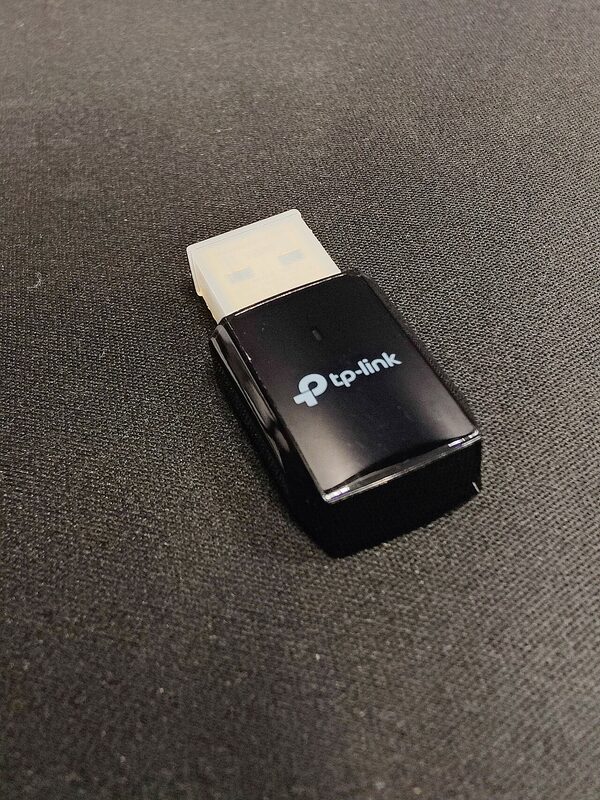
Sooner or later every embedded developer has a laptop with no working network. Sometimes the Wi-Fi driver is missing after a fresh Linux install. Sometimes a USB dongle has gone missing from the drawer. TinyWifiDongle, a new Arduino library from Phil Schatzmann, uses a microcontroller you probably already own for this. The board joins a Wi-Fi network and shows up on the host PC over USB as a standard network adapter. Hackaday covered the project on 22 November 2026 under the headline "Quick WIFI Adapter Through USB."
The project is open source and free, not a hardware product. The GitHub repository (pschatzmann/TinyWifiDongle) has a tagged v0.1.0 release. Its last push was on 30 October 2026, and it had 35 stars when we checked. The library is header-only C++ under the MIT license.
How it works
The README says the microcontroller presents itself to the host as a USB CDC-NCM device. CDC-NCM is the USB class for Ethernet-style network adapters, and operating systems ship a driver for it. The project says no driver install is needed on Linux, macOS or Windows 11. Windows 10 needs one.
The design choice that matters is bridging rather than routing. Ethernet frames pass through the MCU unchanged. The PC gets its IP address straight from the Wi-Fi router's DHCP server, and the microcontroller has no IP address of its own. To the rest of the LAN, the laptop looks like any other client on the network. There is no NAT layer in the middle.
The minimal sketch in the README is short:
TinyWifiDongle dongle;
dongle.begin("ssid","password");
Wi-Fi credentials can be hard-coded like this or entered in a browser on a setup page the board opens itself. Logging goes through a TWD_LOGGER hook that writes to any Arduino Print target. Hackaday says these logging and transparency features suit light IoT monitoring. Some Hackaday commenters dispute the "4 lines of C++" framing. They also point out that one of the photos in the coverage is not an ESP32-S3.
Supported boards and cores
The README and the project's Status wiki page list support as follows:
- ESP32-S3 and ESP32-S2: arduino-esp32 3.x, tested on 3.3.12 (the author tested on an ESP32-S3). The board option USB Mode: USB-OTG (TinyUSB) must be selected.
- Raspberry Pi Pico 2 W: arduino-pico core, tested on 6.3.1. The original Pico W is listed as untested.
- ESP32-P4: compiles. The Wi-Fi side was tested on a Waveshare ESP32-P4-WIFI6, but the USB side is untested because that board has no USB-OTG connector.
Not supported, per the README: the original ESP32, the ESP32-C3 and ESP32-C6 and other chips without a USB device controller that can carry a network class, the Pico without Wi-Fi, and the Arduino mbed cores.
The numbers, and why they are what they are
The author measured throughput with 3 MB downloads from Cloudflare:
| Path | Measured throughput (author's test) |
|---|---|
| ESP32-S3 via TinyWifiDongle | 530–615 KB/s |
| Pico 2 W via TinyWifiDongle | roughly 110–325 KB/s, average about 250 KB/s |
| PC's own Wi-Fi, single stream | 1.5–3.8 MB/s |
| PC's own Wi-Fi, four streams | about 6.8 MB/s |
Hackaday rounds these to 600 KB/s and 250 KB/s. The README attributes the limit to the USB link: both chips have only a full-speed USB controller, which is 12 Mbit/s. The Status page puts the best-case bulk-transfer rate at about 1.1 MB/s. The measured ESP32-S3 rate is about half of that, and the Pico 2 W is lower and varies more from run to run. The author says the dongle is several times slower than the PC's own Wi-Fi in the same test, and that other limits, such as the Wi-Fi throughput of the chip, were not measured. Hackaday sums it up as "not blazing" but enough to update a laptop's own network drivers, which is the job most people would use it for.
Known issues
The Status and Known Issues pages are candid for a v0.1.0 release:
- On the ESP32-S3, a rare USB stall occurs about once every 100–200 MB transferred. A watchdog recovers it within a second or two, at the cost of a USB reconnect that breaks open connections.
- The Pico 2 W rebooted once in a long test, about 10 minutes and 147 MB into continuous downloads, for no known reason. It did not recur in two later tests.
- Testing so far has been on Linux with NetworkManager only. The driverless macOS and Windows 11 support rests on those systems' built-in CDC-NCM drivers, per the README, and has not been tested by the author.
Prior art: pico-usb-wifi
This is not the first attempt at the idea. In July 2026, CNX Software covered pico-usb-wifi, a separate project whose source is on GitLab and which is unrelated to TinyWifiDongle. At v1.1.0 it turns the original Pico W into a CDC-NCM device that bridges at layer 2. It supports IPv4 and IPv6, uses no NAT, and handles WPA2-PSK and WPA3-SAE. It adds a CDC-ACM management console. CNX reported an average of 4.75 Mbit/s, limited mostly by the 12 Mbps USB 1.1 interface. That is in the same range as the roughly 5 Mbit/s the TinyWifiDongle Status page gives for the ESP32-S3.
The two projects share an architecture and a bottleneck. TinyWifiDongle differs in being an Arduino library rather than standalone firmware, and in running across both the Espressif and Raspberry Pi Arduino cores. The Pico W is the board pico-usb-wifi targets, and it is listed as untested in TinyWifiDongle.
What It Means for Makers
This is a recovery tool and a learning project, not a replacement for a real Wi-Fi adapter. CNX Software pointed out in its pico-usb-wifi coverage that a low-end USB Wi-Fi dongle costs $2–$3 and up, so these MCU bridges are mainly useful in an emergency. That holds here too. If you have an ESP32-S3 dev board but no spare dongle, TinyWifiDongle can get a machine online long enough to fetch a driver or a firmware image.
Embedded developers get a readable reference implementation of a CDC-NCM bridge in a header-only Arduino library. Because the MCU is transparent at layer 2 and logs to any Print target, it can also watch traffic for small IoT setups, as Hackaday suggests. Educators get a concrete demo of USB device classes, bridging and DHCP.
Price and availability: the library is free under the MIT license, and v0.1.0 is on GitHub now. None of the sources give prices for the boards. Expect full-speed USB throughput, at most about 600 KB/s on the ESP32-S3 in the author's test. Before you rely on it, note that the ESP32-S3 still has an occasional USB stall that recovers by itself, and the project has been tested on Linux with NetworkManager only.
